%22%3E%3C/path%3E%3Cpath d=%22M 63.072 7.554 C 62.258 8.022 61.577 8.689 61.092 9.493 L 61.092 7.076 L 57.158 7.076 L 57.158 22.64 L 61.089 22.64 L 61.089 14.888 C 61.089 13.446 61.403 12.434 62.03 11.853 C 62.818 11.218 63.818 10.907 64.826 10.982 L 65.868 10.982 L 65.868 6.851 C 64.891 6.834 63.926 7.076 63.073 7.554 Z%22 fill=%22rgb(17,17,17)%22%3E%3C/path%3E%3Cpath d=%22M 78.916 7.82 C 76.363 6.49 73.321 6.49 70.768 7.82 C 69.562 8.473 68.564 9.451 67.888 10.644 C 67.167 11.931 66.803 13.387 66.834 14.862 C 66.804 16.332 67.157 17.785 67.86 19.077 C 68.515 20.267 69.494 21.246 70.684 21.901 C 71.924 22.576 73.318 22.92 74.73 22.898 C 76.164 22.918 77.58 22.575 78.846 21.901 C 80.062 21.247 81.073 20.27 81.768 19.077 C 82.506 17.797 82.88 16.339 82.85 14.862 C 82.88 13.389 82.517 11.934 81.797 10.647 C 81.12 9.455 80.122 8.477 78.917 7.824 M 78.803 14.862 C 78.829 15.739 78.636 16.608 78.241 17.391 C 77.903 18.046 77.38 18.588 76.738 18.95 C 76.124 19.293 75.432 19.472 74.729 19.47 C 73.668 19.497 72.648 19.061 71.934 18.276 C 71.139 17.323 70.741 16.1 70.823 14.862 C 70.741 13.62 71.149 12.395 71.959 11.45 C 72.687 10.667 73.715 10.233 74.783 10.256 C 75.859 10.236 76.894 10.67 77.635 11.45 C 78.464 12.387 78.884 13.616 78.801 14.864%22 fill=%22rgb(17,17,17)%22%3E%3C/path%3E%3Cpath d=%22M 95.906 7.076 L 95.906 15.646 C 95.975 16.68 95.643 17.701 94.979 18.498 C 94.311 19.184 93.379 19.547 92.422 19.495 C 91.475 19.544 90.553 19.18 89.894 18.498 C 89.23 17.701 88.898 16.68 88.967 15.646 L 88.967 7.076 L 85.033 7.076 L 85.033 16.207 C 85 17.449 85.275 18.68 85.834 19.79 C 86.327 20.75 87.095 21.542 88.039 22.065 C 89.033 22.594 90.145 22.861 91.271 22.838 C 92.188 22.847 93.095 22.65 93.926 22.263 C 94.708 21.905 95.388 21.36 95.906 20.675 L 95.906 22.645 L 99.865 22.645 L 99.865 7.076 Z%22 fill=%22rgb(17,17,17)%22%3E%3C/path%3E%3Cpath d=%22M 4.513 15.626 C 4.511 10.815 7.606 6.549 12.181 5.059 C 16.756 3.57 21.77 5.195 24.601 9.086 L 27.816 5.87 C 24.074 1.186 17.981 -0.943 12.137 0.393 C 6.292 1.728 1.728 6.292 0.393 12.137 C -0.943 17.981 1.186 24.074 5.87 27.816 L 9.085 24.601 C 6.214 22.512 4.515 19.177 4.513 15.626%22 fill=%22rgb(32,62,235)%22%3E%3C/path%3E%3Cpath d=%22M 17.114 14.343 L 13.354 18.01 L 13.354 18.026 L 21.071 18.026 L 11.412 27.609 L 17.389 27.609 L 23.999 21.081 L 23.999 28.316 L 24.005 28.316 L 27.967 24.393 L 27.967 14.343 Z%22 fill=%22rgb(32,62,235)%22%3E%3C/path%3E%3C/g%3E%3C/svg%3E) ×
× ××
××›
›
›
›
Master B2B Lead Generation on LinkedIn: Your 2026 Playbook
Master B2B Lead Generation on LinkedIn: Your 2026 Playbook
Master B2B Lead Generation on LinkedIn: Your 2026 Playbook
Master B2B Lead Generation on LinkedIn: Your 2026 Playbook
Master B2B Lead Generation on LinkedIn: Your 2026 Playbook
Master B2B Lead Generation on LinkedIn: Your 2026 Playbook

Author
Aljaz Peklaj

You're probably already doing the obvious LinkedIn work. Posts are going out. Sales Navigator searches are saved. Connection requests are moving. Maybe there's even a light outbound sequence running through HeyReach, Lemlist, or Instantly.
But the calendar still looks thin.
That usually isn't a LinkedIn problem. It's a systems problem. Teams commonly run B2B lead generation on LinkedIn as separate activities, content over here, outreach over there, profile somewhere in the middle, with no shared message, no routing logic, and no reporting line tied to pipeline.
The platform is too important to run that way. LinkedIn remains the core B2B social channel, with 89% of B2B marketers using it for lead generation, 80% of B2B social leads coming from LinkedIn, and a 2.74% visitor-to-lead conversion rate in one comparison set, ahead of Facebook and X, according to Brenton Way's LinkedIn marketing stats roundup.
Table of Contents
Build the foundation with lists and a conversion-focused profile
Create a clear operational path for routing and qualifying leads
Your LinkedIn activity is high but your pipeline is empty
Busy isn't the same as effective. A team can post consistently, scrape lists, send invites, and still produce almost no qualified conversations if those actions don't connect.
That's the pattern behind most underperforming LinkedIn programs. Content is written for reach. Outbound is written for response. The profile is written like a résumé. Sales measures meetings. Marketing measures impressions. Nobody owns the full path from attention to revenue.
Key takeaways
Profile optimization is conversion work, not a branding exercise. The Featured section holds greater significance than commonly perceived.
The content pillar that drives qualified DMs is decisions and trade-offs, not generic how-to posting.
Outbound improves when segmentation shapes the whole sequence, not just the first line.
Success should be judged on qualified conversations, meetings, opportunity creation, and pipeline influence, not likes or connection volume.
Practical rule: If your content, profile, and outbound can't be described in one sentence to the same ICP, you don't have a LinkedIn system. You have channel noise.
The fix is operational. One target list. One message spine. One conversion path. One dashboard. That's how LinkedIn starts acting like a pipeline engine instead of a set of disconnected motions.
Build the foundation with lists and a conversion-focused profile
Most LinkedIn programs fail before the first message goes out. The list is too broad, the profile is too vague, and the buyer who does click through has no clear next step.
Start with a live list, not a spreadsheet
Use Sales Navigator as the source of truth. Build around firmographic basics first, then tighten the list with triggers and buying context. Apollo and Clay can help enrich data later, but the shape of the audience should come from LinkedIn-native filtering first.
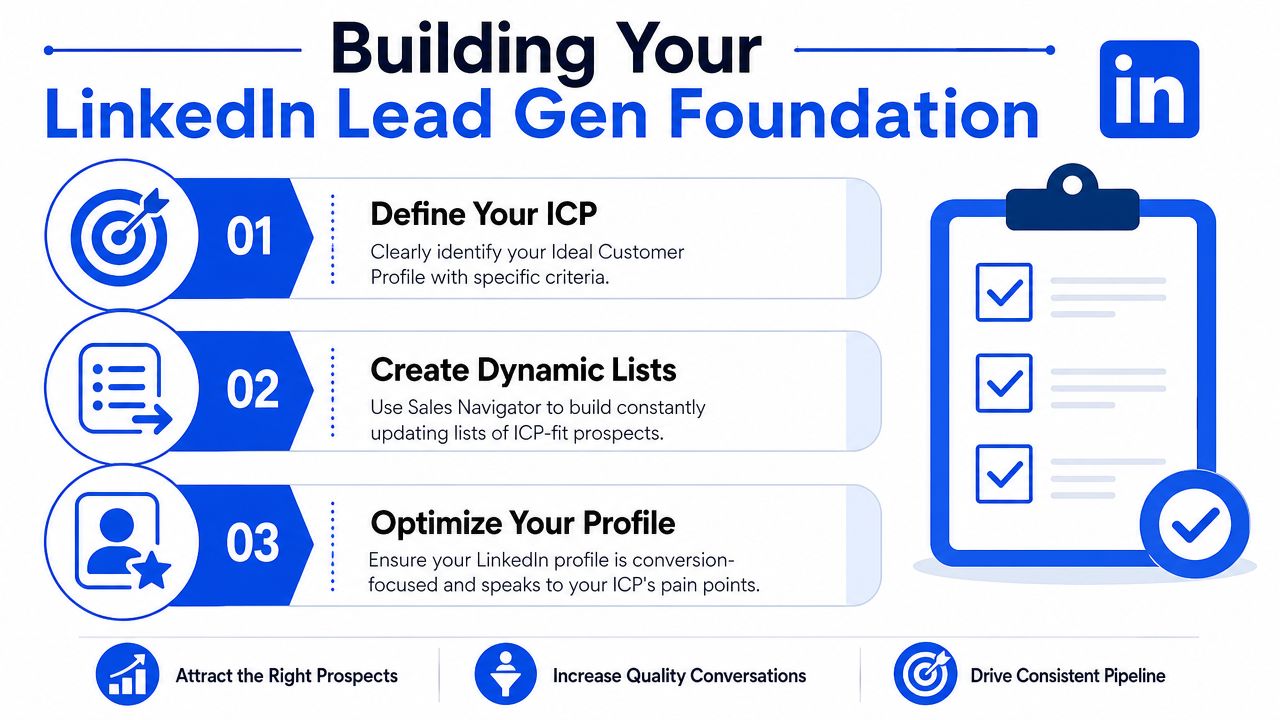
A workable list usually includes filters like this:
Industry and company type
Narrow hard. If you sell into SaaS, manufacturing, legal tech, pharma, or iGaming, don't mix them into one list and hope the messaging still fits.Role and authority level
Separate founder, C-suite, VP, and department head audiences early. They don't respond to the same framing.Context signals
Hiring, expansion, new market entry, funding, leadership changes, and visible posting activity all change how you open the conversation.Ownership fields
Add fields in your CRM or sheet for segment, trigger, message variant, status, and handoff stage. If you can't report by segment later, the list wasn't built properly.
If your ICP still feels broad, tighten it before launch. A useful reference is this guide to building an ideal customer profile.
Turn the profile into a conversion asset
The profile isn't there to impress peers. It exists to convert curiosity into action.
That means the headline should answer who you help and what commercial problem you solve. The about section should read like a buyer-facing summary, not a career recap. The company page matters, but on LinkedIn, personal profiles usually carry the commercial load first.
The most impactful element is the Featured section. Treat it like the top section of a landing page.
Use three assets:
A direct offer link
Send profile visitors to the most relevant service or landing page, not a generic homepage.A low-friction resource
A checklist, calculator, audit, or short diagnostic gives buyers a way to engage before they're ready for a call.A proof asset
Pick one case study, teardown, or client result that's concrete and hard to dismiss.
Most profiles are built to describe credibility. Strong profiles are built to route intent.
If you're doing B2B lead generation on LinkedIn seriously, this work comes before content volume and before automation. More profile visits don't help if the profile doesn't move people anywhere.
Generate inbound with content that signals your values
Most founder content on LinkedIn is safe, polished, and commercially weak. It gets light engagement from peers and almost no inbound from buyers who can purchase.
Most tactical content attracts peers, not buyers
The highest-quality inbound usually comes from content built around decisions and trade-offs. Not recycled tips. Not generic frameworks. Not low-risk thought leadership.

This kind of content works because buyers don't just evaluate competence. They evaluate judgment.
Posts that tend to produce qualified DMs usually do one of these:
Name a hard call
Example, refusing a client because the budget and stage didn't match the delivery model.Break down a live decision
Example, whether to hire an SDR, hire an agency, or keep founder-led outbound for another quarter.Take a defensible position
Example, why more outreach volume is often the wrong fix when reply quality is collapsing.Explain a trade-off
Example, outbound versus content, speed versus precision, founder brand versus company brand.
For deeper planning, this article on LinkedIn content strategy is a useful companion.
The post that gets the most likes often isn't the post that gets the best buyer.
That's a key distinction often overlooked. Engagement and pipeline are different metrics. Sometimes they move together. Often they don't.
Use a sustainable publishing rhythm
A strong founder-led cadence is three posts per week, usually Tuesday through Thursday, with at least one longer post in the mix. That rhythm is enough to stay visible without pushing quality downhill.
What matters more than frequency is this sequence:
Motion | What good looks like |
|---|---|
Topic choice | Clear position, real trade-off, buyer relevance |
Format | Mostly text posts, with one longer post weekly |
Comment handling | Fast replies in the first engagement window |
Profile conversion | Featured section and CTA aligned with the post theme |
Daily posting can create more activity, but it often burns time that should go into sharper topics, better comments, and tighter outbound follow-up.
Add a paid capture layer only after a post proves itself
Once a topic or asset clearly resonates, then add paid distribution. That's where native Lead Gen Forms fit.
According to Firebrand's LinkedIn B2B lead generation best practices, LinkedIn's native Lead Gen Forms can achieve an average conversion rate of 13%, helped by pre-filled user data. That makes them useful when you already know the message is landing and want to reduce friction.
Use them on proven offers, not weak ones. Paid amplification doesn't rescue a vague point of view.
Activate prospects with segmented outbound sequences
Outbound on LinkedIn works best when the message feels context-aware, not mass produced. The mistake isn't using templates. The mistake is using the same template across buyers who think about the problem differently.
Segment on three layers
Start with role. Then add trigger. Then add company size. That's enough structure for many groups.
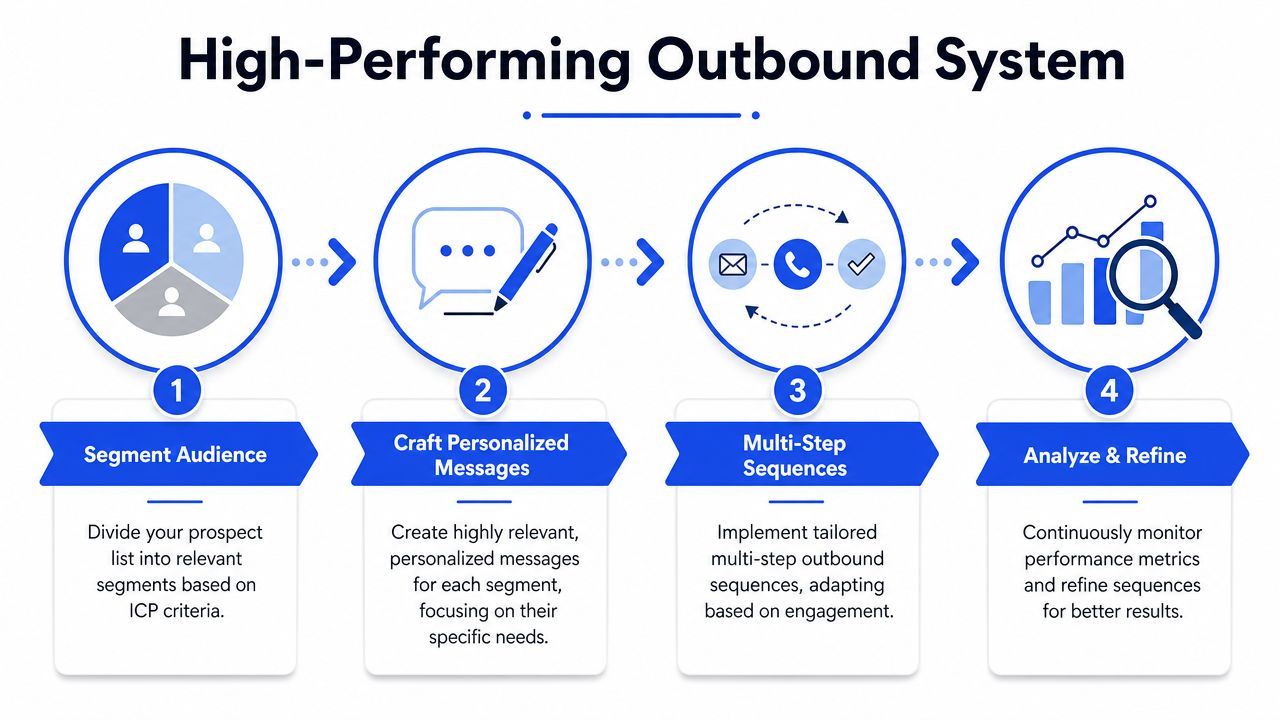
A practical framework looks like this:
Role and authority
C-suite messages should sound peer level and commercial. Heads and VPs usually respond better to operational tension and execution pain. Director-level contacts can handle more tactical framing.Trigger context
A prospect hiring SDRs needs a different opening than one expanding to a new geography or posting about missed pipeline targets.Company size band
Smaller companies usually prefer directness. Larger companies usually need more context, more caution, and clearer process language.
Effective tools are essential. Sales Navigator finds the audience. Clay can enrich trigger fields. Apollo can help unify account and contact data. HeyReach or Lemlist can run channel delivery. If you want a more connected system, AI sales automation workflows are worth mapping before launch.
Use a compact launch model
Keep the first launch tight. According to LeadScrape's B2B lead generation guide, a disciplined outbound model uses a target list of 200 to 500 contacts and a three-step sequence, with many teams seeing their first qualified conversations within two to three weeks.
That's the right shape for testing because it forces discipline. You can inspect message-market fit quickly without hiding weak copy under volume.
A simple launch model:
Batch one audience
Pick one ICP segment only.Create three to five variants
Enough to reflect real context differences, not enough to create chaos.Run a short sequence
Keep spacing deliberate and stop pretending more touches automatically means more meetings.Review by segment
Don't optimize on blended numbers if one segment is carrying the whole campaign.
A good side asset for outbound teams repurposing content into fast visual explainers is Aicut for AI-powered video creation, especially if your team wants a lightweight way to turn proven message angles into social assets without adding a full production workflow.
What the sequence should actually do
The job of outbound isn't to close in the inbox. It's to earn a relevant conversation.
A solid LinkedIn sequence usually has these mechanics:
Step | Job |
|---|---|
Touch 1 | Name the context and show relevance |
Touch 2 | Add a sharper point or observation |
Touch 3 | Give a clean exit or easy next step |
Don't over-segment into ten micro-campaigns. Operationally, three to five segments is usually the workable range. Beyond that, the writing burden grows faster than the performance gain.
Relevance beats personalization theater. A custom opener on a generic sequence still feels generic.
This is also where one provider can make sense if you don't want separate owners for list building, content, outbound, and reporting. Grou is one example of an agency model that runs those pieces inside one pipeline workflow rather than as isolated channel tasks.
Create a clear operational path for routing and qualifying leads
Replies don't become pipeline by default. They become pipeline when somebody owns the next move fast, asks the right questions, and logs the context where sales can use it.
Route replies fast
If you're using HeyReach, Instantly, Lemlist, or LinkedIn manually, positive and neutral replies need one destination for triage. Usually that means a shared Slack channel, a shared inbox, or a task queue tied to HubSpot.
The operating rule is simple:
Positive replies go straight to a qualified follow-up path
Neutral replies get human review, not automation
Negative replies get tagged and suppressed cleanly
Unclear replies stay with the same owner until intent is visible
Response speed matters because buyer intent decays in inboxes. If a prospect replies and nobody touches it until the next day, you've already weakened the conversation.
Qualify inside the conversation
A reply is interest, not fit. Somebody still needs to qualify budget, authority, need, timing, geography, delivery fit, or whatever your team uses to screen opportunities.
Keep the framework lightweight. BANT is fine if your sales motion fits it. A custom scorecard is usually better if your deal shape is more specific.
A short checklist helps:
Commercial fit
Is the company in the segment you can serve well?Problem fit
Are they describing a problem your offer solves?Buying fit
Are you speaking with the right person, or someone close enough to the process?Timing fit
Is there active intent, or just passive curiosity?
If you're redesigning this step, this piece on a lead qualification process is a useful reference.
Fast routing without qualification creates calendar noise. Qualification without fast routing creates missed deals.
Teams also use AI support here, but carefully. Summarization, reply classification, and CRM field suggestions are helpful. Auto-handling nuanced commercial replies usually isn't. For teams exploring that balance, this guide to optimizing lead generation with AI is a useful outside read.
Hand off with context, not fragments
Once the meeting is booked, the CRM record should include the conversation source, trigger, segment, original message path, and qualification notes. HubSpot is usually enough for this. Make or Zapier can push data across tools if your delivery stack is split.
Sales shouldn't need to reconstruct the buyer's intent from screenshots and Slack messages. The rep should open the record and know why the conversation started.
Measure pipeline contribution not vanity metrics
Teams usually optimize for whatever they review most often. If leadership asks about impressions every week, the program drifts toward content that gets seen. If leadership asks about qualified meetings and opportunity creation, the work gets sharper.
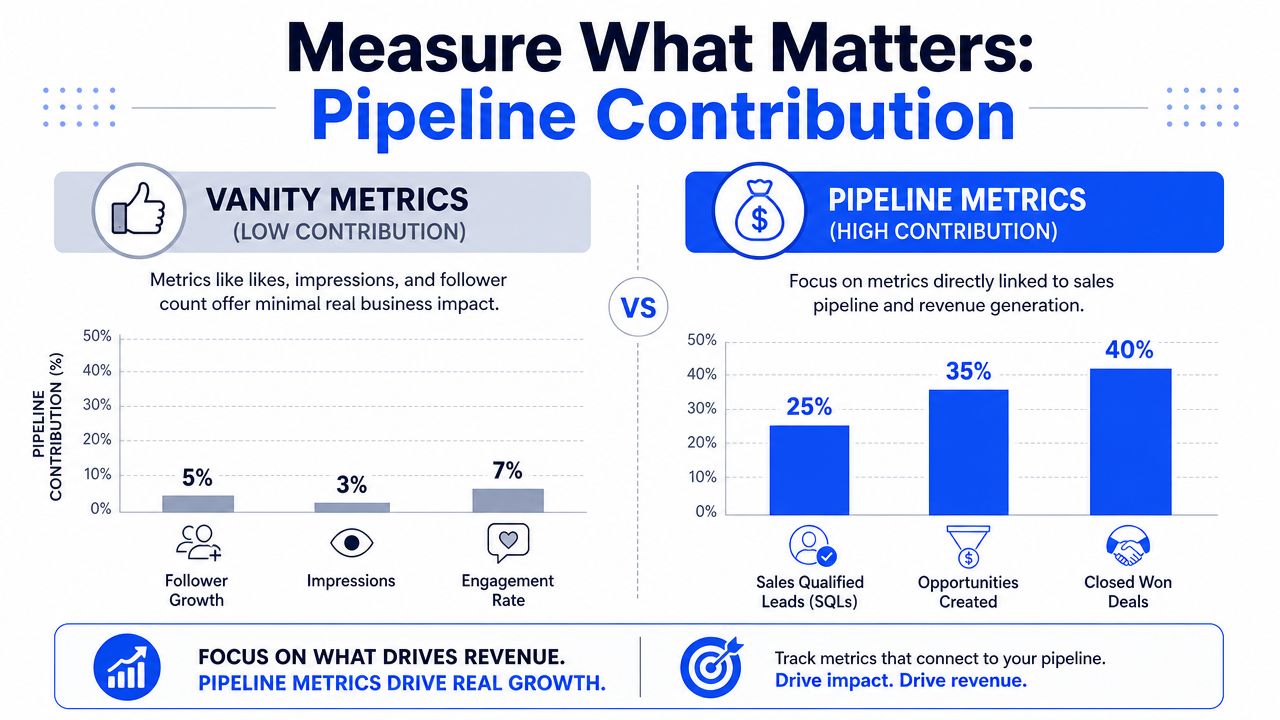
What to track every week
Vanity metrics still have diagnostic value. They just shouldn't be the scoreboard.
Use a dashboard built around pipeline movement:
Qualified conversations started
The first signal that message-market fit exists.Lead-to-meeting conversion
Tells you whether replies are real buying intent or just polite engagement.Cost per qualified meeting
Useful across content, paid, and outbound so channel comparisons stay honest.Opportunities created from LinkedIn-sourced activity
The channel starts proving commercial value at this stage.Closed-won revenue tied back to the source path
Even if attribution is directional, this should still be reviewed.
A practical KPI structure is easier to maintain when everyone uses the same definitions. This guide to lead generation KPIs is a good base.
What scaling actually looks like
Scale only after one segment, one message spine, and one routing flow are working. Before that, more volume usually just multiplies waste.
The strategic case for LinkedIn is already strong. According to Digital Applied's 2026 LinkedIn statistics summary, LinkedIn can deliver a 28% lower cost per qualified lead than Google Ads in B2B campaigns and is cited as 277% more effective for lead generation than other major social platforms.
That doesn't mean every LinkedIn campaign is efficient. It means the platform rewards disciplined operators.
Once the signal is proven, scaling usually means:
Scale motion | What changes |
|---|---|
Audience expansion | More lookalike accounts around winning segments |
Content multiplication | More variants of proven themes, not random new topics |
Workflow automation | Better enrichment, routing, and CRM sync |
Spend increase | Paid support behind offers already showing organic or outbound traction |
Clay is useful here for enrichment and lookalike discovery. AI writing support can help draft variants. But no tool fixes a weak ICP or a fuzzy offer.
Your next step is a 30-day signal sprint
Don't turn this into a six-week planning exercise.
Pick one ICP segment. Build a list of 200 contacts. Tighten the profile. Publish three strong posts per week. Run one segmented outbound sequence. Route every reply fast. Review the outcomes against qualified conversations and meetings, not attention metrics.
That first month doesn't need to prove scale. It needs to prove signal. Are the right people replying. Are they booking. Are they describing the problem you solve. Is the message pulling in fit, or just activity.
If the answer is yes, you have the start of a system. If the answer is no, you still have something valuable, real operating data instead of assumptions.
If you want a team to build that system with you, Grou runs LinkedIn content, outbound, list building, and reply routing as one pipeline workflow, so your team can measure qualified conversations and revenue impact instead of managing disconnected channel activity.
You're probably already doing the obvious LinkedIn work. Posts are going out. Sales Navigator searches are saved. Connection requests are moving. Maybe there's even a light outbound sequence running through HeyReach, Lemlist, or Instantly.
But the calendar still looks thin.
That usually isn't a LinkedIn problem. It's a systems problem. Teams commonly run B2B lead generation on LinkedIn as separate activities, content over here, outreach over there, profile somewhere in the middle, with no shared message, no routing logic, and no reporting line tied to pipeline.
The platform is too important to run that way. LinkedIn remains the core B2B social channel, with 89% of B2B marketers using it for lead generation, 80% of B2B social leads coming from LinkedIn, and a 2.74% visitor-to-lead conversion rate in one comparison set, ahead of Facebook and X, according to Brenton Way's LinkedIn marketing stats roundup.
Table of Contents
Build the foundation with lists and a conversion-focused profile
Create a clear operational path for routing and qualifying leads
Your LinkedIn activity is high but your pipeline is empty
Busy isn't the same as effective. A team can post consistently, scrape lists, send invites, and still produce almost no qualified conversations if those actions don't connect.
That's the pattern behind most underperforming LinkedIn programs. Content is written for reach. Outbound is written for response. The profile is written like a résumé. Sales measures meetings. Marketing measures impressions. Nobody owns the full path from attention to revenue.
Key takeaways
Profile optimization is conversion work, not a branding exercise. The Featured section holds greater significance than commonly perceived.
The content pillar that drives qualified DMs is decisions and trade-offs, not generic how-to posting.
Outbound improves when segmentation shapes the whole sequence, not just the first line.
Success should be judged on qualified conversations, meetings, opportunity creation, and pipeline influence, not likes or connection volume.
Practical rule: If your content, profile, and outbound can't be described in one sentence to the same ICP, you don't have a LinkedIn system. You have channel noise.
The fix is operational. One target list. One message spine. One conversion path. One dashboard. That's how LinkedIn starts acting like a pipeline engine instead of a set of disconnected motions.
Build the foundation with lists and a conversion-focused profile
Most LinkedIn programs fail before the first message goes out. The list is too broad, the profile is too vague, and the buyer who does click through has no clear next step.
Start with a live list, not a spreadsheet
Use Sales Navigator as the source of truth. Build around firmographic basics first, then tighten the list with triggers and buying context. Apollo and Clay can help enrich data later, but the shape of the audience should come from LinkedIn-native filtering first.
A workable list usually includes filters like this:
Industry and company type
Narrow hard. If you sell into SaaS, manufacturing, legal tech, pharma, or iGaming, don't mix them into one list and hope the messaging still fits.Role and authority level
Separate founder, C-suite, VP, and department head audiences early. They don't respond to the same framing.Context signals
Hiring, expansion, new market entry, funding, leadership changes, and visible posting activity all change how you open the conversation.Ownership fields
Add fields in your CRM or sheet for segment, trigger, message variant, status, and handoff stage. If you can't report by segment later, the list wasn't built properly.
If your ICP still feels broad, tighten it before launch. A useful reference is this guide to building an ideal customer profile.
Turn the profile into a conversion asset
The profile isn't there to impress peers. It exists to convert curiosity into action.
That means the headline should answer who you help and what commercial problem you solve. The about section should read like a buyer-facing summary, not a career recap. The company page matters, but on LinkedIn, personal profiles usually carry the commercial load first.
The most impactful element is the Featured section. Treat it like the top section of a landing page.
Use three assets:
A direct offer link
Send profile visitors to the most relevant service or landing page, not a generic homepage.A low-friction resource
A checklist, calculator, audit, or short diagnostic gives buyers a way to engage before they're ready for a call.A proof asset
Pick one case study, teardown, or client result that's concrete and hard to dismiss.
Most profiles are built to describe credibility. Strong profiles are built to route intent.
If you're doing B2B lead generation on LinkedIn seriously, this work comes before content volume and before automation. More profile visits don't help if the profile doesn't move people anywhere.
Generate inbound with content that signals your values
Most founder content on LinkedIn is safe, polished, and commercially weak. It gets light engagement from peers and almost no inbound from buyers who can purchase.
Most tactical content attracts peers, not buyers
The highest-quality inbound usually comes from content built around decisions and trade-offs. Not recycled tips. Not generic frameworks. Not low-risk thought leadership.
This kind of content works because buyers don't just evaluate competence. They evaluate judgment.
Posts that tend to produce qualified DMs usually do one of these:
Name a hard call
Example, refusing a client because the budget and stage didn't match the delivery model.Break down a live decision
Example, whether to hire an SDR, hire an agency, or keep founder-led outbound for another quarter.Take a defensible position
Example, why more outreach volume is often the wrong fix when reply quality is collapsing.Explain a trade-off
Example, outbound versus content, speed versus precision, founder brand versus company brand.
For deeper planning, this article on LinkedIn content strategy is a useful companion.
The post that gets the most likes often isn't the post that gets the best buyer.
That's a key distinction often overlooked. Engagement and pipeline are different metrics. Sometimes they move together. Often they don't.
Use a sustainable publishing rhythm
A strong founder-led cadence is three posts per week, usually Tuesday through Thursday, with at least one longer post in the mix. That rhythm is enough to stay visible without pushing quality downhill.
What matters more than frequency is this sequence:
Motion | What good looks like |
|---|---|
Topic choice | Clear position, real trade-off, buyer relevance |
Format | Mostly text posts, with one longer post weekly |
Comment handling | Fast replies in the first engagement window |
Profile conversion | Featured section and CTA aligned with the post theme |
Daily posting can create more activity, but it often burns time that should go into sharper topics, better comments, and tighter outbound follow-up.
Add a paid capture layer only after a post proves itself
Once a topic or asset clearly resonates, then add paid distribution. That's where native Lead Gen Forms fit.
According to Firebrand's LinkedIn B2B lead generation best practices, LinkedIn's native Lead Gen Forms can achieve an average conversion rate of 13%, helped by pre-filled user data. That makes them useful when you already know the message is landing and want to reduce friction.
Use them on proven offers, not weak ones. Paid amplification doesn't rescue a vague point of view.
Activate prospects with segmented outbound sequences
Outbound on LinkedIn works best when the message feels context-aware, not mass produced. The mistake isn't using templates. The mistake is using the same template across buyers who think about the problem differently.
Segment on three layers
Start with role. Then add trigger. Then add company size. That's enough structure for many groups.
A practical framework looks like this:
Role and authority
C-suite messages should sound peer level and commercial. Heads and VPs usually respond better to operational tension and execution pain. Director-level contacts can handle more tactical framing.Trigger context
A prospect hiring SDRs needs a different opening than one expanding to a new geography or posting about missed pipeline targets.Company size band
Smaller companies usually prefer directness. Larger companies usually need more context, more caution, and clearer process language.
Effective tools are essential. Sales Navigator finds the audience. Clay can enrich trigger fields. Apollo can help unify account and contact data. HeyReach or Lemlist can run channel delivery. If you want a more connected system, AI sales automation workflows are worth mapping before launch.
Use a compact launch model
Keep the first launch tight. According to LeadScrape's B2B lead generation guide, a disciplined outbound model uses a target list of 200 to 500 contacts and a three-step sequence, with many teams seeing their first qualified conversations within two to three weeks.
That's the right shape for testing because it forces discipline. You can inspect message-market fit quickly without hiding weak copy under volume.
A simple launch model:
Batch one audience
Pick one ICP segment only.Create three to five variants
Enough to reflect real context differences, not enough to create chaos.Run a short sequence
Keep spacing deliberate and stop pretending more touches automatically means more meetings.Review by segment
Don't optimize on blended numbers if one segment is carrying the whole campaign.
A good side asset for outbound teams repurposing content into fast visual explainers is Aicut for AI-powered video creation, especially if your team wants a lightweight way to turn proven message angles into social assets without adding a full production workflow.
What the sequence should actually do
The job of outbound isn't to close in the inbox. It's to earn a relevant conversation.
A solid LinkedIn sequence usually has these mechanics:
Step | Job |
|---|---|
Touch 1 | Name the context and show relevance |
Touch 2 | Add a sharper point or observation |
Touch 3 | Give a clean exit or easy next step |
Don't over-segment into ten micro-campaigns. Operationally, three to five segments is usually the workable range. Beyond that, the writing burden grows faster than the performance gain.
Relevance beats personalization theater. A custom opener on a generic sequence still feels generic.
This is also where one provider can make sense if you don't want separate owners for list building, content, outbound, and reporting. Grou is one example of an agency model that runs those pieces inside one pipeline workflow rather than as isolated channel tasks.
Create a clear operational path for routing and qualifying leads
Replies don't become pipeline by default. They become pipeline when somebody owns the next move fast, asks the right questions, and logs the context where sales can use it.
Route replies fast
If you're using HeyReach, Instantly, Lemlist, or LinkedIn manually, positive and neutral replies need one destination for triage. Usually that means a shared Slack channel, a shared inbox, or a task queue tied to HubSpot.
The operating rule is simple:
Positive replies go straight to a qualified follow-up path
Neutral replies get human review, not automation
Negative replies get tagged and suppressed cleanly
Unclear replies stay with the same owner until intent is visible
Response speed matters because buyer intent decays in inboxes. If a prospect replies and nobody touches it until the next day, you've already weakened the conversation.
Qualify inside the conversation
A reply is interest, not fit. Somebody still needs to qualify budget, authority, need, timing, geography, delivery fit, or whatever your team uses to screen opportunities.
Keep the framework lightweight. BANT is fine if your sales motion fits it. A custom scorecard is usually better if your deal shape is more specific.
A short checklist helps:
Commercial fit
Is the company in the segment you can serve well?Problem fit
Are they describing a problem your offer solves?Buying fit
Are you speaking with the right person, or someone close enough to the process?Timing fit
Is there active intent, or just passive curiosity?
If you're redesigning this step, this piece on a lead qualification process is a useful reference.
Fast routing without qualification creates calendar noise. Qualification without fast routing creates missed deals.
Teams also use AI support here, but carefully. Summarization, reply classification, and CRM field suggestions are helpful. Auto-handling nuanced commercial replies usually isn't. For teams exploring that balance, this guide to optimizing lead generation with AI is a useful outside read.
Hand off with context, not fragments
Once the meeting is booked, the CRM record should include the conversation source, trigger, segment, original message path, and qualification notes. HubSpot is usually enough for this. Make or Zapier can push data across tools if your delivery stack is split.
Sales shouldn't need to reconstruct the buyer's intent from screenshots and Slack messages. The rep should open the record and know why the conversation started.
Measure pipeline contribution not vanity metrics
Teams usually optimize for whatever they review most often. If leadership asks about impressions every week, the program drifts toward content that gets seen. If leadership asks about qualified meetings and opportunity creation, the work gets sharper.
What to track every week
Vanity metrics still have diagnostic value. They just shouldn't be the scoreboard.
Use a dashboard built around pipeline movement:
Qualified conversations started
The first signal that message-market fit exists.Lead-to-meeting conversion
Tells you whether replies are real buying intent or just polite engagement.Cost per qualified meeting
Useful across content, paid, and outbound so channel comparisons stay honest.Opportunities created from LinkedIn-sourced activity
The channel starts proving commercial value at this stage.Closed-won revenue tied back to the source path
Even if attribution is directional, this should still be reviewed.
A practical KPI structure is easier to maintain when everyone uses the same definitions. This guide to lead generation KPIs is a good base.
What scaling actually looks like
Scale only after one segment, one message spine, and one routing flow are working. Before that, more volume usually just multiplies waste.
The strategic case for LinkedIn is already strong. According to Digital Applied's 2026 LinkedIn statistics summary, LinkedIn can deliver a 28% lower cost per qualified lead than Google Ads in B2B campaigns and is cited as 277% more effective for lead generation than other major social platforms.
That doesn't mean every LinkedIn campaign is efficient. It means the platform rewards disciplined operators.
Once the signal is proven, scaling usually means:
Scale motion | What changes |
|---|---|
Audience expansion | More lookalike accounts around winning segments |
Content multiplication | More variants of proven themes, not random new topics |
Workflow automation | Better enrichment, routing, and CRM sync |
Spend increase | Paid support behind offers already showing organic or outbound traction |
Clay is useful here for enrichment and lookalike discovery. AI writing support can help draft variants. But no tool fixes a weak ICP or a fuzzy offer.
Your next step is a 30-day signal sprint
Don't turn this into a six-week planning exercise.
Pick one ICP segment. Build a list of 200 contacts. Tighten the profile. Publish three strong posts per week. Run one segmented outbound sequence. Route every reply fast. Review the outcomes against qualified conversations and meetings, not attention metrics.
That first month doesn't need to prove scale. It needs to prove signal. Are the right people replying. Are they booking. Are they describing the problem you solve. Is the message pulling in fit, or just activity.
If the answer is yes, you have the start of a system. If the answer is no, you still have something valuable, real operating data instead of assumptions.
If you want a team to build that system with you, Grou runs LinkedIn content, outbound, list building, and reply routing as one pipeline workflow, so your team can measure qualified conversations and revenue impact instead of managing disconnected channel activity.
You're probably already doing the obvious LinkedIn work. Posts are going out. Sales Navigator searches are saved. Connection requests are moving. Maybe there's even a light outbound sequence running through HeyReach, Lemlist, or Instantly.
But the calendar still looks thin.
That usually isn't a LinkedIn problem. It's a systems problem. Teams commonly run B2B lead generation on LinkedIn as separate activities, content over here, outreach over there, profile somewhere in the middle, with no shared message, no routing logic, and no reporting line tied to pipeline.
The platform is too important to run that way. LinkedIn remains the core B2B social channel, with 89% of B2B marketers using it for lead generation, 80% of B2B social leads coming from LinkedIn, and a 2.74% visitor-to-lead conversion rate in one comparison set, ahead of Facebook and X, according to Brenton Way's LinkedIn marketing stats roundup.
Table of Contents
Build the foundation with lists and a conversion-focused profile
Create a clear operational path for routing and qualifying leads
Your LinkedIn activity is high but your pipeline is empty
Busy isn't the same as effective. A team can post consistently, scrape lists, send invites, and still produce almost no qualified conversations if those actions don't connect.
That's the pattern behind most underperforming LinkedIn programs. Content is written for reach. Outbound is written for response. The profile is written like a résumé. Sales measures meetings. Marketing measures impressions. Nobody owns the full path from attention to revenue.
Key takeaways
Profile optimization is conversion work, not a branding exercise. The Featured section holds greater significance than commonly perceived.
The content pillar that drives qualified DMs is decisions and trade-offs, not generic how-to posting.
Outbound improves when segmentation shapes the whole sequence, not just the first line.
Success should be judged on qualified conversations, meetings, opportunity creation, and pipeline influence, not likes or connection volume.
Practical rule: If your content, profile, and outbound can't be described in one sentence to the same ICP, you don't have a LinkedIn system. You have channel noise.
The fix is operational. One target list. One message spine. One conversion path. One dashboard. That's how LinkedIn starts acting like a pipeline engine instead of a set of disconnected motions.
Build the foundation with lists and a conversion-focused profile
Most LinkedIn programs fail before the first message goes out. The list is too broad, the profile is too vague, and the buyer who does click through has no clear next step.
Start with a live list, not a spreadsheet
Use Sales Navigator as the source of truth. Build around firmographic basics first, then tighten the list with triggers and buying context. Apollo and Clay can help enrich data later, but the shape of the audience should come from LinkedIn-native filtering first.
A workable list usually includes filters like this:
Industry and company type
Narrow hard. If you sell into SaaS, manufacturing, legal tech, pharma, or iGaming, don't mix them into one list and hope the messaging still fits.Role and authority level
Separate founder, C-suite, VP, and department head audiences early. They don't respond to the same framing.Context signals
Hiring, expansion, new market entry, funding, leadership changes, and visible posting activity all change how you open the conversation.Ownership fields
Add fields in your CRM or sheet for segment, trigger, message variant, status, and handoff stage. If you can't report by segment later, the list wasn't built properly.
If your ICP still feels broad, tighten it before launch. A useful reference is this guide to building an ideal customer profile.
Turn the profile into a conversion asset
The profile isn't there to impress peers. It exists to convert curiosity into action.
That means the headline should answer who you help and what commercial problem you solve. The about section should read like a buyer-facing summary, not a career recap. The company page matters, but on LinkedIn, personal profiles usually carry the commercial load first.
The most impactful element is the Featured section. Treat it like the top section of a landing page.
Use three assets:
A direct offer link
Send profile visitors to the most relevant service or landing page, not a generic homepage.A low-friction resource
A checklist, calculator, audit, or short diagnostic gives buyers a way to engage before they're ready for a call.A proof asset
Pick one case study, teardown, or client result that's concrete and hard to dismiss.
Most profiles are built to describe credibility. Strong profiles are built to route intent.
If you're doing B2B lead generation on LinkedIn seriously, this work comes before content volume and before automation. More profile visits don't help if the profile doesn't move people anywhere.
Generate inbound with content that signals your values
Most founder content on LinkedIn is safe, polished, and commercially weak. It gets light engagement from peers and almost no inbound from buyers who can purchase.
Most tactical content attracts peers, not buyers
The highest-quality inbound usually comes from content built around decisions and trade-offs. Not recycled tips. Not generic frameworks. Not low-risk thought leadership.
This kind of content works because buyers don't just evaluate competence. They evaluate judgment.
Posts that tend to produce qualified DMs usually do one of these:
Name a hard call
Example, refusing a client because the budget and stage didn't match the delivery model.Break down a live decision
Example, whether to hire an SDR, hire an agency, or keep founder-led outbound for another quarter.Take a defensible position
Example, why more outreach volume is often the wrong fix when reply quality is collapsing.Explain a trade-off
Example, outbound versus content, speed versus precision, founder brand versus company brand.
For deeper planning, this article on LinkedIn content strategy is a useful companion.
The post that gets the most likes often isn't the post that gets the best buyer.
That's a key distinction often overlooked. Engagement and pipeline are different metrics. Sometimes they move together. Often they don't.
Use a sustainable publishing rhythm
A strong founder-led cadence is three posts per week, usually Tuesday through Thursday, with at least one longer post in the mix. That rhythm is enough to stay visible without pushing quality downhill.
What matters more than frequency is this sequence:
Motion | What good looks like |
|---|---|
Topic choice | Clear position, real trade-off, buyer relevance |
Format | Mostly text posts, with one longer post weekly |
Comment handling | Fast replies in the first engagement window |
Profile conversion | Featured section and CTA aligned with the post theme |
Daily posting can create more activity, but it often burns time that should go into sharper topics, better comments, and tighter outbound follow-up.
Add a paid capture layer only after a post proves itself
Once a topic or asset clearly resonates, then add paid distribution. That's where native Lead Gen Forms fit.
According to Firebrand's LinkedIn B2B lead generation best practices, LinkedIn's native Lead Gen Forms can achieve an average conversion rate of 13%, helped by pre-filled user data. That makes them useful when you already know the message is landing and want to reduce friction.
Use them on proven offers, not weak ones. Paid amplification doesn't rescue a vague point of view.
Activate prospects with segmented outbound sequences
Outbound on LinkedIn works best when the message feels context-aware, not mass produced. The mistake isn't using templates. The mistake is using the same template across buyers who think about the problem differently.
Segment on three layers
Start with role. Then add trigger. Then add company size. That's enough structure for many groups.
A practical framework looks like this:
Role and authority
C-suite messages should sound peer level and commercial. Heads and VPs usually respond better to operational tension and execution pain. Director-level contacts can handle more tactical framing.Trigger context
A prospect hiring SDRs needs a different opening than one expanding to a new geography or posting about missed pipeline targets.Company size band
Smaller companies usually prefer directness. Larger companies usually need more context, more caution, and clearer process language.
Effective tools are essential. Sales Navigator finds the audience. Clay can enrich trigger fields. Apollo can help unify account and contact data. HeyReach or Lemlist can run channel delivery. If you want a more connected system, AI sales automation workflows are worth mapping before launch.
Use a compact launch model
Keep the first launch tight. According to LeadScrape's B2B lead generation guide, a disciplined outbound model uses a target list of 200 to 500 contacts and a three-step sequence, with many teams seeing their first qualified conversations within two to three weeks.
That's the right shape for testing because it forces discipline. You can inspect message-market fit quickly without hiding weak copy under volume.
A simple launch model:
Batch one audience
Pick one ICP segment only.Create three to five variants
Enough to reflect real context differences, not enough to create chaos.Run a short sequence
Keep spacing deliberate and stop pretending more touches automatically means more meetings.Review by segment
Don't optimize on blended numbers if one segment is carrying the whole campaign.
A good side asset for outbound teams repurposing content into fast visual explainers is Aicut for AI-powered video creation, especially if your team wants a lightweight way to turn proven message angles into social assets without adding a full production workflow.
What the sequence should actually do
The job of outbound isn't to close in the inbox. It's to earn a relevant conversation.
A solid LinkedIn sequence usually has these mechanics:
Step | Job |
|---|---|
Touch 1 | Name the context and show relevance |
Touch 2 | Add a sharper point or observation |
Touch 3 | Give a clean exit or easy next step |
Don't over-segment into ten micro-campaigns. Operationally, three to five segments is usually the workable range. Beyond that, the writing burden grows faster than the performance gain.
Relevance beats personalization theater. A custom opener on a generic sequence still feels generic.
This is also where one provider can make sense if you don't want separate owners for list building, content, outbound, and reporting. Grou is one example of an agency model that runs those pieces inside one pipeline workflow rather than as isolated channel tasks.
Create a clear operational path for routing and qualifying leads
Replies don't become pipeline by default. They become pipeline when somebody owns the next move fast, asks the right questions, and logs the context where sales can use it.
Route replies fast
If you're using HeyReach, Instantly, Lemlist, or LinkedIn manually, positive and neutral replies need one destination for triage. Usually that means a shared Slack channel, a shared inbox, or a task queue tied to HubSpot.
The operating rule is simple:
Positive replies go straight to a qualified follow-up path
Neutral replies get human review, not automation
Negative replies get tagged and suppressed cleanly
Unclear replies stay with the same owner until intent is visible
Response speed matters because buyer intent decays in inboxes. If a prospect replies and nobody touches it until the next day, you've already weakened the conversation.
Qualify inside the conversation
A reply is interest, not fit. Somebody still needs to qualify budget, authority, need, timing, geography, delivery fit, or whatever your team uses to screen opportunities.
Keep the framework lightweight. BANT is fine if your sales motion fits it. A custom scorecard is usually better if your deal shape is more specific.
A short checklist helps:
Commercial fit
Is the company in the segment you can serve well?Problem fit
Are they describing a problem your offer solves?Buying fit
Are you speaking with the right person, or someone close enough to the process?Timing fit
Is there active intent, or just passive curiosity?
If you're redesigning this step, this piece on a lead qualification process is a useful reference.
Fast routing without qualification creates calendar noise. Qualification without fast routing creates missed deals.
Teams also use AI support here, but carefully. Summarization, reply classification, and CRM field suggestions are helpful. Auto-handling nuanced commercial replies usually isn't. For teams exploring that balance, this guide to optimizing lead generation with AI is a useful outside read.
Hand off with context, not fragments
Once the meeting is booked, the CRM record should include the conversation source, trigger, segment, original message path, and qualification notes. HubSpot is usually enough for this. Make or Zapier can push data across tools if your delivery stack is split.
Sales shouldn't need to reconstruct the buyer's intent from screenshots and Slack messages. The rep should open the record and know why the conversation started.
Measure pipeline contribution not vanity metrics
Teams usually optimize for whatever they review most often. If leadership asks about impressions every week, the program drifts toward content that gets seen. If leadership asks about qualified meetings and opportunity creation, the work gets sharper.
What to track every week
Vanity metrics still have diagnostic value. They just shouldn't be the scoreboard.
Use a dashboard built around pipeline movement:
Qualified conversations started
The first signal that message-market fit exists.Lead-to-meeting conversion
Tells you whether replies are real buying intent or just polite engagement.Cost per qualified meeting
Useful across content, paid, and outbound so channel comparisons stay honest.Opportunities created from LinkedIn-sourced activity
The channel starts proving commercial value at this stage.Closed-won revenue tied back to the source path
Even if attribution is directional, this should still be reviewed.
A practical KPI structure is easier to maintain when everyone uses the same definitions. This guide to lead generation KPIs is a good base.
What scaling actually looks like
Scale only after one segment, one message spine, and one routing flow are working. Before that, more volume usually just multiplies waste.
The strategic case for LinkedIn is already strong. According to Digital Applied's 2026 LinkedIn statistics summary, LinkedIn can deliver a 28% lower cost per qualified lead than Google Ads in B2B campaigns and is cited as 277% more effective for lead generation than other major social platforms.
That doesn't mean every LinkedIn campaign is efficient. It means the platform rewards disciplined operators.
Once the signal is proven, scaling usually means:
Scale motion | What changes |
|---|---|
Audience expansion | More lookalike accounts around winning segments |
Content multiplication | More variants of proven themes, not random new topics |
Workflow automation | Better enrichment, routing, and CRM sync |
Spend increase | Paid support behind offers already showing organic or outbound traction |
Clay is useful here for enrichment and lookalike discovery. AI writing support can help draft variants. But no tool fixes a weak ICP or a fuzzy offer.
Your next step is a 30-day signal sprint
Don't turn this into a six-week planning exercise.
Pick one ICP segment. Build a list of 200 contacts. Tighten the profile. Publish three strong posts per week. Run one segmented outbound sequence. Route every reply fast. Review the outcomes against qualified conversations and meetings, not attention metrics.
That first month doesn't need to prove scale. It needs to prove signal. Are the right people replying. Are they booking. Are they describing the problem you solve. Is the message pulling in fit, or just activity.
If the answer is yes, you have the start of a system. If the answer is no, you still have something valuable, real operating data instead of assumptions.
If you want a team to build that system with you, Grou runs LinkedIn content, outbound, list building, and reply routing as one pipeline workflow, so your team can measure qualified conversations and revenue impact instead of managing disconnected channel activity.
Pipeline OS Newsletter
Build qualified pipeline
Get weekly tactics to generate demand, improve lead quality, and book more meetings.







Trusted by industry leaders
Trusted by industry leaders
Trusted by industry leaders
Ready to build qualified pipeline?
Ready to build qualified pipeline?
Ready to build qualified pipeline?
Book a call to see if we're the right fit, or take the 2-minute quiz to get a clear starting point.
Book a call to see if we're the right fit, or take the 2-minute quiz to get a clear starting point.
Book a call to see if we're the right fit, or take the 2-minute quiz to get a clear starting point.
" height="30.21639343089746px" id="hfGbXmQR2" width="30.216393430897455px"/></svg>)
Copyright © 2026 – All Right Reserved
Copyright © 2026 – All Right Reserved
Copyright © 2026 – All Right Reserved