%22%3E%3C/path%3E%3Cpath d=%22M 63.072 7.554 C 62.258 8.022 61.577 8.689 61.092 9.493 L 61.092 7.076 L 57.158 7.076 L 57.158 22.64 L 61.089 22.64 L 61.089 14.888 C 61.089 13.446 61.403 12.434 62.03 11.853 C 62.818 11.218 63.818 10.907 64.826 10.982 L 65.868 10.982 L 65.868 6.851 C 64.891 6.834 63.926 7.076 63.073 7.554 Z%22 fill=%22rgb(17,17,17)%22%3E%3C/path%3E%3Cpath d=%22M 78.916 7.82 C 76.363 6.49 73.321 6.49 70.768 7.82 C 69.562 8.473 68.564 9.451 67.888 10.644 C 67.167 11.931 66.803 13.387 66.834 14.862 C 66.804 16.332 67.157 17.785 67.86 19.077 C 68.515 20.267 69.494 21.246 70.684 21.901 C 71.924 22.576 73.318 22.92 74.73 22.898 C 76.164 22.918 77.58 22.575 78.846 21.901 C 80.062 21.247 81.073 20.27 81.768 19.077 C 82.506 17.797 82.88 16.339 82.85 14.862 C 82.88 13.389 82.517 11.934 81.797 10.647 C 81.12 9.455 80.122 8.477 78.917 7.824 M 78.803 14.862 C 78.829 15.739 78.636 16.608 78.241 17.391 C 77.903 18.046 77.38 18.588 76.738 18.95 C 76.124 19.293 75.432 19.472 74.729 19.47 C 73.668 19.497 72.648 19.061 71.934 18.276 C 71.139 17.323 70.741 16.1 70.823 14.862 C 70.741 13.62 71.149 12.395 71.959 11.45 C 72.687 10.667 73.715 10.233 74.783 10.256 C 75.859 10.236 76.894 10.67 77.635 11.45 C 78.464 12.387 78.884 13.616 78.801 14.864%22 fill=%22rgb(17,17,17)%22%3E%3C/path%3E%3Cpath d=%22M 95.906 7.076 L 95.906 15.646 C 95.975 16.68 95.643 17.701 94.979 18.498 C 94.311 19.184 93.379 19.547 92.422 19.495 C 91.475 19.544 90.553 19.18 89.894 18.498 C 89.23 17.701 88.898 16.68 88.967 15.646 L 88.967 7.076 L 85.033 7.076 L 85.033 16.207 C 85 17.449 85.275 18.68 85.834 19.79 C 86.327 20.75 87.095 21.542 88.039 22.065 C 89.033 22.594 90.145 22.861 91.271 22.838 C 92.188 22.847 93.095 22.65 93.926 22.263 C 94.708 21.905 95.388 21.36 95.906 20.675 L 95.906 22.645 L 99.865 22.645 L 99.865 7.076 Z%22 fill=%22rgb(17,17,17)%22%3E%3C/path%3E%3Cpath d=%22M 4.513 15.626 C 4.511 10.815 7.606 6.549 12.181 5.059 C 16.756 3.57 21.77 5.195 24.601 9.086 L 27.816 5.87 C 24.074 1.186 17.981 -0.943 12.137 0.393 C 6.292 1.728 1.728 6.292 0.393 12.137 C -0.943 17.981 1.186 24.074 5.87 27.816 L 9.085 24.601 C 6.214 22.512 4.515 19.177 4.513 15.626%22 fill=%22rgb(32,62,235)%22%3E%3C/path%3E%3Cpath d=%22M 17.114 14.343 L 13.354 18.01 L 13.354 18.026 L 21.071 18.026 L 11.412 27.609 L 17.389 27.609 L 23.999 21.081 L 23.999 28.316 L 24.005 28.316 L 27.967 24.393 L 27.967 14.343 Z%22 fill=%22rgb(32,62,235)%22%3E%3C/path%3E%3C/g%3E%3C/svg%3E) ×
× ××
××›
›
›
›
How to generate leads for IT sales in 2026
How to generate leads for IT sales in 2026
How to generate leads for IT sales in 2026
How to generate leads for IT sales in 2026
How to generate leads for IT sales in 2026
How to generate leads for IT sales in 2026

Author
Aljaz Peklaj

Your IT pipeline probably isn't empty because you need more channels. It's empty because attention is fragmented, reply speed is slow, and your targeting is still too close to firmographics and too far from actual buying fit.
Cold outbound baselines are weak now, with cold email reply rates at 5.8% and cold-calling success at 2.3%, which means generic volume-first outreach is a losing bet for IT sales (Belkins and Cognism data via Division50).
Three channels usually carry the load for IT services accounts, while the rest add noise unless they support those core motions.
ICP quality drives meeting quality, and the biggest gains often come from cutting the list, not expanding it.
Speed's value is greater than commonly perceived, especially once a prospect replies or books.
Structure turns attention into pipeline, if the stack, routing, messaging, and qualification rules are connected.
Table of Contents
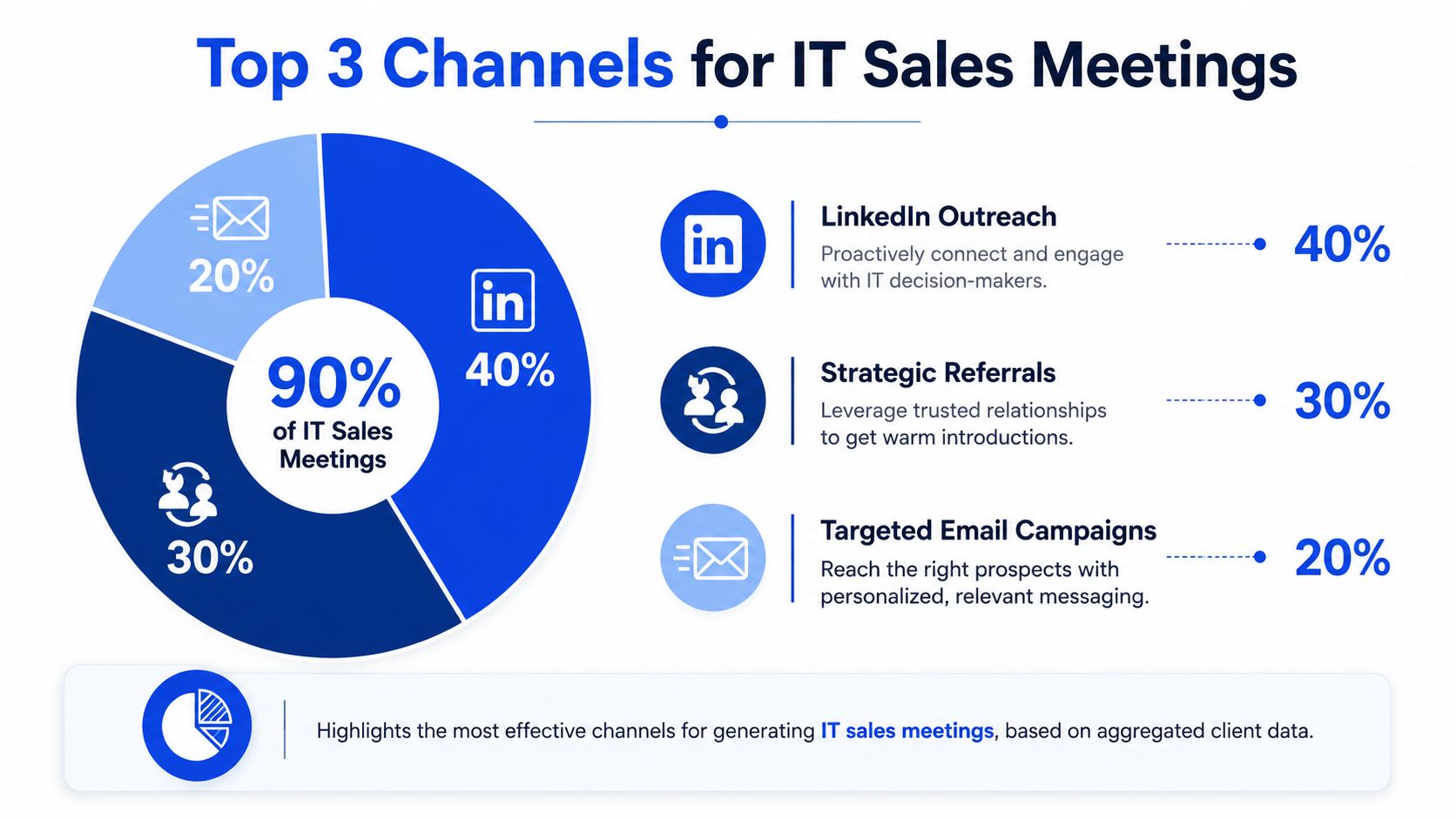
Focus on the three channels that drive 90% of IT sales meetings
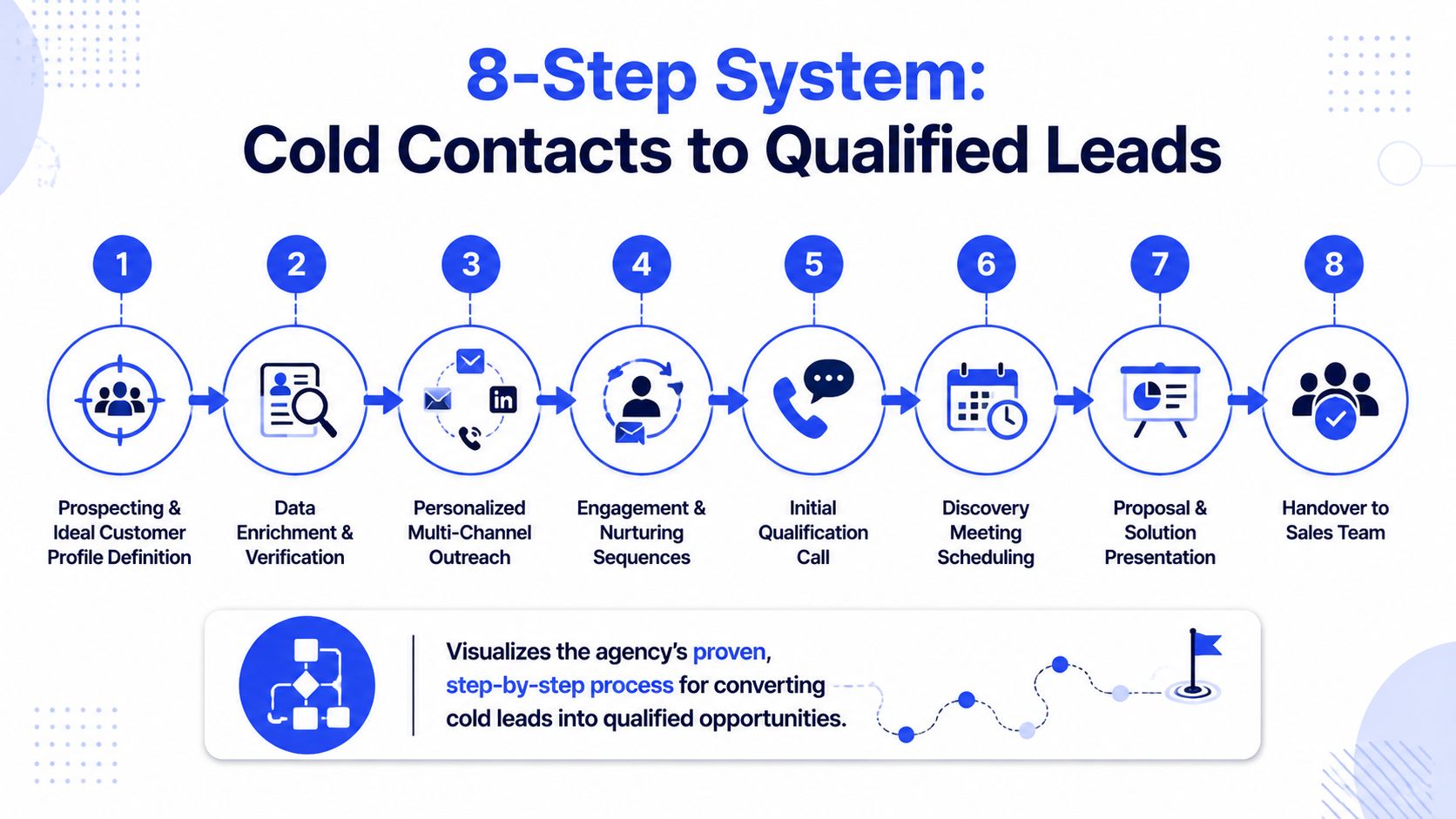
The 8-step system for turning cold contacts into qualified leads
Focus on the three channels that drive 90% of IT sales meetings
A common IT services pipeline problem looks like this. The team is running paid search, cold email, SDR calling, webinars, partner outreach, events, LinkedIn, and a few one-off campaigns. Activity looks healthy. Meetings do not.
The fix is usually subtraction, not another tactic. Across IT services programs, three channels produce nearly all sales conversations that turn into real pipeline: LinkedIn outbound, email outbound, and founder-led content. Everything else should earn its place after these three are working at target efficiency.
As noted earlier, cold outbound response benchmarks have tightened. Generic email and static-list calling still produce some conversations, but the hit rate is too low to carry an IT services growth plan on their own. The teams that keep booking meetings use intent signals, tighter account selection, and channel coordination.
LinkedIn should be first for most IT services teams
In our client work, LinkedIn outbound usually drives the biggest share of meeting volume because it gives reps context before the first touch. Analysts at Artisan found that 40% of marketers named LinkedIn the most effective B2B lead generation channel in Artisan's roundup of B2B SaaS lead generation. That lines up with what happens in IT services, where buyers care about timing, credibility, and relevance more than raw channel volume.
LinkedIn works best when the trigger is specific:
a new CIO, VP of IT, or infrastructure lead
an acquisition that creates integration work
a public post about modernization, cloud migration, or security priorities
job openings that show delivery pressure or missing capability
Those signals answer the question that matters in outbound. Why this account right now?
For teams trying to reduce channel sprawl, this piece on optimal marketing channels for startups supports the same operating principle. Fewer channels, run with discipline, usually beat a wide mix of half-managed campaigns.
If LinkedIn is going to become a dependable meeting source, it needs a process. Profile views, connection requests, message sequencing, and rep handoff all need to be managed as one motion. GROU's article on LinkedIn lead generation for B2B pipeline building is useful here because it treats the channel as an outbound system, not a personal branding side project.
A simple rule keeps quality high. If a rep cannot explain the trigger in one sentence, the account is not ready for outreach.
Email still works when it carries technical substance
Email usually contributes the second-largest share of qualified meetings, but only when the message reflects the buyer's actual environment. IT leaders ignore broad promises. They respond to a clear observation about stack complexity, migration timing, security exposure, hiring pressure, or integration risk.
That is why research comes first. BuiltWith and Wappalyzer help identify web and application stack signals. LinkedIn hiring pages show whether the company is building internal capability or filling gaps. Job descriptions often reveal cloud priorities, compliance demands, and support burden. Good outbound teams turn that research into a point of view the prospect can react to.
Three practices consistently improve email performance:
segment by stack, operating model, or hiring pattern
write around one technical observation, not a company pitch
test angles and calls to action, as Cognism recommends in its SaaS lead generation guide
The trade-off is speed versus relevance. A rep can send 500 generic emails in a day and get weak conversations, or send 80 researched emails and get replies from accounts that can buy. For IT services, the second model usually wins because deal value is high and sales cycles are long enough that poor-fit meetings are expensive.
Founder-led content is the force multiplier
Founder-led content rarely beats outbound on raw meeting count. It improves conversion across the whole system.
When a founder or practice leader posts useful technical opinions on LinkedIn, publishes detailed articles, and comments on issues buyers already care about, two things happen. Inbound appears from people who were already in the market. Outbound reply rates also improve because prospects recognize the name or company before the message arrives.
One managed services client showed this clearly in a recent quarter:
Channel | MQL contribution |
|---|---|
LinkedIn outbound | 24 MQLs, 51% |
Email outbound | 14 MQLs, 30% |
Content-driven inbound | 8 MQLs, 17% |
Other channels | 1 MQL, 2% |
That split is typical of a focused, signal-driven system. LinkedIn creates timed entry points. Email adds technical precision. Founder-led content raises trust and shortens the distance from cold outreach to booked meeting.
Those three channels should carry the pipeline first. Paid search, events, partners, and review sites can help, but they work better as support layers after the core system is producing meetings at a predictable rate.
Refine your ICP from firmographics to fit
A bad ICP doesn't always look bad at the top of the funnel. You still get replies. You still book meetings. The problem shows up later, when qualification collapses and sales starts saying the leads “look right on paper.”
One managed services client made that visible fast. About 8 weeks into a 6-month engagement, their reply rate was 9.2%, which was acceptable. Their qualification rate after the first meeting was 34%, which wasn't. Closed-won analysis later showed that 78% of their won deals came from a narrower subset the original ICP had missed.
What the original ICP missed
Their initial definition looked normal enough. Mid-market companies, 200 to 800 employees, North America and Western Europe, IT decision-makers as targets. That gave them volume, but it didn't give them fit.
We reviewed 27 closed-won deals from the previous 18 months. 21 of those 27 deals, the same 78%, shared patterns that weren't in the formal ICP:
Internal IT team size → the sweet spot was 3 to 8 IT staff
Growth stage → companies growing 30%+ year over year
Business complexity → multi-location operations, compliance requirements, or customer-facing technology dependency
Leadership capacity → an IT leader with room for strategic work, not constant firefighting
That changed the targeting model completely.
A broader ABM point matters here. High-intent accounts with automated alerts around spiking intent signals convert at rates 3x higher than cold lists, according to PMG B2B. The practical takeaway isn't “buy more intent software.” It's that fit improves when the account model includes actual buying conditions.
If you need a separate framework for tightening that definition, GROU's guide to the ideal customer profile is the right place to pressure-test what belongs in your model.
The five-step refinement process
We ran the correction in five parts.
Closed-deal analysis
We looked backward first. Not to confirm assumptions, but to find what was common among actual wins.Criteria extraction
Team structure, growth pattern, and complexity came out stronger than standard firmographics.Disqualification rules
We removed companies with 9+ IT staff, companies in decline, and simpler single-location businesses.Signal adjustment
Clay research shifted toward growth indicators, hiring velocity, expansion signals, and evidence of operational complexity.Messaging rewrite
Outreach started speaking to scaling pressure and team-capacity gaps, instead of generic managed services language.
Meetings don't turn into pipeline because the target account matches employee count. They turn because the account has a specific operational reason to act.
What changed after the ICP got narrower
The initial response is often fear. A narrower ICP means a smaller list. That part is true. It also usually means the list stops wasting your sales team's calendar.
In the 4 weeks after refinement, results changed sharply:
Metric | Before refinement | After refinement |
|---|---|---|
Reply rate | 9.2% | 12.8% |
Qualification rate after first meeting | 34% | 68% |
Cost per qualified opportunity | €1,240 | €490 |
Within 4 months, that refined targeting produced 5 deals worth €480k combined.
The most important variable was the 3 to 8 IT staff filter. It explained roughly 45% of the qualification rate improvement in that case. The growth-stage requirement was next. Leadership capacity was harder to detect, but still useful when verified through public signals and discovery.
This pattern repeats across IT services segments, even when the details shift:
IT consulting → buyer readiness often depends on a board-backed mandate, not just “transformation” language
Infrastructure implementation → hybrid complexity and internal transition capacity matter more than broad cloud intent
Cybersecurity services → compliance deadlines and incident context often sort true demand from ambient concern
That's why firmographics alone are too blunt. If you want to know how to generate leads for IT sales without flooding the funnel with low-fit meetings, define the ICP from closed-deal evidence, then write your list rules around what delivers conversions.
The 8-step system for turning cold contacts into qualified leads
A common failure pattern in IT sales looks like this. The team builds a decent list, launches sequences, gets a small wave of replies, then loses deals in the gap between interest and qualification. Response times slip. AEs walk into meetings with thin context. Calendar volume looks healthy, but pipeline quality does not.
The fix is operational discipline. The system below is the one we use to turn outbound activity into qualified pipeline for IT services clients.
1) Start with signal-triggered intake
Prospects should enter the system because something changed, not because they matched a static filter six months ago.
We use Clay to watch for buying signals such as CIO or Head of IT changes, M&A activity, infrastructure hiring, public security initiatives, funding events, and compliance deadlines. Those signals give outreach a reason for contact and improve timing. They also help reps avoid generic messaging that technical buyers ignore.
2) Enrich the account before sales touches it
Basic firmographics are not enough once you sell technical services. The rep needs enough context to form a credible point of view before sending the first message.
That enrichment usually combines Clay with Apollo or ZoomInfo for contact data, BuiltWith and Wappalyzer for stack signals, and Hunter, Snov, ZeroBounce, and NeverBounce for email finding and verification. We add role context, adjacent technologies, hiring clues, and signs of internal capacity. The goal is simple. Give the rep enough evidence to write a message that sounds informed, not templated.
Here's the process in visual form.
3) Open with a coordinated multi-channel sequence
For IT services, we usually run a 16-day opening sequence across LinkedIn and email:
Day 0 → LinkedIn connection request tied to the trigger
Day 2 → email with one technical observation and a low-friction CTA
Day 4 → engagement with the prospect's LinkedIn content
Day 6 → LinkedIn follow-up that references the email
Day 9 → second email from a different angle
Day 12 → direct message with concise business value
Day 16 → break-up email offering a useful resource instead of a meeting push
The channel mix matters less than message continuity. Each touch should reflect the same account context, the same trigger, and the same hypothesis about what changed.
For teams tightening handoff standards, this piece on qualifying sales-ready leads is worth reading because it addresses the same conversion problem from the qualification side.
Email still carries a large share of booked meetings, so copy quality matters. GROU's article on cold email for outbound sales teams aligns with how we run it. Keep the message short, specific, and tied to something real about the account.
4) Route replies fast
Once a prospect replies, speed becomes a pipeline variable.
Positive replies route through Zapier into Slack and the assigned AE queue. During business hours, the target is a live response within 15 minutes. After hours, the target is within 60 minutes. Teams that treat reply handling as admin work usually waste the hardest part of outbound. They already earned attention and then respond too slowly to convert it.
Analysts cited by Email Vendor Selection's lead generation statistics roundup found that responding within 5 minutes sharply improves contact and conversion rates compared with waiting 30 minutes. The same roundup cites materially higher qualification rates for teams that respond within 1 minute versus 30 minutes.
If a prospect replies and waits half a day for a human answer, the outreach did its job and the operating system failed.
A short walkthrough helps here before the remaining steps.
5) Build a pre-meeting brief
The AE should not walk into discovery cold.
Before the first meeting, we prepare a short brief with the trigger event, technology notes, relevant public activity, likely pain points, and open questions. Good prep usually takes 15 to 25 minutes. That time is cheap compared with the cost of a weak meeting that advances a poor-fit account.
6) Run discovery like a qualification event
The first meeting is for qualification, not a broad capability pitch.
The AE needs to confirm buying structure, budget reality, timeline, current environment, technical constraints, urgency, and alternatives under consideration. In IT services, a deal can sound promising and still stall because the prospect lacks internal capacity, executive sponsorship, or a near-term initiative. Discovery has to surface that early.
7) Follow up within 24 hours with something tailored
Fast follow-up keeps momentum and proves the team listened.
We send a recap within 24 hours that includes the prospect's stated priorities, next-step recommendations, and any promised materials. For stronger opportunities, that follow-up includes a personalized Loom or a short summary mapped to the prospect's environment. Generic recap emails lose deals because they force the buyer to reconstruct the conversation.
8) Use a structured proposal path
Proposal stage discipline protects close rates.
That means clear owners, documented next steps, buying committee visibility, and a proposal that reflects the actual scope discussed in discovery. In IT services, proposals often fail because the seller jumps from interest to pricing before the internal decision path is visible. A structured proposal process reduces that risk and makes forecast calls more credible.
A cybersecurity-focused managed services client shows how this system performs over a 90-day period:
940 cold contacts entered
118 positive replies, a 12.6% reply rate
84 booked meetings, 71% of positive replies
76 meetings held, a 90% show rate
47 qualified opportunities, a 62% qualification rate
11 closed deals within 6 months, worth roughly €680k combined
Those results did not come from sending more volume. They came from signal-based intake, better account context, fast reply handling, disciplined discovery, and tighter qualification standards.
Assembling the right tech stack for IT lead generation
A bloated stack creates slow follow-up, duplicate records, broken attribution, and reps working from stale data. In IT services, that usually shows up as missed buying signals, poor handoff quality, and meetings booked with accounts that were never a fit.
The stack that performs is a connected system built around signals, routing, and CRM discipline. One system owns account and contact history. One layer handles enrichment and logic. Channel tools do the execution work they are good at.

The core architecture
For most mid-market IT services teams, the stack looks like this:
CRM: HubSpot as the system of record. Salesforce if the client already has enterprise reporting, admin support, and process maturity
Orchestration and enrichment: Clay
Firmographic and contact data: Apollo or ZoomInfo
Technical stack detection: BuiltWith and Wappalyzer
Email outreach: Lemlist, with Instantly for teams that need more sending capacity
LinkedIn outreach: HeyReach plus Sales Navigator
Verification: ZeroBounce and NeverBounce
Routing and collaboration: Zapier and Slack
Meeting and proposal support: Loom
Reporting: HubSpot dashboards, Google Sheets, and sometimes Looker
Grou can also sit in this model as the operator running the stack, content, and outbound motion for teams that do not want to build the workflow internally. The useful part is not the vendor label. It is having one team accountable for targeting logic, execution, and reporting instead of splitting ownership across marketing, SDRs, and freelancers.
Why each layer earns its cost
HubSpot is usually the better fit for this motion because setup is faster, custom objects are easier to manage, and outbound activity is easier to audit. For IT sales, those details matter. The CRM needs to hold stack notes, compliance constraints, buying committee roles, trigger source, qualification status, and next action without turning into a cleanup project every Friday.
Clay is the operating layer. It monitors inputs, enriches records, applies routing rules, and pushes clean data into the tools that reps use. Without it, teams end up researching in tabs, exporting CSVs, reformatting fields by hand, and launching sequences with partial context.
That breakdown creates real pipeline drag.
A few stack decisions have outsized impact:
Separate channel tools improve control because email deliverability issues and LinkedIn workflow limits need different handling
Waterfall enrichment improves match rates because no single data provider covers IT buyers cleanly across role changes, subsidiaries, and regional entities
Sales Navigator still fills critical gaps because live profile activity often explains role scope better than a static database field
BuiltWith and Wappalyzer help qualification because technology context changes the message, the case study used, and whether the account belongs in the queue at all
For teams adding founder-led posting or employee advocacy to support outbound, this guide to the best social media automation tools is a useful companion. It supports the content side of the system, not prospecting infrastructure.
If you are comparing categories and vendors more broadly, this breakdown of lead generation software for outbound and pipeline teams helps sort useful tools from software that adds another login and little else.
Buy for data flow, ownership, and reporting accuracy. Feature count is secondary.
Cost and integration reality
A working stack for IT lead generation usually costs less than the wasted spend caused by bad data and weak routing, but the budget still needs to match the motion. Data providers and enrichment credits are often the largest line items. Outreach seats, LinkedIn tooling, and CRM upgrades follow behind.
Typical ranges look like this:
Tool category | Typical cost |
|---|---|
HubSpot Sales Hub Professional | roughly €90 to €150 per user per month |
Clay | €15k to €35k annually |
Apollo or ZoomInfo | €15k to €40k annually |
Lemlist | roughly €80 to €150 per user per month |
HeyReach | roughly €70 to €120 per LinkedIn account per month |
Sales Navigator | roughly €80 to €120 per user per month |
Verification and enrichment credits | €500 to €2,000 per month |
The integration logic should stay simple. Clay pulls in trigger-based accounts, enriches them, and scores whether they belong in the active queue. Approved records move into Lemlist and HeyReach. Replies, tasks, meeting outcomes, and opportunity stages sync back to HubSpot. Slack handles rep alerts and AE handoffs. Reporting comes from the CRM so managers can trust source, status, and conversion data without stitching screenshots together.
That structure is less flashy than an all-in-one promise. It gives pipeline operators what they need: cleaner inputs, faster execution, and reporting that stands up in a forecast call.
Your 90-day sprint plan to a predictable IT pipeline
A predictable IT pipeline is built in the week after the first replies come in. One rep answers within 10 minutes, books a call, logs the trigger, and the account moves cleanly into discovery. Another rep waits until the afternoon, misses the context, and the interest goes cold. The difference usually is not copy. It is operating discipline.
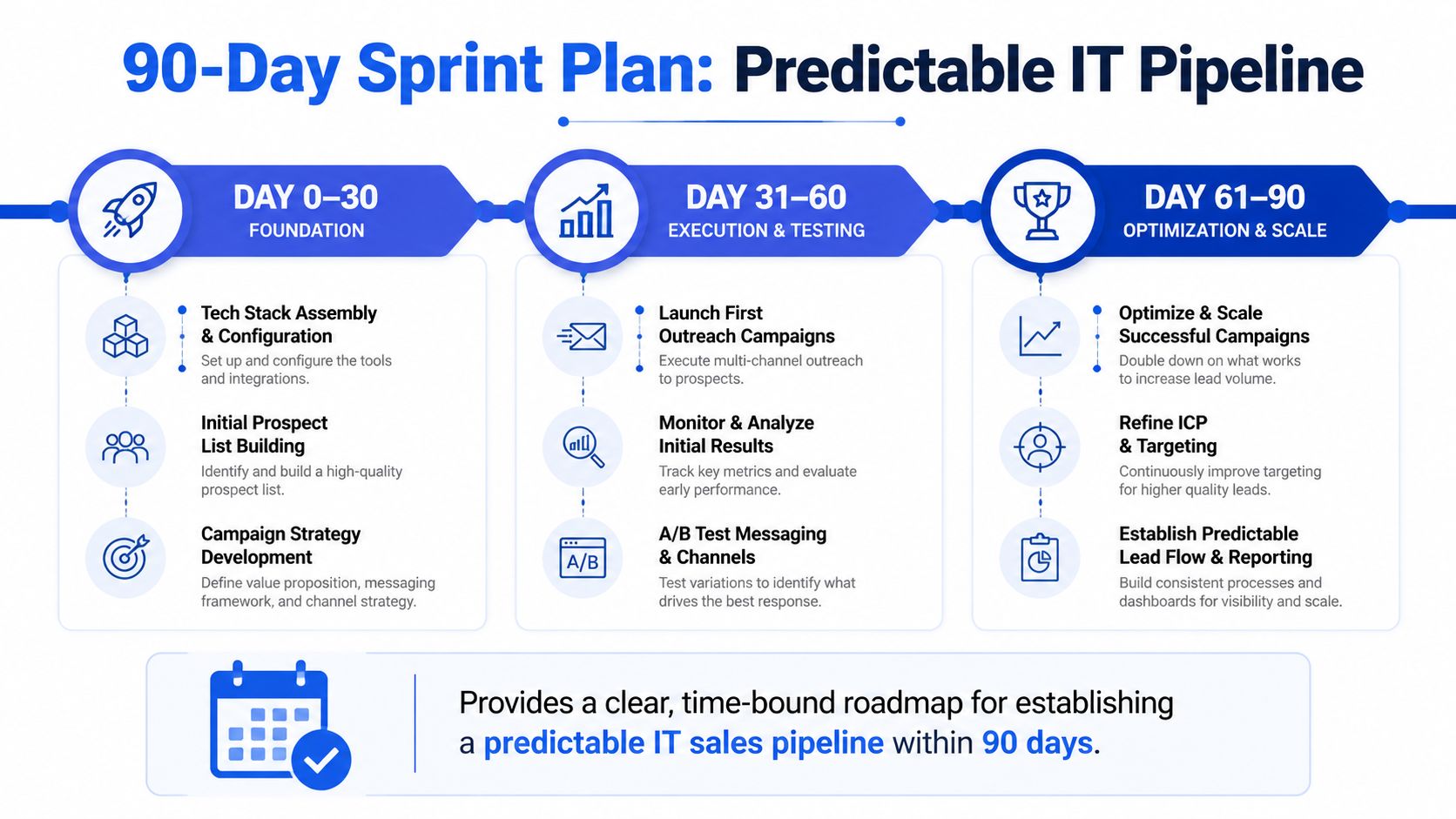
Days 1 to 30, define fit and wire the system
The first month is for setup that sales teams usually rush past.
Review closed won, closed lost, and stalled deals side by side. The goal is to find the conditions that predict movement for your offer. In IT services, those signals often sit below simple firmographics. A company can match headcount and industry and still be a poor target if the internal team owns the work already, the stack is stable, or there is no buying event.
Build the system around those realities.
Create CRM fields for signal source, buying committee role, stack notes, current provider status, disqualification reason, and "why now"
Set up Clay tables to capture trigger-based accounts, enrichment outputs, scoring logic, and routing status
Connect HubSpot, Lemlist, HeyReach, Slack, and calendar tooling
Define qualification rules shared by SDRs, AEs, and marketing so meeting quality is judged the same way by everyone
I usually want this month to end with one thing. A rep should be able to open any booked meeting and see why the account entered outreach, what signal fired, who engaged first, and how fast the team responded.
Daily production starts here too. A practical outbound unit for IT services is small. Five accounts. Five contacts per account. Twenty-five people with clear fit and a known reason to care now. That is enough volume to test channel coordination without flooding the team with weak leads.
If you need a broader operating checklist, GROU's guide on how to build a lead generation system is a useful reference because it treats pipeline as an execution model, not a campaign.
Days 31 to 60, launch small and read the signals carefully
Month two is for controlled execution.
Run pilots by segment, not across the full market. Managed services buyers respond to different pressure than cybersecurity buyers. Infrastructure projects have different buying groups than cloud cost optimization work. If the offer changes, the trigger changes. If the trigger changes, the message and follow-up path should change too.
Use this period to answer three practical questions. Are the right people replying? Are booked meetings showing up? Are qualified conversations concentrated around a small set of triggers?
A review cadence I trust looks like this:
What to review | What to look for |
|---|---|
Replies | Do buyers engage with the problem and timing, or only ask who you are? |
Meetings booked | Are the accepted meetings coming from economic buyers, technical evaluators, or low-context contacts? |
Meetings held | Do no-shows track back to weak follow-up speed, weak confirmation, or low urgency? |
Qualification outcomes | Which disqualifiers repeat often enough to remove accounts upstream? |
Bad habits show up fast. Teams chase reply rate, widen the list, and call it progress. In IT sales, that usually lowers meeting quality within two weeks. Lower volume with stronger fit tends to win because technical buyers are quick to ignore vague outreach and even quicker to reject meetings that lack context.
Watch reply handling closely. If positive responses sit in a shared inbox, or if AEs pick them up when they have time, the pilot will underperform for an avoidable reason. I want a measured KPI here: reply-to-human-response time. If it drifts past an hour during business hours, held-meeting rate usually suffers.
Days 61 to 90, scale the winners and tighten the exclusions
By the third month, the job changes. You are no longer asking whether the motion can work. You are deciding which parts deserve more volume and which parts should be cut.
Scale only what has already produced qualified meetings. That can mean adding more accounts with the same trigger pattern, adding more stakeholders inside accounts that already match, or expanding into one adjacent segment with similar technical conditions. Do not scale because a sequence got attention. Scale because the meetings held, qualified, and moved.
Cut harder too.
If a pattern keeps failing in discovery, remove it from the queue. If companies with fully built internal IT teams never progress, stop routing them in. If one title replies often but never brings buying authority, reduce its share in the mix. Good pipeline operators protect the sales team from bad volume.
The scorecard at the end of the sprint should be simple enough to inspect every Friday:
Signal source
Sequence entry date
Positive reply date
Reply-to-human-response time
Booked meeting status
Held meeting status
Qualification result
Opportunity stage progression
Those fields are enough to show whether the system is working.
For teams supporting outbound with inbound content, keep the asset mix practical. Comparison pages, migration checklists, implementation timelines, security FAQ pages, and ROI calculators help technical buyers validate you after the first touch. Broad educational posts help less at this stage because the buyer is trying to reduce risk, not learn the category from scratch.
One useful habit for Monday morning: add a required CRM field for why now on every booked IT meeting. Force the rep to log the actual trigger, such as leadership change, active hiring, tooling shift, compliance pressure, vendor dissatisfaction, or a public initiative. After two weeks, sort held meetings and qualified meetings by that field. You will see very quickly which signals deserve more budget, more reps, and tighter follow-up.
GROU helps B2B teams build pipeline through LinkedIn content, lead generation, and outbound tied into one system. The methodology is simple. Structure turns attention into pipeline through tight ICPs, signal-driven outreach, fast routing, and shared reporting.
Your IT pipeline probably isn't empty because you need more channels. It's empty because attention is fragmented, reply speed is slow, and your targeting is still too close to firmographics and too far from actual buying fit.
Cold outbound baselines are weak now, with cold email reply rates at 5.8% and cold-calling success at 2.3%, which means generic volume-first outreach is a losing bet for IT sales (Belkins and Cognism data via Division50).
Three channels usually carry the load for IT services accounts, while the rest add noise unless they support those core motions.
ICP quality drives meeting quality, and the biggest gains often come from cutting the list, not expanding it.
Speed's value is greater than commonly perceived, especially once a prospect replies or books.
Structure turns attention into pipeline, if the stack, routing, messaging, and qualification rules are connected.
Table of Contents
Focus on the three channels that drive 90% of IT sales meetings
The 8-step system for turning cold contacts into qualified leads
Focus on the three channels that drive 90% of IT sales meetings
A common IT services pipeline problem looks like this. The team is running paid search, cold email, SDR calling, webinars, partner outreach, events, LinkedIn, and a few one-off campaigns. Activity looks healthy. Meetings do not.
The fix is usually subtraction, not another tactic. Across IT services programs, three channels produce nearly all sales conversations that turn into real pipeline: LinkedIn outbound, email outbound, and founder-led content. Everything else should earn its place after these three are working at target efficiency.
As noted earlier, cold outbound response benchmarks have tightened. Generic email and static-list calling still produce some conversations, but the hit rate is too low to carry an IT services growth plan on their own. The teams that keep booking meetings use intent signals, tighter account selection, and channel coordination.
LinkedIn should be first for most IT services teams
In our client work, LinkedIn outbound usually drives the biggest share of meeting volume because it gives reps context before the first touch. Analysts at Artisan found that 40% of marketers named LinkedIn the most effective B2B lead generation channel in Artisan's roundup of B2B SaaS lead generation. That lines up with what happens in IT services, where buyers care about timing, credibility, and relevance more than raw channel volume.
LinkedIn works best when the trigger is specific:
a new CIO, VP of IT, or infrastructure lead
an acquisition that creates integration work
a public post about modernization, cloud migration, or security priorities
job openings that show delivery pressure or missing capability
Those signals answer the question that matters in outbound. Why this account right now?
For teams trying to reduce channel sprawl, this piece on optimal marketing channels for startups supports the same operating principle. Fewer channels, run with discipline, usually beat a wide mix of half-managed campaigns.
If LinkedIn is going to become a dependable meeting source, it needs a process. Profile views, connection requests, message sequencing, and rep handoff all need to be managed as one motion. GROU's article on LinkedIn lead generation for B2B pipeline building is useful here because it treats the channel as an outbound system, not a personal branding side project.
A simple rule keeps quality high. If a rep cannot explain the trigger in one sentence, the account is not ready for outreach.
Email still works when it carries technical substance
Email usually contributes the second-largest share of qualified meetings, but only when the message reflects the buyer's actual environment. IT leaders ignore broad promises. They respond to a clear observation about stack complexity, migration timing, security exposure, hiring pressure, or integration risk.
That is why research comes first. BuiltWith and Wappalyzer help identify web and application stack signals. LinkedIn hiring pages show whether the company is building internal capability or filling gaps. Job descriptions often reveal cloud priorities, compliance demands, and support burden. Good outbound teams turn that research into a point of view the prospect can react to.
Three practices consistently improve email performance:
segment by stack, operating model, or hiring pattern
write around one technical observation, not a company pitch
test angles and calls to action, as Cognism recommends in its SaaS lead generation guide
The trade-off is speed versus relevance. A rep can send 500 generic emails in a day and get weak conversations, or send 80 researched emails and get replies from accounts that can buy. For IT services, the second model usually wins because deal value is high and sales cycles are long enough that poor-fit meetings are expensive.
Founder-led content is the force multiplier
Founder-led content rarely beats outbound on raw meeting count. It improves conversion across the whole system.
When a founder or practice leader posts useful technical opinions on LinkedIn, publishes detailed articles, and comments on issues buyers already care about, two things happen. Inbound appears from people who were already in the market. Outbound reply rates also improve because prospects recognize the name or company before the message arrives.
One managed services client showed this clearly in a recent quarter:
Channel | MQL contribution |
|---|---|
LinkedIn outbound | 24 MQLs, 51% |
Email outbound | 14 MQLs, 30% |
Content-driven inbound | 8 MQLs, 17% |
Other channels | 1 MQL, 2% |
That split is typical of a focused, signal-driven system. LinkedIn creates timed entry points. Email adds technical precision. Founder-led content raises trust and shortens the distance from cold outreach to booked meeting.
Those three channels should carry the pipeline first. Paid search, events, partners, and review sites can help, but they work better as support layers after the core system is producing meetings at a predictable rate.
Refine your ICP from firmographics to fit
A bad ICP doesn't always look bad at the top of the funnel. You still get replies. You still book meetings. The problem shows up later, when qualification collapses and sales starts saying the leads “look right on paper.”
One managed services client made that visible fast. About 8 weeks into a 6-month engagement, their reply rate was 9.2%, which was acceptable. Their qualification rate after the first meeting was 34%, which wasn't. Closed-won analysis later showed that 78% of their won deals came from a narrower subset the original ICP had missed.
What the original ICP missed
Their initial definition looked normal enough. Mid-market companies, 200 to 800 employees, North America and Western Europe, IT decision-makers as targets. That gave them volume, but it didn't give them fit.
We reviewed 27 closed-won deals from the previous 18 months. 21 of those 27 deals, the same 78%, shared patterns that weren't in the formal ICP:
Internal IT team size → the sweet spot was 3 to 8 IT staff
Growth stage → companies growing 30%+ year over year
Business complexity → multi-location operations, compliance requirements, or customer-facing technology dependency
Leadership capacity → an IT leader with room for strategic work, not constant firefighting
That changed the targeting model completely.
A broader ABM point matters here. High-intent accounts with automated alerts around spiking intent signals convert at rates 3x higher than cold lists, according to PMG B2B. The practical takeaway isn't “buy more intent software.” It's that fit improves when the account model includes actual buying conditions.
If you need a separate framework for tightening that definition, GROU's guide to the ideal customer profile is the right place to pressure-test what belongs in your model.
The five-step refinement process
We ran the correction in five parts.
Closed-deal analysis
We looked backward first. Not to confirm assumptions, but to find what was common among actual wins.Criteria extraction
Team structure, growth pattern, and complexity came out stronger than standard firmographics.Disqualification rules
We removed companies with 9+ IT staff, companies in decline, and simpler single-location businesses.Signal adjustment
Clay research shifted toward growth indicators, hiring velocity, expansion signals, and evidence of operational complexity.Messaging rewrite
Outreach started speaking to scaling pressure and team-capacity gaps, instead of generic managed services language.
Meetings don't turn into pipeline because the target account matches employee count. They turn because the account has a specific operational reason to act.
What changed after the ICP got narrower
The initial response is often fear. A narrower ICP means a smaller list. That part is true. It also usually means the list stops wasting your sales team's calendar.
In the 4 weeks after refinement, results changed sharply:
Metric | Before refinement | After refinement |
|---|---|---|
Reply rate | 9.2% | 12.8% |
Qualification rate after first meeting | 34% | 68% |
Cost per qualified opportunity | €1,240 | €490 |
Within 4 months, that refined targeting produced 5 deals worth €480k combined.
The most important variable was the 3 to 8 IT staff filter. It explained roughly 45% of the qualification rate improvement in that case. The growth-stage requirement was next. Leadership capacity was harder to detect, but still useful when verified through public signals and discovery.
This pattern repeats across IT services segments, even when the details shift:
IT consulting → buyer readiness often depends on a board-backed mandate, not just “transformation” language
Infrastructure implementation → hybrid complexity and internal transition capacity matter more than broad cloud intent
Cybersecurity services → compliance deadlines and incident context often sort true demand from ambient concern
That's why firmographics alone are too blunt. If you want to know how to generate leads for IT sales without flooding the funnel with low-fit meetings, define the ICP from closed-deal evidence, then write your list rules around what delivers conversions.
The 8-step system for turning cold contacts into qualified leads
A common failure pattern in IT sales looks like this. The team builds a decent list, launches sequences, gets a small wave of replies, then loses deals in the gap between interest and qualification. Response times slip. AEs walk into meetings with thin context. Calendar volume looks healthy, but pipeline quality does not.
The fix is operational discipline. The system below is the one we use to turn outbound activity into qualified pipeline for IT services clients.
1) Start with signal-triggered intake
Prospects should enter the system because something changed, not because they matched a static filter six months ago.
We use Clay to watch for buying signals such as CIO or Head of IT changes, M&A activity, infrastructure hiring, public security initiatives, funding events, and compliance deadlines. Those signals give outreach a reason for contact and improve timing. They also help reps avoid generic messaging that technical buyers ignore.
2) Enrich the account before sales touches it
Basic firmographics are not enough once you sell technical services. The rep needs enough context to form a credible point of view before sending the first message.
That enrichment usually combines Clay with Apollo or ZoomInfo for contact data, BuiltWith and Wappalyzer for stack signals, and Hunter, Snov, ZeroBounce, and NeverBounce for email finding and verification. We add role context, adjacent technologies, hiring clues, and signs of internal capacity. The goal is simple. Give the rep enough evidence to write a message that sounds informed, not templated.
Here's the process in visual form.
3) Open with a coordinated multi-channel sequence
For IT services, we usually run a 16-day opening sequence across LinkedIn and email:
Day 0 → LinkedIn connection request tied to the trigger
Day 2 → email with one technical observation and a low-friction CTA
Day 4 → engagement with the prospect's LinkedIn content
Day 6 → LinkedIn follow-up that references the email
Day 9 → second email from a different angle
Day 12 → direct message with concise business value
Day 16 → break-up email offering a useful resource instead of a meeting push
The channel mix matters less than message continuity. Each touch should reflect the same account context, the same trigger, and the same hypothesis about what changed.
For teams tightening handoff standards, this piece on qualifying sales-ready leads is worth reading because it addresses the same conversion problem from the qualification side.
Email still carries a large share of booked meetings, so copy quality matters. GROU's article on cold email for outbound sales teams aligns with how we run it. Keep the message short, specific, and tied to something real about the account.
4) Route replies fast
Once a prospect replies, speed becomes a pipeline variable.
Positive replies route through Zapier into Slack and the assigned AE queue. During business hours, the target is a live response within 15 minutes. After hours, the target is within 60 minutes. Teams that treat reply handling as admin work usually waste the hardest part of outbound. They already earned attention and then respond too slowly to convert it.
Analysts cited by Email Vendor Selection's lead generation statistics roundup found that responding within 5 minutes sharply improves contact and conversion rates compared with waiting 30 minutes. The same roundup cites materially higher qualification rates for teams that respond within 1 minute versus 30 minutes.
If a prospect replies and waits half a day for a human answer, the outreach did its job and the operating system failed.
A short walkthrough helps here before the remaining steps.
5) Build a pre-meeting brief
The AE should not walk into discovery cold.
Before the first meeting, we prepare a short brief with the trigger event, technology notes, relevant public activity, likely pain points, and open questions. Good prep usually takes 15 to 25 minutes. That time is cheap compared with the cost of a weak meeting that advances a poor-fit account.
6) Run discovery like a qualification event
The first meeting is for qualification, not a broad capability pitch.
The AE needs to confirm buying structure, budget reality, timeline, current environment, technical constraints, urgency, and alternatives under consideration. In IT services, a deal can sound promising and still stall because the prospect lacks internal capacity, executive sponsorship, or a near-term initiative. Discovery has to surface that early.
7) Follow up within 24 hours with something tailored
Fast follow-up keeps momentum and proves the team listened.
We send a recap within 24 hours that includes the prospect's stated priorities, next-step recommendations, and any promised materials. For stronger opportunities, that follow-up includes a personalized Loom or a short summary mapped to the prospect's environment. Generic recap emails lose deals because they force the buyer to reconstruct the conversation.
8) Use a structured proposal path
Proposal stage discipline protects close rates.
That means clear owners, documented next steps, buying committee visibility, and a proposal that reflects the actual scope discussed in discovery. In IT services, proposals often fail because the seller jumps from interest to pricing before the internal decision path is visible. A structured proposal process reduces that risk and makes forecast calls more credible.
A cybersecurity-focused managed services client shows how this system performs over a 90-day period:
940 cold contacts entered
118 positive replies, a 12.6% reply rate
84 booked meetings, 71% of positive replies
76 meetings held, a 90% show rate
47 qualified opportunities, a 62% qualification rate
11 closed deals within 6 months, worth roughly €680k combined
Those results did not come from sending more volume. They came from signal-based intake, better account context, fast reply handling, disciplined discovery, and tighter qualification standards.
Assembling the right tech stack for IT lead generation
A bloated stack creates slow follow-up, duplicate records, broken attribution, and reps working from stale data. In IT services, that usually shows up as missed buying signals, poor handoff quality, and meetings booked with accounts that were never a fit.
The stack that performs is a connected system built around signals, routing, and CRM discipline. One system owns account and contact history. One layer handles enrichment and logic. Channel tools do the execution work they are good at.
The core architecture
For most mid-market IT services teams, the stack looks like this:
CRM: HubSpot as the system of record. Salesforce if the client already has enterprise reporting, admin support, and process maturity
Orchestration and enrichment: Clay
Firmographic and contact data: Apollo or ZoomInfo
Technical stack detection: BuiltWith and Wappalyzer
Email outreach: Lemlist, with Instantly for teams that need more sending capacity
LinkedIn outreach: HeyReach plus Sales Navigator
Verification: ZeroBounce and NeverBounce
Routing and collaboration: Zapier and Slack
Meeting and proposal support: Loom
Reporting: HubSpot dashboards, Google Sheets, and sometimes Looker
Grou can also sit in this model as the operator running the stack, content, and outbound motion for teams that do not want to build the workflow internally. The useful part is not the vendor label. It is having one team accountable for targeting logic, execution, and reporting instead of splitting ownership across marketing, SDRs, and freelancers.
Why each layer earns its cost
HubSpot is usually the better fit for this motion because setup is faster, custom objects are easier to manage, and outbound activity is easier to audit. For IT sales, those details matter. The CRM needs to hold stack notes, compliance constraints, buying committee roles, trigger source, qualification status, and next action without turning into a cleanup project every Friday.
Clay is the operating layer. It monitors inputs, enriches records, applies routing rules, and pushes clean data into the tools that reps use. Without it, teams end up researching in tabs, exporting CSVs, reformatting fields by hand, and launching sequences with partial context.
That breakdown creates real pipeline drag.
A few stack decisions have outsized impact:
Separate channel tools improve control because email deliverability issues and LinkedIn workflow limits need different handling
Waterfall enrichment improves match rates because no single data provider covers IT buyers cleanly across role changes, subsidiaries, and regional entities
Sales Navigator still fills critical gaps because live profile activity often explains role scope better than a static database field
BuiltWith and Wappalyzer help qualification because technology context changes the message, the case study used, and whether the account belongs in the queue at all
For teams adding founder-led posting or employee advocacy to support outbound, this guide to the best social media automation tools is a useful companion. It supports the content side of the system, not prospecting infrastructure.
If you are comparing categories and vendors more broadly, this breakdown of lead generation software for outbound and pipeline teams helps sort useful tools from software that adds another login and little else.
Buy for data flow, ownership, and reporting accuracy. Feature count is secondary.
Cost and integration reality
A working stack for IT lead generation usually costs less than the wasted spend caused by bad data and weak routing, but the budget still needs to match the motion. Data providers and enrichment credits are often the largest line items. Outreach seats, LinkedIn tooling, and CRM upgrades follow behind.
Typical ranges look like this:
Tool category | Typical cost |
|---|---|
HubSpot Sales Hub Professional | roughly €90 to €150 per user per month |
Clay | €15k to €35k annually |
Apollo or ZoomInfo | €15k to €40k annually |
Lemlist | roughly €80 to €150 per user per month |
HeyReach | roughly €70 to €120 per LinkedIn account per month |
Sales Navigator | roughly €80 to €120 per user per month |
Verification and enrichment credits | €500 to €2,000 per month |
The integration logic should stay simple. Clay pulls in trigger-based accounts, enriches them, and scores whether they belong in the active queue. Approved records move into Lemlist and HeyReach. Replies, tasks, meeting outcomes, and opportunity stages sync back to HubSpot. Slack handles rep alerts and AE handoffs. Reporting comes from the CRM so managers can trust source, status, and conversion data without stitching screenshots together.
That structure is less flashy than an all-in-one promise. It gives pipeline operators what they need: cleaner inputs, faster execution, and reporting that stands up in a forecast call.
Your 90-day sprint plan to a predictable IT pipeline
A predictable IT pipeline is built in the week after the first replies come in. One rep answers within 10 minutes, books a call, logs the trigger, and the account moves cleanly into discovery. Another rep waits until the afternoon, misses the context, and the interest goes cold. The difference usually is not copy. It is operating discipline.
Days 1 to 30, define fit and wire the system
The first month is for setup that sales teams usually rush past.
Review closed won, closed lost, and stalled deals side by side. The goal is to find the conditions that predict movement for your offer. In IT services, those signals often sit below simple firmographics. A company can match headcount and industry and still be a poor target if the internal team owns the work already, the stack is stable, or there is no buying event.
Build the system around those realities.
Create CRM fields for signal source, buying committee role, stack notes, current provider status, disqualification reason, and "why now"
Set up Clay tables to capture trigger-based accounts, enrichment outputs, scoring logic, and routing status
Connect HubSpot, Lemlist, HeyReach, Slack, and calendar tooling
Define qualification rules shared by SDRs, AEs, and marketing so meeting quality is judged the same way by everyone
I usually want this month to end with one thing. A rep should be able to open any booked meeting and see why the account entered outreach, what signal fired, who engaged first, and how fast the team responded.
Daily production starts here too. A practical outbound unit for IT services is small. Five accounts. Five contacts per account. Twenty-five people with clear fit and a known reason to care now. That is enough volume to test channel coordination without flooding the team with weak leads.
If you need a broader operating checklist, GROU's guide on how to build a lead generation system is a useful reference because it treats pipeline as an execution model, not a campaign.
Days 31 to 60, launch small and read the signals carefully
Month two is for controlled execution.
Run pilots by segment, not across the full market. Managed services buyers respond to different pressure than cybersecurity buyers. Infrastructure projects have different buying groups than cloud cost optimization work. If the offer changes, the trigger changes. If the trigger changes, the message and follow-up path should change too.
Use this period to answer three practical questions. Are the right people replying? Are booked meetings showing up? Are qualified conversations concentrated around a small set of triggers?
A review cadence I trust looks like this:
What to review | What to look for |
|---|---|
Replies | Do buyers engage with the problem and timing, or only ask who you are? |
Meetings booked | Are the accepted meetings coming from economic buyers, technical evaluators, or low-context contacts? |
Meetings held | Do no-shows track back to weak follow-up speed, weak confirmation, or low urgency? |
Qualification outcomes | Which disqualifiers repeat often enough to remove accounts upstream? |
Bad habits show up fast. Teams chase reply rate, widen the list, and call it progress. In IT sales, that usually lowers meeting quality within two weeks. Lower volume with stronger fit tends to win because technical buyers are quick to ignore vague outreach and even quicker to reject meetings that lack context.
Watch reply handling closely. If positive responses sit in a shared inbox, or if AEs pick them up when they have time, the pilot will underperform for an avoidable reason. I want a measured KPI here: reply-to-human-response time. If it drifts past an hour during business hours, held-meeting rate usually suffers.
Days 61 to 90, scale the winners and tighten the exclusions
By the third month, the job changes. You are no longer asking whether the motion can work. You are deciding which parts deserve more volume and which parts should be cut.
Scale only what has already produced qualified meetings. That can mean adding more accounts with the same trigger pattern, adding more stakeholders inside accounts that already match, or expanding into one adjacent segment with similar technical conditions. Do not scale because a sequence got attention. Scale because the meetings held, qualified, and moved.
Cut harder too.
If a pattern keeps failing in discovery, remove it from the queue. If companies with fully built internal IT teams never progress, stop routing them in. If one title replies often but never brings buying authority, reduce its share in the mix. Good pipeline operators protect the sales team from bad volume.
The scorecard at the end of the sprint should be simple enough to inspect every Friday:
Signal source
Sequence entry date
Positive reply date
Reply-to-human-response time
Booked meeting status
Held meeting status
Qualification result
Opportunity stage progression
Those fields are enough to show whether the system is working.
For teams supporting outbound with inbound content, keep the asset mix practical. Comparison pages, migration checklists, implementation timelines, security FAQ pages, and ROI calculators help technical buyers validate you after the first touch. Broad educational posts help less at this stage because the buyer is trying to reduce risk, not learn the category from scratch.
One useful habit for Monday morning: add a required CRM field for why now on every booked IT meeting. Force the rep to log the actual trigger, such as leadership change, active hiring, tooling shift, compliance pressure, vendor dissatisfaction, or a public initiative. After two weeks, sort held meetings and qualified meetings by that field. You will see very quickly which signals deserve more budget, more reps, and tighter follow-up.
GROU helps B2B teams build pipeline through LinkedIn content, lead generation, and outbound tied into one system. The methodology is simple. Structure turns attention into pipeline through tight ICPs, signal-driven outreach, fast routing, and shared reporting.
Your IT pipeline probably isn't empty because you need more channels. It's empty because attention is fragmented, reply speed is slow, and your targeting is still too close to firmographics and too far from actual buying fit.
Cold outbound baselines are weak now, with cold email reply rates at 5.8% and cold-calling success at 2.3%, which means generic volume-first outreach is a losing bet for IT sales (Belkins and Cognism data via Division50).
Three channels usually carry the load for IT services accounts, while the rest add noise unless they support those core motions.
ICP quality drives meeting quality, and the biggest gains often come from cutting the list, not expanding it.
Speed's value is greater than commonly perceived, especially once a prospect replies or books.
Structure turns attention into pipeline, if the stack, routing, messaging, and qualification rules are connected.
Table of Contents
Focus on the three channels that drive 90% of IT sales meetings
The 8-step system for turning cold contacts into qualified leads
Focus on the three channels that drive 90% of IT sales meetings
A common IT services pipeline problem looks like this. The team is running paid search, cold email, SDR calling, webinars, partner outreach, events, LinkedIn, and a few one-off campaigns. Activity looks healthy. Meetings do not.
The fix is usually subtraction, not another tactic. Across IT services programs, three channels produce nearly all sales conversations that turn into real pipeline: LinkedIn outbound, email outbound, and founder-led content. Everything else should earn its place after these three are working at target efficiency.
As noted earlier, cold outbound response benchmarks have tightened. Generic email and static-list calling still produce some conversations, but the hit rate is too low to carry an IT services growth plan on their own. The teams that keep booking meetings use intent signals, tighter account selection, and channel coordination.
LinkedIn should be first for most IT services teams
In our client work, LinkedIn outbound usually drives the biggest share of meeting volume because it gives reps context before the first touch. Analysts at Artisan found that 40% of marketers named LinkedIn the most effective B2B lead generation channel in Artisan's roundup of B2B SaaS lead generation. That lines up with what happens in IT services, where buyers care about timing, credibility, and relevance more than raw channel volume.
LinkedIn works best when the trigger is specific:
a new CIO, VP of IT, or infrastructure lead
an acquisition that creates integration work
a public post about modernization, cloud migration, or security priorities
job openings that show delivery pressure or missing capability
Those signals answer the question that matters in outbound. Why this account right now?
For teams trying to reduce channel sprawl, this piece on optimal marketing channels for startups supports the same operating principle. Fewer channels, run with discipline, usually beat a wide mix of half-managed campaigns.
If LinkedIn is going to become a dependable meeting source, it needs a process. Profile views, connection requests, message sequencing, and rep handoff all need to be managed as one motion. GROU's article on LinkedIn lead generation for B2B pipeline building is useful here because it treats the channel as an outbound system, not a personal branding side project.
A simple rule keeps quality high. If a rep cannot explain the trigger in one sentence, the account is not ready for outreach.
Email still works when it carries technical substance
Email usually contributes the second-largest share of qualified meetings, but only when the message reflects the buyer's actual environment. IT leaders ignore broad promises. They respond to a clear observation about stack complexity, migration timing, security exposure, hiring pressure, or integration risk.
That is why research comes first. BuiltWith and Wappalyzer help identify web and application stack signals. LinkedIn hiring pages show whether the company is building internal capability or filling gaps. Job descriptions often reveal cloud priorities, compliance demands, and support burden. Good outbound teams turn that research into a point of view the prospect can react to.
Three practices consistently improve email performance:
segment by stack, operating model, or hiring pattern
write around one technical observation, not a company pitch
test angles and calls to action, as Cognism recommends in its SaaS lead generation guide
The trade-off is speed versus relevance. A rep can send 500 generic emails in a day and get weak conversations, or send 80 researched emails and get replies from accounts that can buy. For IT services, the second model usually wins because deal value is high and sales cycles are long enough that poor-fit meetings are expensive.
Founder-led content is the force multiplier
Founder-led content rarely beats outbound on raw meeting count. It improves conversion across the whole system.
When a founder or practice leader posts useful technical opinions on LinkedIn, publishes detailed articles, and comments on issues buyers already care about, two things happen. Inbound appears from people who were already in the market. Outbound reply rates also improve because prospects recognize the name or company before the message arrives.
One managed services client showed this clearly in a recent quarter:
Channel | MQL contribution |
|---|---|
LinkedIn outbound | 24 MQLs, 51% |
Email outbound | 14 MQLs, 30% |
Content-driven inbound | 8 MQLs, 17% |
Other channels | 1 MQL, 2% |
That split is typical of a focused, signal-driven system. LinkedIn creates timed entry points. Email adds technical precision. Founder-led content raises trust and shortens the distance from cold outreach to booked meeting.
Those three channels should carry the pipeline first. Paid search, events, partners, and review sites can help, but they work better as support layers after the core system is producing meetings at a predictable rate.
Refine your ICP from firmographics to fit
A bad ICP doesn't always look bad at the top of the funnel. You still get replies. You still book meetings. The problem shows up later, when qualification collapses and sales starts saying the leads “look right on paper.”
One managed services client made that visible fast. About 8 weeks into a 6-month engagement, their reply rate was 9.2%, which was acceptable. Their qualification rate after the first meeting was 34%, which wasn't. Closed-won analysis later showed that 78% of their won deals came from a narrower subset the original ICP had missed.
What the original ICP missed
Their initial definition looked normal enough. Mid-market companies, 200 to 800 employees, North America and Western Europe, IT decision-makers as targets. That gave them volume, but it didn't give them fit.
We reviewed 27 closed-won deals from the previous 18 months. 21 of those 27 deals, the same 78%, shared patterns that weren't in the formal ICP:
Internal IT team size → the sweet spot was 3 to 8 IT staff
Growth stage → companies growing 30%+ year over year
Business complexity → multi-location operations, compliance requirements, or customer-facing technology dependency
Leadership capacity → an IT leader with room for strategic work, not constant firefighting
That changed the targeting model completely.
A broader ABM point matters here. High-intent accounts with automated alerts around spiking intent signals convert at rates 3x higher than cold lists, according to PMG B2B. The practical takeaway isn't “buy more intent software.” It's that fit improves when the account model includes actual buying conditions.
If you need a separate framework for tightening that definition, GROU's guide to the ideal customer profile is the right place to pressure-test what belongs in your model.
The five-step refinement process
We ran the correction in five parts.
Closed-deal analysis
We looked backward first. Not to confirm assumptions, but to find what was common among actual wins.Criteria extraction
Team structure, growth pattern, and complexity came out stronger than standard firmographics.Disqualification rules
We removed companies with 9+ IT staff, companies in decline, and simpler single-location businesses.Signal adjustment
Clay research shifted toward growth indicators, hiring velocity, expansion signals, and evidence of operational complexity.Messaging rewrite
Outreach started speaking to scaling pressure and team-capacity gaps, instead of generic managed services language.
Meetings don't turn into pipeline because the target account matches employee count. They turn because the account has a specific operational reason to act.
What changed after the ICP got narrower
The initial response is often fear. A narrower ICP means a smaller list. That part is true. It also usually means the list stops wasting your sales team's calendar.
In the 4 weeks after refinement, results changed sharply:
Metric | Before refinement | After refinement |
|---|---|---|
Reply rate | 9.2% | 12.8% |
Qualification rate after first meeting | 34% | 68% |
Cost per qualified opportunity | €1,240 | €490 |
Within 4 months, that refined targeting produced 5 deals worth €480k combined.
The most important variable was the 3 to 8 IT staff filter. It explained roughly 45% of the qualification rate improvement in that case. The growth-stage requirement was next. Leadership capacity was harder to detect, but still useful when verified through public signals and discovery.
This pattern repeats across IT services segments, even when the details shift:
IT consulting → buyer readiness often depends on a board-backed mandate, not just “transformation” language
Infrastructure implementation → hybrid complexity and internal transition capacity matter more than broad cloud intent
Cybersecurity services → compliance deadlines and incident context often sort true demand from ambient concern
That's why firmographics alone are too blunt. If you want to know how to generate leads for IT sales without flooding the funnel with low-fit meetings, define the ICP from closed-deal evidence, then write your list rules around what delivers conversions.
The 8-step system for turning cold contacts into qualified leads
A common failure pattern in IT sales looks like this. The team builds a decent list, launches sequences, gets a small wave of replies, then loses deals in the gap between interest and qualification. Response times slip. AEs walk into meetings with thin context. Calendar volume looks healthy, but pipeline quality does not.
The fix is operational discipline. The system below is the one we use to turn outbound activity into qualified pipeline for IT services clients.
1) Start with signal-triggered intake
Prospects should enter the system because something changed, not because they matched a static filter six months ago.
We use Clay to watch for buying signals such as CIO or Head of IT changes, M&A activity, infrastructure hiring, public security initiatives, funding events, and compliance deadlines. Those signals give outreach a reason for contact and improve timing. They also help reps avoid generic messaging that technical buyers ignore.
2) Enrich the account before sales touches it
Basic firmographics are not enough once you sell technical services. The rep needs enough context to form a credible point of view before sending the first message.
That enrichment usually combines Clay with Apollo or ZoomInfo for contact data, BuiltWith and Wappalyzer for stack signals, and Hunter, Snov, ZeroBounce, and NeverBounce for email finding and verification. We add role context, adjacent technologies, hiring clues, and signs of internal capacity. The goal is simple. Give the rep enough evidence to write a message that sounds informed, not templated.
Here's the process in visual form.
3) Open with a coordinated multi-channel sequence
For IT services, we usually run a 16-day opening sequence across LinkedIn and email:
Day 0 → LinkedIn connection request tied to the trigger
Day 2 → email with one technical observation and a low-friction CTA
Day 4 → engagement with the prospect's LinkedIn content
Day 6 → LinkedIn follow-up that references the email
Day 9 → second email from a different angle
Day 12 → direct message with concise business value
Day 16 → break-up email offering a useful resource instead of a meeting push
The channel mix matters less than message continuity. Each touch should reflect the same account context, the same trigger, and the same hypothesis about what changed.
For teams tightening handoff standards, this piece on qualifying sales-ready leads is worth reading because it addresses the same conversion problem from the qualification side.
Email still carries a large share of booked meetings, so copy quality matters. GROU's article on cold email for outbound sales teams aligns with how we run it. Keep the message short, specific, and tied to something real about the account.
4) Route replies fast
Once a prospect replies, speed becomes a pipeline variable.
Positive replies route through Zapier into Slack and the assigned AE queue. During business hours, the target is a live response within 15 minutes. After hours, the target is within 60 minutes. Teams that treat reply handling as admin work usually waste the hardest part of outbound. They already earned attention and then respond too slowly to convert it.
Analysts cited by Email Vendor Selection's lead generation statistics roundup found that responding within 5 minutes sharply improves contact and conversion rates compared with waiting 30 minutes. The same roundup cites materially higher qualification rates for teams that respond within 1 minute versus 30 minutes.
If a prospect replies and waits half a day for a human answer, the outreach did its job and the operating system failed.
A short walkthrough helps here before the remaining steps.
5) Build a pre-meeting brief
The AE should not walk into discovery cold.
Before the first meeting, we prepare a short brief with the trigger event, technology notes, relevant public activity, likely pain points, and open questions. Good prep usually takes 15 to 25 minutes. That time is cheap compared with the cost of a weak meeting that advances a poor-fit account.
6) Run discovery like a qualification event
The first meeting is for qualification, not a broad capability pitch.
The AE needs to confirm buying structure, budget reality, timeline, current environment, technical constraints, urgency, and alternatives under consideration. In IT services, a deal can sound promising and still stall because the prospect lacks internal capacity, executive sponsorship, or a near-term initiative. Discovery has to surface that early.
7) Follow up within 24 hours with something tailored
Fast follow-up keeps momentum and proves the team listened.
We send a recap within 24 hours that includes the prospect's stated priorities, next-step recommendations, and any promised materials. For stronger opportunities, that follow-up includes a personalized Loom or a short summary mapped to the prospect's environment. Generic recap emails lose deals because they force the buyer to reconstruct the conversation.
8) Use a structured proposal path
Proposal stage discipline protects close rates.
That means clear owners, documented next steps, buying committee visibility, and a proposal that reflects the actual scope discussed in discovery. In IT services, proposals often fail because the seller jumps from interest to pricing before the internal decision path is visible. A structured proposal process reduces that risk and makes forecast calls more credible.
A cybersecurity-focused managed services client shows how this system performs over a 90-day period:
940 cold contacts entered
118 positive replies, a 12.6% reply rate
84 booked meetings, 71% of positive replies
76 meetings held, a 90% show rate
47 qualified opportunities, a 62% qualification rate
11 closed deals within 6 months, worth roughly €680k combined
Those results did not come from sending more volume. They came from signal-based intake, better account context, fast reply handling, disciplined discovery, and tighter qualification standards.
Assembling the right tech stack for IT lead generation
A bloated stack creates slow follow-up, duplicate records, broken attribution, and reps working from stale data. In IT services, that usually shows up as missed buying signals, poor handoff quality, and meetings booked with accounts that were never a fit.
The stack that performs is a connected system built around signals, routing, and CRM discipline. One system owns account and contact history. One layer handles enrichment and logic. Channel tools do the execution work they are good at.
The core architecture
For most mid-market IT services teams, the stack looks like this:
CRM: HubSpot as the system of record. Salesforce if the client already has enterprise reporting, admin support, and process maturity
Orchestration and enrichment: Clay
Firmographic and contact data: Apollo or ZoomInfo
Technical stack detection: BuiltWith and Wappalyzer
Email outreach: Lemlist, with Instantly for teams that need more sending capacity
LinkedIn outreach: HeyReach plus Sales Navigator
Verification: ZeroBounce and NeverBounce
Routing and collaboration: Zapier and Slack
Meeting and proposal support: Loom
Reporting: HubSpot dashboards, Google Sheets, and sometimes Looker
Grou can also sit in this model as the operator running the stack, content, and outbound motion for teams that do not want to build the workflow internally. The useful part is not the vendor label. It is having one team accountable for targeting logic, execution, and reporting instead of splitting ownership across marketing, SDRs, and freelancers.
Why each layer earns its cost
HubSpot is usually the better fit for this motion because setup is faster, custom objects are easier to manage, and outbound activity is easier to audit. For IT sales, those details matter. The CRM needs to hold stack notes, compliance constraints, buying committee roles, trigger source, qualification status, and next action without turning into a cleanup project every Friday.
Clay is the operating layer. It monitors inputs, enriches records, applies routing rules, and pushes clean data into the tools that reps use. Without it, teams end up researching in tabs, exporting CSVs, reformatting fields by hand, and launching sequences with partial context.
That breakdown creates real pipeline drag.
A few stack decisions have outsized impact:
Separate channel tools improve control because email deliverability issues and LinkedIn workflow limits need different handling
Waterfall enrichment improves match rates because no single data provider covers IT buyers cleanly across role changes, subsidiaries, and regional entities
Sales Navigator still fills critical gaps because live profile activity often explains role scope better than a static database field
BuiltWith and Wappalyzer help qualification because technology context changes the message, the case study used, and whether the account belongs in the queue at all
For teams adding founder-led posting or employee advocacy to support outbound, this guide to the best social media automation tools is a useful companion. It supports the content side of the system, not prospecting infrastructure.
If you are comparing categories and vendors more broadly, this breakdown of lead generation software for outbound and pipeline teams helps sort useful tools from software that adds another login and little else.
Buy for data flow, ownership, and reporting accuracy. Feature count is secondary.
Cost and integration reality
A working stack for IT lead generation usually costs less than the wasted spend caused by bad data and weak routing, but the budget still needs to match the motion. Data providers and enrichment credits are often the largest line items. Outreach seats, LinkedIn tooling, and CRM upgrades follow behind.
Typical ranges look like this:
Tool category | Typical cost |
|---|---|
HubSpot Sales Hub Professional | roughly €90 to €150 per user per month |
Clay | €15k to €35k annually |
Apollo or ZoomInfo | €15k to €40k annually |
Lemlist | roughly €80 to €150 per user per month |
HeyReach | roughly €70 to €120 per LinkedIn account per month |
Sales Navigator | roughly €80 to €120 per user per month |
Verification and enrichment credits | €500 to €2,000 per month |
The integration logic should stay simple. Clay pulls in trigger-based accounts, enriches them, and scores whether they belong in the active queue. Approved records move into Lemlist and HeyReach. Replies, tasks, meeting outcomes, and opportunity stages sync back to HubSpot. Slack handles rep alerts and AE handoffs. Reporting comes from the CRM so managers can trust source, status, and conversion data without stitching screenshots together.
That structure is less flashy than an all-in-one promise. It gives pipeline operators what they need: cleaner inputs, faster execution, and reporting that stands up in a forecast call.
Your 90-day sprint plan to a predictable IT pipeline
A predictable IT pipeline is built in the week after the first replies come in. One rep answers within 10 minutes, books a call, logs the trigger, and the account moves cleanly into discovery. Another rep waits until the afternoon, misses the context, and the interest goes cold. The difference usually is not copy. It is operating discipline.
Days 1 to 30, define fit and wire the system
The first month is for setup that sales teams usually rush past.
Review closed won, closed lost, and stalled deals side by side. The goal is to find the conditions that predict movement for your offer. In IT services, those signals often sit below simple firmographics. A company can match headcount and industry and still be a poor target if the internal team owns the work already, the stack is stable, or there is no buying event.
Build the system around those realities.
Create CRM fields for signal source, buying committee role, stack notes, current provider status, disqualification reason, and "why now"
Set up Clay tables to capture trigger-based accounts, enrichment outputs, scoring logic, and routing status
Connect HubSpot, Lemlist, HeyReach, Slack, and calendar tooling
Define qualification rules shared by SDRs, AEs, and marketing so meeting quality is judged the same way by everyone
I usually want this month to end with one thing. A rep should be able to open any booked meeting and see why the account entered outreach, what signal fired, who engaged first, and how fast the team responded.
Daily production starts here too. A practical outbound unit for IT services is small. Five accounts. Five contacts per account. Twenty-five people with clear fit and a known reason to care now. That is enough volume to test channel coordination without flooding the team with weak leads.
If you need a broader operating checklist, GROU's guide on how to build a lead generation system is a useful reference because it treats pipeline as an execution model, not a campaign.
Days 31 to 60, launch small and read the signals carefully
Month two is for controlled execution.
Run pilots by segment, not across the full market. Managed services buyers respond to different pressure than cybersecurity buyers. Infrastructure projects have different buying groups than cloud cost optimization work. If the offer changes, the trigger changes. If the trigger changes, the message and follow-up path should change too.
Use this period to answer three practical questions. Are the right people replying? Are booked meetings showing up? Are qualified conversations concentrated around a small set of triggers?
A review cadence I trust looks like this:
What to review | What to look for |
|---|---|
Replies | Do buyers engage with the problem and timing, or only ask who you are? |
Meetings booked | Are the accepted meetings coming from economic buyers, technical evaluators, or low-context contacts? |
Meetings held | Do no-shows track back to weak follow-up speed, weak confirmation, or low urgency? |
Qualification outcomes | Which disqualifiers repeat often enough to remove accounts upstream? |
Bad habits show up fast. Teams chase reply rate, widen the list, and call it progress. In IT sales, that usually lowers meeting quality within two weeks. Lower volume with stronger fit tends to win because technical buyers are quick to ignore vague outreach and even quicker to reject meetings that lack context.
Watch reply handling closely. If positive responses sit in a shared inbox, or if AEs pick them up when they have time, the pilot will underperform for an avoidable reason. I want a measured KPI here: reply-to-human-response time. If it drifts past an hour during business hours, held-meeting rate usually suffers.
Days 61 to 90, scale the winners and tighten the exclusions
By the third month, the job changes. You are no longer asking whether the motion can work. You are deciding which parts deserve more volume and which parts should be cut.
Scale only what has already produced qualified meetings. That can mean adding more accounts with the same trigger pattern, adding more stakeholders inside accounts that already match, or expanding into one adjacent segment with similar technical conditions. Do not scale because a sequence got attention. Scale because the meetings held, qualified, and moved.
Cut harder too.
If a pattern keeps failing in discovery, remove it from the queue. If companies with fully built internal IT teams never progress, stop routing them in. If one title replies often but never brings buying authority, reduce its share in the mix. Good pipeline operators protect the sales team from bad volume.
The scorecard at the end of the sprint should be simple enough to inspect every Friday:
Signal source
Sequence entry date
Positive reply date
Reply-to-human-response time
Booked meeting status
Held meeting status
Qualification result
Opportunity stage progression
Those fields are enough to show whether the system is working.
For teams supporting outbound with inbound content, keep the asset mix practical. Comparison pages, migration checklists, implementation timelines, security FAQ pages, and ROI calculators help technical buyers validate you after the first touch. Broad educational posts help less at this stage because the buyer is trying to reduce risk, not learn the category from scratch.
One useful habit for Monday morning: add a required CRM field for why now on every booked IT meeting. Force the rep to log the actual trigger, such as leadership change, active hiring, tooling shift, compliance pressure, vendor dissatisfaction, or a public initiative. After two weeks, sort held meetings and qualified meetings by that field. You will see very quickly which signals deserve more budget, more reps, and tighter follow-up.
GROU helps B2B teams build pipeline through LinkedIn content, lead generation, and outbound tied into one system. The methodology is simple. Structure turns attention into pipeline through tight ICPs, signal-driven outreach, fast routing, and shared reporting.
Pipeline OS Newsletter
Build qualified pipeline
Get weekly tactics to generate demand, improve lead quality, and book more meetings.





Trusted by industry leaders
Trusted by industry leaders
Trusted by industry leaders
Ready to build qualified pipeline?
Ready to build qualified pipeline?
Ready to build qualified pipeline?
Book a call to see if we're the right fit, or take the 2-minute quiz to get a clear starting point.
Book a call to see if we're the right fit, or take the 2-minute quiz to get a clear starting point.
Book a call to see if we're the right fit, or take the 2-minute quiz to get a clear starting point.
" height="30.21639343089746px" id="hfGbXmQR2" width="30.216393430897455px"/></svg>)
Copyright © 2026 – All Right Reserved
Copyright © 2026 – All Right Reserved
Copyright © 2026 – All Right Reserved