%22%3E%3C/path%3E%3Cpath d=%22M 63.072 7.554 C 62.258 8.022 61.577 8.689 61.092 9.493 L 61.092 7.076 L 57.158 7.076 L 57.158 22.64 L 61.089 22.64 L 61.089 14.888 C 61.089 13.446 61.403 12.434 62.03 11.853 C 62.818 11.218 63.818 10.907 64.826 10.982 L 65.868 10.982 L 65.868 6.851 C 64.891 6.834 63.926 7.076 63.073 7.554 Z%22 fill=%22rgb(17,17,17)%22%3E%3C/path%3E%3Cpath d=%22M 78.916 7.82 C 76.363 6.49 73.321 6.49 70.768 7.82 C 69.562 8.473 68.564 9.451 67.888 10.644 C 67.167 11.931 66.803 13.387 66.834 14.862 C 66.804 16.332 67.157 17.785 67.86 19.077 C 68.515 20.267 69.494 21.246 70.684 21.901 C 71.924 22.576 73.318 22.92 74.73 22.898 C 76.164 22.918 77.58 22.575 78.846 21.901 C 80.062 21.247 81.073 20.27 81.768 19.077 C 82.506 17.797 82.88 16.339 82.85 14.862 C 82.88 13.389 82.517 11.934 81.797 10.647 C 81.12 9.455 80.122 8.477 78.917 7.824 M 78.803 14.862 C 78.829 15.739 78.636 16.608 78.241 17.391 C 77.903 18.046 77.38 18.588 76.738 18.95 C 76.124 19.293 75.432 19.472 74.729 19.47 C 73.668 19.497 72.648 19.061 71.934 18.276 C 71.139 17.323 70.741 16.1 70.823 14.862 C 70.741 13.62 71.149 12.395 71.959 11.45 C 72.687 10.667 73.715 10.233 74.783 10.256 C 75.859 10.236 76.894 10.67 77.635 11.45 C 78.464 12.387 78.884 13.616 78.801 14.864%22 fill=%22rgb(17,17,17)%22%3E%3C/path%3E%3Cpath d=%22M 95.906 7.076 L 95.906 15.646 C 95.975 16.68 95.643 17.701 94.979 18.498 C 94.311 19.184 93.379 19.547 92.422 19.495 C 91.475 19.544 90.553 19.18 89.894 18.498 C 89.23 17.701 88.898 16.68 88.967 15.646 L 88.967 7.076 L 85.033 7.076 L 85.033 16.207 C 85 17.449 85.275 18.68 85.834 19.79 C 86.327 20.75 87.095 21.542 88.039 22.065 C 89.033 22.594 90.145 22.861 91.271 22.838 C 92.188 22.847 93.095 22.65 93.926 22.263 C 94.708 21.905 95.388 21.36 95.906 20.675 L 95.906 22.645 L 99.865 22.645 L 99.865 7.076 Z%22 fill=%22rgb(17,17,17)%22%3E%3C/path%3E%3Cpath d=%22M 4.513 15.626 C 4.511 10.815 7.606 6.549 12.181 5.059 C 16.756 3.57 21.77 5.195 24.601 9.086 L 27.816 5.87 C 24.074 1.186 17.981 -0.943 12.137 0.393 C 6.292 1.728 1.728 6.292 0.393 12.137 C -0.943 17.981 1.186 24.074 5.87 27.816 L 9.085 24.601 C 6.214 22.512 4.515 19.177 4.513 15.626%22 fill=%22rgb(32,62,235)%22%3E%3C/path%3E%3Cpath d=%22M 17.114 14.343 L 13.354 18.01 L 13.354 18.026 L 21.071 18.026 L 11.412 27.609 L 17.389 27.609 L 23.999 21.081 L 23.999 28.316 L 24.005 28.316 L 27.967 24.393 L 27.967 14.343 Z%22 fill=%22rgb(32,62,235)%22%3E%3C/path%3E%3C/g%3E%3C/svg%3E) ×
× ××
××›
›
›
›
Outsourced lead generation 2026: the complete buyer's guide
Outsourced lead generation 2026: the complete buyer's guide
Outsourced lead generation 2026: the complete buyer's guide
Outsourced lead generation 2026: the complete buyer's guide
Outsourced lead generation 2026: the complete buyer's guide
Outsourced lead generation 2026: the complete buyer's guide

Author
Aljaz Peklaj

Your pipeline isn't empty because your team forgot to prospect. It's empty because the motion is unstable. One month your SDRs book meetings, the next month they're buried in follow-ups, hiring, CRM cleanup, or territory changes. When leaders start looking at outsourced lead generation, the question isn't cost. It's whether an external team can add structure without creating a black box.
Outsourcing usually wins when ACV supports the math and your internal sales team can convert meetings
The agency choice matters less than the operating model, especially ICP discipline and channel coordination
The first 30 days decide whether the engagement becomes pipeline or noise
ROI is usually negative early, visible by day 90, and judged fairly at day 180
Table of Contents
The decision framework for outsourcing lead generation
A VP Sales hires an agency in January because pipeline is light. By March, the agency has booked meetings, but the account executives are slow to follow up, the ICP is still being debated, and leadership is asking why revenue has not moved yet. That is the true outsourcing decision. It is not just a sourcing question. It is an operating model question.

Start with the cost and ramp math
The cleanest first pass is still cost, speed, and management load. In-house lead generation typically costs $20,000 to $30,000 per month, while outsourced programs usually sit at $6,000 to $15,000 per month. Internal teams also often need 3 to 6 months to get established, while outsourced providers can start in 2 to 4 weeks, according to Callbox's cost comparison.
Those ranges are directionally useful, but they hide where teams get burned. An internal SDR function is not just base salary plus commission. It usually includes Sales Navigator, sequencing software, data vendors, inbox setup, list QA, call recording, coaching time, manager review, and the hours your sales lead spends fixing reply handling and message quality. An agency bundle can look cheaper because those pieces are wrapped into one retainer. It can also look better on paper than it performs if your team cannot process meetings fast enough.
Use one simple test. If your team needs pipeline in the next 30 to 60 days, outsourcing can create speed. If your team needs message discovery, offer refinement, or founder-led customer learning, keep that work closer to home first.
If you need a refresher on how the lead generation process fits together before you model delivery options, MakeAutomation's lead generation guide is a useful reference because it breaks the motion into stages instead of treating it as one line item.
Build the decision from your unit economics
Model the decision the way RevOps would. Start with monthly spend, expected qualified meetings, show rate, opportunity rate, close rate, and your average sales cycle. Then stress-test it.
Factor | Favors outsourcing | Favors internal |
|---|---|---|
ACV | Mid to high ACV deals where one closed deal can cover a meaningful share of monthly spend | Lower ACV where outbound margin stays thin |
Urgency | Pipeline needs to improve this quarter | You can absorb a hiring and ramp period |
Internal management bandwidth | Leadership cannot take on another hiring, QA, and coaching layer | You already have SDR leadership and process control |
ICP maturity | You know the verticals, titles, and pain points that convert | You are still testing who buys and why |
Sales follow-up discipline | AEs accept meetings fast and work them inside the CRM | Leads sit untouched or recycled without feedback |
Here is the blunt version. Outsourcing works best when the offer already sells and the bottleneck is top-of-funnel execution.
For SaaS, that usually means ACV is high enough that one or two new deals per quarter can justify a retainer. For professional services, the math can work even faster if project values are large and sales leadership can run a tight follow-up process. For manufacturing, outsourced outbound can still work, but the return often lands later because buying groups are larger, qualification takes longer, and revenue realization lags the meeting count.
Practical rule: If ACV is low, ICP is still fuzzy, and account executives are inconsistent on follow-up, outsourced lead generation will not repair the revenue model. It will expose the weak points faster.
That is why vendor comparison is only a small part of the decision. Teams often spend more time comparing agency websites than checking whether reps respond to booked meetings within 24 hours, whether Salesforce fields are ready for attribution, or whether HubSpot lifecycle stages are clean enough to measure outcome quality. Those details decide whether the program earns a second quarter.
For teams comparing the category, this breakdown of lead generation companies is useful as a category map. Use it after you have confirmed the economics and handoff process can support external execution.
The practical yes and no
Outsource when these conditions are already true:
Your ACV supports paid outbound. A realistic number of closed deals can pay back monthly program cost.
Your offer is understood by the market. Prospects do not need a founder on every first call to explain what you do.
Your CRM and handoff process are usable. Meetings can be routed, accepted, worked, and measured without cleanup every week.
Your sales team responds fast. Same-day follow-up is the standard, not the exception.
Keep it internal for now when these conditions are true:
You are still finding the message. The learning loop needs to stay close to product, founder, or sales leadership.
Your sales cycle is long and cash is tight. You may create activity now and still wait months for revenue proof.
Your team wants the agency to compensate for poor execution downstream. No partner can fix slow follow-up, weak discovery, or bad close management.
In iGaming, SaaS, manufacturing, legal tech, and pharma, I see the same pattern. Outsourcing performs well when the company already knows who it wants, what pain it solves, and how sales will handle demand once it appears. When those basics are unsettled, the agency does not fail alone. The operating model fails with it.
How to select the right agency partner
Most agencies shouldn't make your shortlist. The right partner is the one running a coordinated multi-channel system, not the one promising more meetings from a single channel.

The verdict
Choose the agency that can prove it runs a Converged Engine. That means LinkedIn outreach, email sequences, and targeted content sharing are coordinated inside a 24 to 48 hour window. Programs built this way produce 43% higher outcome volumes than in-house efforts, while single-channel tactics can cut reach by 70%. Those are the numbers that matter from the benchmark included in the verified data.
That operating model fits how real buyers behave. A compliance lead in iGaming might ignore your first email, notice the founder's LinkedIn post later, then reply when the second touch references the earlier interaction. If those touches aren't coordinated, the momentum dies.
Questions that expose the real operating model
Ask these in the sales call and don't accept fluffy answers:
How do you sequence LinkedIn, email, and content touches? If they can't describe timing across channels, they probably run channel silos.
What happens inside the first 48 hours after a prospect engages? You want a defined follow-up path, not "the SDR handles it."
How do you score lead quality before handoff? Look for engagement plus demographic fit, not just reply volume.
How do you handle tool orchestration? Good answers mention systems like Apollo, Clay, Lemlist, Instantly, Smartlead, HeyReach, HubSpot, and Sales Navigator in one connected workflow.
How do you report on lead source and progression? If reporting stops at booked meetings, you'll lose visibility where it matters.
A serious partner should be able to explain whether Clay enriches the list, whether Apollo or Sales Navigator feeds segmentation, whether HeyReach handles LinkedIn steps, whether Smartlead or Instantly handles sending, and how HubSpot receives statuses and notes. That's normal operating detail, not technical theater.
Agencies that sell "meetings booked" without explaining the qualification gate are usually selling calendar volume.
If you're comparing service models, this review of what a lead generation agency should actually do is a good benchmark.
Pricing model to prefer
Retainer plus qualification rules is usually the cleanest model.
Pay-per-meeting sounds aligned, but it often pushes the vendor toward softer qualification. Pure commission sounds attractive, but in B2B it usually creates attribution fights and bad behavior around handoff. A monthly retainer tied to written ICP rules, SQL criteria, and reporting discipline gives both sides room to run the motion properly.
GROU is one example of the integrated model. It runs LinkedIn content, lead generation, and outbound in one system so the message, list, and reporting line stay connected. That structure is usually stronger than buying disconnected services from different vendors.
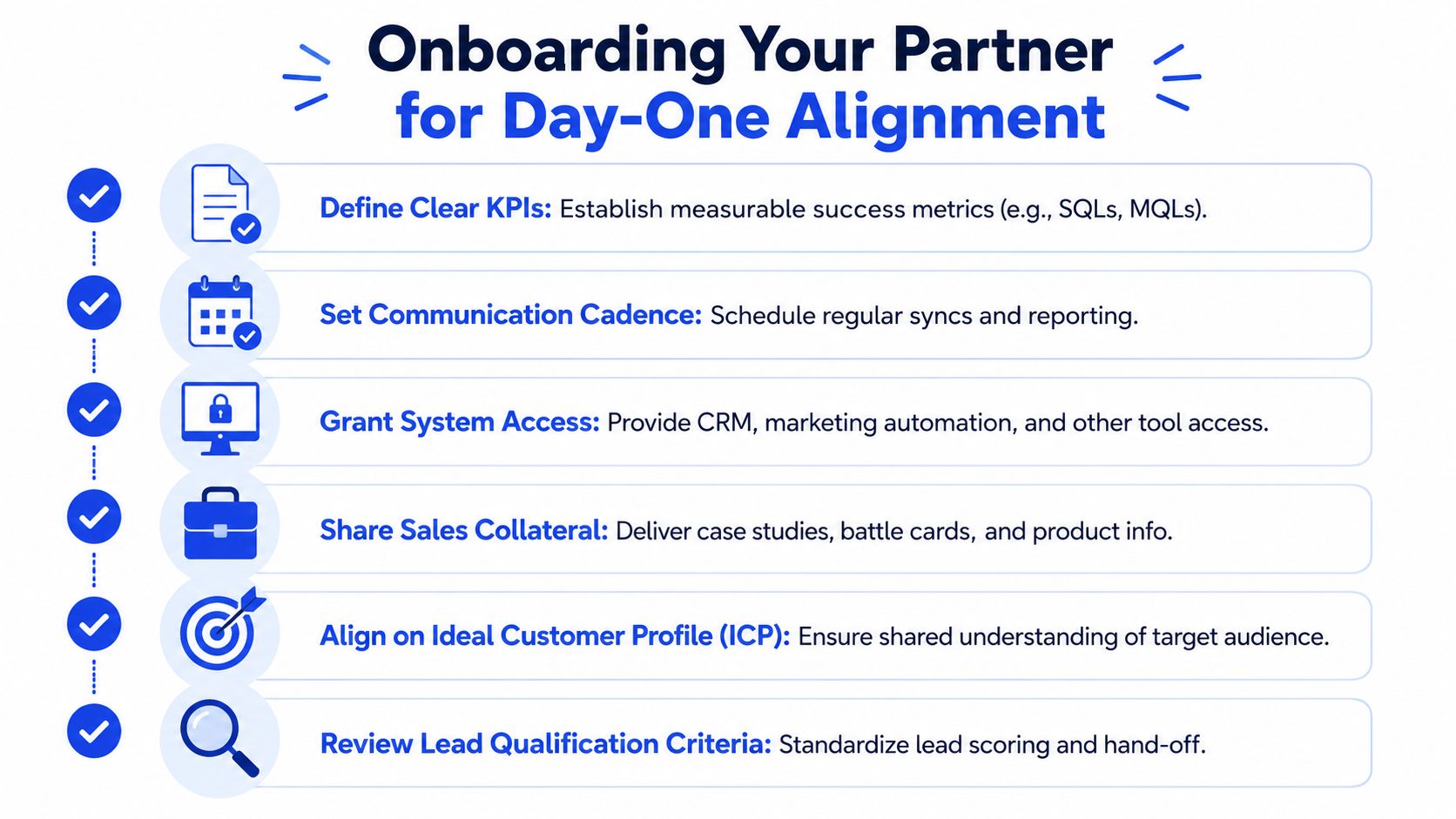
Onboarding your partner for day-one alignment
Most outsourced lead generation failures are already visible in the first month. The contract isn't the hard part. The hard part is whether the client and agency can translate "our ICP is mid-market" into a targeting spec a machine and a human can both execute.
What the first month has to produce
The first 30 days need four outputs. A locked ICP, a message map, a connected tool stack, and written handoff criteria.
The ICP definition often proves to be a challenge. Over 85% of failed outsourced initiatives come from a fuzzy ICP, and when the targeting spec isn't granular enough, outreach conversion rates drop by 60%. The fix is an ICP Calibration Sprint that maps at least 15 data attributes before any list is built, based on the verified benchmark included for this topic.
Use that sprint to force decisions that teams usually postpone. Not "SaaS companies in Europe." More like this: revenue band, headcount range, region, excluded countries, CRM in use, hiring signal, product motion, buyer function, buyer seniority, adjacent functions, regulatory trigger, installed tech, average deal motion, sales model, and current pain pattern.
The 15 attributes to lock before list building
A useful calibration sheet includes these:
Industry segment
Sub-vertical
Company size
Revenue band
Geography
Excluded geographies
Primary persona
Secondary persona
Seniority floor
Tech stack marker
Commercial trigger
Operational trigger
Compliance or regulatory trigger
Disqualifiers
SQL handoff rule
For an iGaming SaaS motion, that might include risk and compliance leaders, companies responding to regulatory changes, and accounts with visible hiring in governance or operations. For manufacturing, the trigger layer often sits closer to capacity changes, expansions, distributor shifts, or event follow-up.
Here's the test. Can the agency build the first list without asking what "mid-market" means? If yes, your inputs are probably concrete enough.
A shared alignment framework matters as much as the targeting itself, especially when sales and marketing interpret lead quality differently. This guide on sales and marketing alignment is worth passing around internally before kickoff.
Close the integration gap early
The other hidden failure is process integration. Teams blame the agency, but the primary issue is usually that replies, statuses, and qualification notes don't flow cleanly into the systems your sales team already lives in.
Set up the stack on day one:
CRM first: HubSpot or Salesforce must be the source of truth for lifecycle stages and attribution notes.
Outbound layer: Tools like Smartlead, Instantly, Lemlist, or HeyReach should map statuses back to CRM fields.
Shared channel: A Slack channel should handle exceptions, wrong-fit meetings, and message approvals fast.
Bi-weekly sprint review: Review segment drift, reply themes, and next sequence changes on a fixed rhythm.
A short visual helps keep that checklist grounded.
If the agency works in one dashboard and your AEs work in another, someone will start making decisions from partial data.
The best onboarding periods feel slow to impatient buyers. That's normal. The work is mostly invisible at first, but it's what stops bad-fit meetings from hitting your calendar later.
Managing the engagement for predictable results
Once the machine is live, leaders usually make one of two mistakes. They either ignore the account until month end, or they inspect every daily fluctuation and force changes before enough data exists. Both create bad outcomes.
Weekly beats daily
Daily monitoring sounds disciplined, but it usually creates noise. A few booked meetings or one bad-fit reply doesn't tell you whether targeting is drifting. Weekly review does.
That matters because 40% of leads from traditional providers fail the budget or interest qualification check upon handoff, and when SaaS conversion rates sit around 3.2%, the difference between raw volume and a qualified conversation is everything, based on the verified data for this topic.
Operator note: Review every reply in real time for obvious fit. Review campaign quality weekly. Review pipeline progression monthly. Those are different jobs.
If your team needs a clean KPI framework before you build your own reporting sheet, MetricsWatch's explanation of lead generation KPIs is a solid external reference.
What to review each week
Don't start with open rates. Start with fit and movement.
Weekly check | What to look for | What it usually means |
|---|---|---|
ICP match | Are booked meetings inside your size, role, industry, and geography rules? | Drift in targeting or weak qualification |
Meeting quality | Do notes show pain, timing, and decision relevance? | Message map quality |
Sales acceptance | Are AEs accepting or rejecting handoffs? | Misaligned SQL criteria |
Opportunity progression | Which meetings move past first call? | Real buying intent versus polite curiosity |
Segment pattern | Which ICP clusters produce cleaner meetings? | Where to double down |
For workflow, keep it simple. Pull the prior week's meetings from HubSpot. Check role, company fit, and source context. Tag each one accepted, borderline, or wrong-fit. Then compare by segment instead of by rep. That keeps the discussion grounded.
For teams formalizing this process, this sales pipeline management guide gives a useful structure for stage definitions and review cadence.
Feedback an agency can act on
Bad feedback sounds like this: "Lead quality feels off."
Good feedback sounds like this:
Role mismatch: Too many director-level contacts when the agreed buyer is VP and above.
Company size drift: Meetings are landing below target account size.
Weak trigger relevance: Replies are positive, but discovery shows no active project.
Messaging issue: Prospects engage on one pain angle and ignore the rest.
That kind of feedback gives the agency something to fix in Clay filters, Sales Navigator searches, sequence branching, or handoff rules. It also forces your own team to be specific, which is healthy.
The honest ROI timeline from day 0 to day 180
A client signs on Monday and asks on Friday why there are no meetings yet. That conversation happens more often than agencies admit. The first 180 days follow a pretty consistent pattern, and teams that expect revenue before the system is set up usually make the wrong call too early.

Days 0 to 21
This period is operational, not commercial. Domains need warming. ICP rules need to be fixed in writing. Message angles need approval. HubSpot or Salesforce needs the right source fields, routing, and attribution logic. Lists need QA. Calendars, enrichment tools, and sequence infrastructure need testing.
No healthy program produces meaningful ROI here. Spend starts immediately. Pipeline does not.
If an agency promises booked meetings in week one, one of two things is usually true. They are using old infrastructure that was not built for your account, or they are skipping setup steps that protect deliverability and meeting quality later.
Days 21 to 90
The first useful signal usually shows up between day 21 and day 35. For a well-scoped outbound program, that often means 2 to 5 qualified meetings, enough to judge response quality, not enough to judge financial return.
From day 35 to day 60, volume starts to normalize. Many programs settle into 8 to 18 meetings per month, depending on list size, channel mix, and how narrow the ICP is. A narrow enterprise motion may sit at the lower end and still be healthy. A broader mid-market motion should usually produce more.
By day 60 to day 90, shorter sales cycles can start to convert. That is why day 90 is the first fair ROI checkpoint for many outsourced lead generation engagements. Day 30 only tells you whether the engine started.
If you need a practical benchmark for what to measure during this window, these lead generation KPI definitions help separate activity from pipeline contribution.
Automation also affects this period more than clients expect. Sequence logic, routing, lead enrichment, CRM hygiene, and follow-up speed all shape return. This piece on unlocking true value from marketing automation is useful context if you want to understand why outreach performance depends on the system around it, not just the copy.
Days 90 to 180
Engagement becomes easier to judge. By now, you have enough reply data to know which pain points pull meetings, which segments waste volume, and whether AEs are converting agency-sourced calls into real opportunities.
Across well-fit accounts, this is often the window where ROI moves from theoretical to visible. Attribution is cleaner. Sales has adapted to the flow. The agency has enough feedback to cut weak segments, tighten triggers, and put more volume behind the buyers who progress.
The timing still depends heavily on business model:
B2B SaaS with €25k+ ACV: Break-even often lands around day 75 to 100, then around 5x ROI by month 6 and 8x by month 12
Professional services with €50k+ project values: Break-even is often day 60 to 90, then around 6x by month 6 and 10x by month 12
Manufacturing with 90 to 180 day cycles: Break-even often shifts to month 5 to 7, with around 4x by month 12
Lower ACV B2B under €12k average deal: Many programs stall at 2x to 3x, even by month 12, because the margin for poor targeting or slow follow-up is too small
The uncomfortable truth is that outsourced lead generation rarely fails because the agency booked zero meetings. It fails because the economics never had room to work, the client took 10 days to follow up, or the target market was too broad to produce repeatable buying intent.
What top-end and typical results look like
A high-end example from our portfolio came from a B2B SaaS company in the iGaming space, roughly 50 employees, selling into compliance and risk operations leaders. The campaign ran for 8 months at roughly €11,600 per month, made up of €8,400 for outbound and €3,200 for LinkedIn content support.
The program booked 134 qualified meetings, created 67 qualified opportunities, and closed 11 deals during the engagement, with 4 more deals closing in the following 4 months. Total attributable closed revenue was roughly €1.24M ARR across 15 deals, with roughly €620k still active in late-stage pipeline. Total agency spend was €92,800, producing roughly 13.4x direct ROI and about 16.2x including post-engagement closes and expected late-stage value.
That result sat at the top end for a reason. The average deal value was roughly €83k ARR. The founder posted on LinkedIn 2 to 3 times per week. Triggering included regulatory changes and event signals like ICE Barcelona. The AE team got proposals out in 5 to 7 days. Strong agency execution helped, but the client-side operating discipline mattered just as much.
A more typical strong result looked different. One B2B SaaS client with roughly €35k average ACV ran for 6 months, spent roughly €45k, booked 78 qualified meetings, closed 6 deals, and produced roughly €210k in closed revenue. That worked out to roughly 4.7x direct ROI, or roughly 5.9x when active pipeline was included at expected close rates.
That is the standard to use. Judge the program on whether the math is credible by month six, not on whether month one felt exciting.
The final check your sales cycle length
Outsourced lead generation often adds pipeline while making your blended sales cycle look longer. That's not a contradiction. It's what happens when outbound surfaces earlier-stage buyers than referrals and inbound usually do.
Measure the trade-off correctly
The market is moving this way for a reason. The global B2B lead generation market is projected to reach $32.85 billion by 2035, and that growth sits alongside a basic tension in B2B demand creation. 91% of B2B marketers rank lead generation as their top priority, while 58% say it's their biggest challenge, according to Cirrus Insight's lead generation statistics.
The right comparison isn't "Did the cycle get shorter?" The right comparison is "Did total revenue improve at an acceptable cycle length?" For SaaS, legal tech, pharma, iGaming, and manufacturing, outbound-sourced deals often take longer because those buyers entered earlier. That's normal.
Audit one thing this Friday. Pull your last 20 closed-won deals and add a CRM column for meeting-to-close days by source. Separate inbound, referral, partner, and outbound. That's the baseline you need before you judge any outsourced lead generation partner.
GROU works with B2B teams globally that need structure behind LinkedIn content, outbound, and lead generation instead of disconnected activity. The method is simple, one message, one target list, one reporting line, run in bi-weekly sprints so attention turns into pipeline.
Your pipeline isn't empty because your team forgot to prospect. It's empty because the motion is unstable. One month your SDRs book meetings, the next month they're buried in follow-ups, hiring, CRM cleanup, or territory changes. When leaders start looking at outsourced lead generation, the question isn't cost. It's whether an external team can add structure without creating a black box.
Outsourcing usually wins when ACV supports the math and your internal sales team can convert meetings
The agency choice matters less than the operating model, especially ICP discipline and channel coordination
The first 30 days decide whether the engagement becomes pipeline or noise
ROI is usually negative early, visible by day 90, and judged fairly at day 180
Table of Contents
The decision framework for outsourcing lead generation
A VP Sales hires an agency in January because pipeline is light. By March, the agency has booked meetings, but the account executives are slow to follow up, the ICP is still being debated, and leadership is asking why revenue has not moved yet. That is the true outsourcing decision. It is not just a sourcing question. It is an operating model question.
Start with the cost and ramp math
The cleanest first pass is still cost, speed, and management load. In-house lead generation typically costs $20,000 to $30,000 per month, while outsourced programs usually sit at $6,000 to $15,000 per month. Internal teams also often need 3 to 6 months to get established, while outsourced providers can start in 2 to 4 weeks, according to Callbox's cost comparison.
Those ranges are directionally useful, but they hide where teams get burned. An internal SDR function is not just base salary plus commission. It usually includes Sales Navigator, sequencing software, data vendors, inbox setup, list QA, call recording, coaching time, manager review, and the hours your sales lead spends fixing reply handling and message quality. An agency bundle can look cheaper because those pieces are wrapped into one retainer. It can also look better on paper than it performs if your team cannot process meetings fast enough.
Use one simple test. If your team needs pipeline in the next 30 to 60 days, outsourcing can create speed. If your team needs message discovery, offer refinement, or founder-led customer learning, keep that work closer to home first.
If you need a refresher on how the lead generation process fits together before you model delivery options, MakeAutomation's lead generation guide is a useful reference because it breaks the motion into stages instead of treating it as one line item.
Build the decision from your unit economics
Model the decision the way RevOps would. Start with monthly spend, expected qualified meetings, show rate, opportunity rate, close rate, and your average sales cycle. Then stress-test it.
Factor | Favors outsourcing | Favors internal |
|---|---|---|
ACV | Mid to high ACV deals where one closed deal can cover a meaningful share of monthly spend | Lower ACV where outbound margin stays thin |
Urgency | Pipeline needs to improve this quarter | You can absorb a hiring and ramp period |
Internal management bandwidth | Leadership cannot take on another hiring, QA, and coaching layer | You already have SDR leadership and process control |
ICP maturity | You know the verticals, titles, and pain points that convert | You are still testing who buys and why |
Sales follow-up discipline | AEs accept meetings fast and work them inside the CRM | Leads sit untouched or recycled without feedback |
Here is the blunt version. Outsourcing works best when the offer already sells and the bottleneck is top-of-funnel execution.
For SaaS, that usually means ACV is high enough that one or two new deals per quarter can justify a retainer. For professional services, the math can work even faster if project values are large and sales leadership can run a tight follow-up process. For manufacturing, outsourced outbound can still work, but the return often lands later because buying groups are larger, qualification takes longer, and revenue realization lags the meeting count.
Practical rule: If ACV is low, ICP is still fuzzy, and account executives are inconsistent on follow-up, outsourced lead generation will not repair the revenue model. It will expose the weak points faster.
That is why vendor comparison is only a small part of the decision. Teams often spend more time comparing agency websites than checking whether reps respond to booked meetings within 24 hours, whether Salesforce fields are ready for attribution, or whether HubSpot lifecycle stages are clean enough to measure outcome quality. Those details decide whether the program earns a second quarter.
For teams comparing the category, this breakdown of lead generation companies is useful as a category map. Use it after you have confirmed the economics and handoff process can support external execution.
The practical yes and no
Outsource when these conditions are already true:
Your ACV supports paid outbound. A realistic number of closed deals can pay back monthly program cost.
Your offer is understood by the market. Prospects do not need a founder on every first call to explain what you do.
Your CRM and handoff process are usable. Meetings can be routed, accepted, worked, and measured without cleanup every week.
Your sales team responds fast. Same-day follow-up is the standard, not the exception.
Keep it internal for now when these conditions are true:
You are still finding the message. The learning loop needs to stay close to product, founder, or sales leadership.
Your sales cycle is long and cash is tight. You may create activity now and still wait months for revenue proof.
Your team wants the agency to compensate for poor execution downstream. No partner can fix slow follow-up, weak discovery, or bad close management.
In iGaming, SaaS, manufacturing, legal tech, and pharma, I see the same pattern. Outsourcing performs well when the company already knows who it wants, what pain it solves, and how sales will handle demand once it appears. When those basics are unsettled, the agency does not fail alone. The operating model fails with it.
How to select the right agency partner
Most agencies shouldn't make your shortlist. The right partner is the one running a coordinated multi-channel system, not the one promising more meetings from a single channel.
The verdict
Choose the agency that can prove it runs a Converged Engine. That means LinkedIn outreach, email sequences, and targeted content sharing are coordinated inside a 24 to 48 hour window. Programs built this way produce 43% higher outcome volumes than in-house efforts, while single-channel tactics can cut reach by 70%. Those are the numbers that matter from the benchmark included in the verified data.
That operating model fits how real buyers behave. A compliance lead in iGaming might ignore your first email, notice the founder's LinkedIn post later, then reply when the second touch references the earlier interaction. If those touches aren't coordinated, the momentum dies.
Questions that expose the real operating model
Ask these in the sales call and don't accept fluffy answers:
How do you sequence LinkedIn, email, and content touches? If they can't describe timing across channels, they probably run channel silos.
What happens inside the first 48 hours after a prospect engages? You want a defined follow-up path, not "the SDR handles it."
How do you score lead quality before handoff? Look for engagement plus demographic fit, not just reply volume.
How do you handle tool orchestration? Good answers mention systems like Apollo, Clay, Lemlist, Instantly, Smartlead, HeyReach, HubSpot, and Sales Navigator in one connected workflow.
How do you report on lead source and progression? If reporting stops at booked meetings, you'll lose visibility where it matters.
A serious partner should be able to explain whether Clay enriches the list, whether Apollo or Sales Navigator feeds segmentation, whether HeyReach handles LinkedIn steps, whether Smartlead or Instantly handles sending, and how HubSpot receives statuses and notes. That's normal operating detail, not technical theater.
Agencies that sell "meetings booked" without explaining the qualification gate are usually selling calendar volume.
If you're comparing service models, this review of what a lead generation agency should actually do is a good benchmark.
Pricing model to prefer
Retainer plus qualification rules is usually the cleanest model.
Pay-per-meeting sounds aligned, but it often pushes the vendor toward softer qualification. Pure commission sounds attractive, but in B2B it usually creates attribution fights and bad behavior around handoff. A monthly retainer tied to written ICP rules, SQL criteria, and reporting discipline gives both sides room to run the motion properly.
GROU is one example of the integrated model. It runs LinkedIn content, lead generation, and outbound in one system so the message, list, and reporting line stay connected. That structure is usually stronger than buying disconnected services from different vendors.
Onboarding your partner for day-one alignment
Most outsourced lead generation failures are already visible in the first month. The contract isn't the hard part. The hard part is whether the client and agency can translate "our ICP is mid-market" into a targeting spec a machine and a human can both execute.
What the first month has to produce
The first 30 days need four outputs. A locked ICP, a message map, a connected tool stack, and written handoff criteria.
The ICP definition often proves to be a challenge. Over 85% of failed outsourced initiatives come from a fuzzy ICP, and when the targeting spec isn't granular enough, outreach conversion rates drop by 60%. The fix is an ICP Calibration Sprint that maps at least 15 data attributes before any list is built, based on the verified benchmark included for this topic.
Use that sprint to force decisions that teams usually postpone. Not "SaaS companies in Europe." More like this: revenue band, headcount range, region, excluded countries, CRM in use, hiring signal, product motion, buyer function, buyer seniority, adjacent functions, regulatory trigger, installed tech, average deal motion, sales model, and current pain pattern.
The 15 attributes to lock before list building
A useful calibration sheet includes these:
Industry segment
Sub-vertical
Company size
Revenue band
Geography
Excluded geographies
Primary persona
Secondary persona
Seniority floor
Tech stack marker
Commercial trigger
Operational trigger
Compliance or regulatory trigger
Disqualifiers
SQL handoff rule
For an iGaming SaaS motion, that might include risk and compliance leaders, companies responding to regulatory changes, and accounts with visible hiring in governance or operations. For manufacturing, the trigger layer often sits closer to capacity changes, expansions, distributor shifts, or event follow-up.
Here's the test. Can the agency build the first list without asking what "mid-market" means? If yes, your inputs are probably concrete enough.
A shared alignment framework matters as much as the targeting itself, especially when sales and marketing interpret lead quality differently. This guide on sales and marketing alignment is worth passing around internally before kickoff.
Close the integration gap early
The other hidden failure is process integration. Teams blame the agency, but the primary issue is usually that replies, statuses, and qualification notes don't flow cleanly into the systems your sales team already lives in.
Set up the stack on day one:
CRM first: HubSpot or Salesforce must be the source of truth for lifecycle stages and attribution notes.
Outbound layer: Tools like Smartlead, Instantly, Lemlist, or HeyReach should map statuses back to CRM fields.
Shared channel: A Slack channel should handle exceptions, wrong-fit meetings, and message approvals fast.
Bi-weekly sprint review: Review segment drift, reply themes, and next sequence changes on a fixed rhythm.
A short visual helps keep that checklist grounded.
If the agency works in one dashboard and your AEs work in another, someone will start making decisions from partial data.
The best onboarding periods feel slow to impatient buyers. That's normal. The work is mostly invisible at first, but it's what stops bad-fit meetings from hitting your calendar later.
Managing the engagement for predictable results
Once the machine is live, leaders usually make one of two mistakes. They either ignore the account until month end, or they inspect every daily fluctuation and force changes before enough data exists. Both create bad outcomes.
Weekly beats daily
Daily monitoring sounds disciplined, but it usually creates noise. A few booked meetings or one bad-fit reply doesn't tell you whether targeting is drifting. Weekly review does.
That matters because 40% of leads from traditional providers fail the budget or interest qualification check upon handoff, and when SaaS conversion rates sit around 3.2%, the difference between raw volume and a qualified conversation is everything, based on the verified data for this topic.
Operator note: Review every reply in real time for obvious fit. Review campaign quality weekly. Review pipeline progression monthly. Those are different jobs.
If your team needs a clean KPI framework before you build your own reporting sheet, MetricsWatch's explanation of lead generation KPIs is a solid external reference.
What to review each week
Don't start with open rates. Start with fit and movement.
Weekly check | What to look for | What it usually means |
|---|---|---|
ICP match | Are booked meetings inside your size, role, industry, and geography rules? | Drift in targeting or weak qualification |
Meeting quality | Do notes show pain, timing, and decision relevance? | Message map quality |
Sales acceptance | Are AEs accepting or rejecting handoffs? | Misaligned SQL criteria |
Opportunity progression | Which meetings move past first call? | Real buying intent versus polite curiosity |
Segment pattern | Which ICP clusters produce cleaner meetings? | Where to double down |
For workflow, keep it simple. Pull the prior week's meetings from HubSpot. Check role, company fit, and source context. Tag each one accepted, borderline, or wrong-fit. Then compare by segment instead of by rep. That keeps the discussion grounded.
For teams formalizing this process, this sales pipeline management guide gives a useful structure for stage definitions and review cadence.
Feedback an agency can act on
Bad feedback sounds like this: "Lead quality feels off."
Good feedback sounds like this:
Role mismatch: Too many director-level contacts when the agreed buyer is VP and above.
Company size drift: Meetings are landing below target account size.
Weak trigger relevance: Replies are positive, but discovery shows no active project.
Messaging issue: Prospects engage on one pain angle and ignore the rest.
That kind of feedback gives the agency something to fix in Clay filters, Sales Navigator searches, sequence branching, or handoff rules. It also forces your own team to be specific, which is healthy.
The honest ROI timeline from day 0 to day 180
A client signs on Monday and asks on Friday why there are no meetings yet. That conversation happens more often than agencies admit. The first 180 days follow a pretty consistent pattern, and teams that expect revenue before the system is set up usually make the wrong call too early.
Days 0 to 21
This period is operational, not commercial. Domains need warming. ICP rules need to be fixed in writing. Message angles need approval. HubSpot or Salesforce needs the right source fields, routing, and attribution logic. Lists need QA. Calendars, enrichment tools, and sequence infrastructure need testing.
No healthy program produces meaningful ROI here. Spend starts immediately. Pipeline does not.
If an agency promises booked meetings in week one, one of two things is usually true. They are using old infrastructure that was not built for your account, or they are skipping setup steps that protect deliverability and meeting quality later.
Days 21 to 90
The first useful signal usually shows up between day 21 and day 35. For a well-scoped outbound program, that often means 2 to 5 qualified meetings, enough to judge response quality, not enough to judge financial return.
From day 35 to day 60, volume starts to normalize. Many programs settle into 8 to 18 meetings per month, depending on list size, channel mix, and how narrow the ICP is. A narrow enterprise motion may sit at the lower end and still be healthy. A broader mid-market motion should usually produce more.
By day 60 to day 90, shorter sales cycles can start to convert. That is why day 90 is the first fair ROI checkpoint for many outsourced lead generation engagements. Day 30 only tells you whether the engine started.
If you need a practical benchmark for what to measure during this window, these lead generation KPI definitions help separate activity from pipeline contribution.
Automation also affects this period more than clients expect. Sequence logic, routing, lead enrichment, CRM hygiene, and follow-up speed all shape return. This piece on unlocking true value from marketing automation is useful context if you want to understand why outreach performance depends on the system around it, not just the copy.
Days 90 to 180
Engagement becomes easier to judge. By now, you have enough reply data to know which pain points pull meetings, which segments waste volume, and whether AEs are converting agency-sourced calls into real opportunities.
Across well-fit accounts, this is often the window where ROI moves from theoretical to visible. Attribution is cleaner. Sales has adapted to the flow. The agency has enough feedback to cut weak segments, tighten triggers, and put more volume behind the buyers who progress.
The timing still depends heavily on business model:
B2B SaaS with €25k+ ACV: Break-even often lands around day 75 to 100, then around 5x ROI by month 6 and 8x by month 12
Professional services with €50k+ project values: Break-even is often day 60 to 90, then around 6x by month 6 and 10x by month 12
Manufacturing with 90 to 180 day cycles: Break-even often shifts to month 5 to 7, with around 4x by month 12
Lower ACV B2B under €12k average deal: Many programs stall at 2x to 3x, even by month 12, because the margin for poor targeting or slow follow-up is too small
The uncomfortable truth is that outsourced lead generation rarely fails because the agency booked zero meetings. It fails because the economics never had room to work, the client took 10 days to follow up, or the target market was too broad to produce repeatable buying intent.
What top-end and typical results look like
A high-end example from our portfolio came from a B2B SaaS company in the iGaming space, roughly 50 employees, selling into compliance and risk operations leaders. The campaign ran for 8 months at roughly €11,600 per month, made up of €8,400 for outbound and €3,200 for LinkedIn content support.
The program booked 134 qualified meetings, created 67 qualified opportunities, and closed 11 deals during the engagement, with 4 more deals closing in the following 4 months. Total attributable closed revenue was roughly €1.24M ARR across 15 deals, with roughly €620k still active in late-stage pipeline. Total agency spend was €92,800, producing roughly 13.4x direct ROI and about 16.2x including post-engagement closes and expected late-stage value.
That result sat at the top end for a reason. The average deal value was roughly €83k ARR. The founder posted on LinkedIn 2 to 3 times per week. Triggering included regulatory changes and event signals like ICE Barcelona. The AE team got proposals out in 5 to 7 days. Strong agency execution helped, but the client-side operating discipline mattered just as much.
A more typical strong result looked different. One B2B SaaS client with roughly €35k average ACV ran for 6 months, spent roughly €45k, booked 78 qualified meetings, closed 6 deals, and produced roughly €210k in closed revenue. That worked out to roughly 4.7x direct ROI, or roughly 5.9x when active pipeline was included at expected close rates.
That is the standard to use. Judge the program on whether the math is credible by month six, not on whether month one felt exciting.
The final check your sales cycle length
Outsourced lead generation often adds pipeline while making your blended sales cycle look longer. That's not a contradiction. It's what happens when outbound surfaces earlier-stage buyers than referrals and inbound usually do.
Measure the trade-off correctly
The market is moving this way for a reason. The global B2B lead generation market is projected to reach $32.85 billion by 2035, and that growth sits alongside a basic tension in B2B demand creation. 91% of B2B marketers rank lead generation as their top priority, while 58% say it's their biggest challenge, according to Cirrus Insight's lead generation statistics.
The right comparison isn't "Did the cycle get shorter?" The right comparison is "Did total revenue improve at an acceptable cycle length?" For SaaS, legal tech, pharma, iGaming, and manufacturing, outbound-sourced deals often take longer because those buyers entered earlier. That's normal.
Audit one thing this Friday. Pull your last 20 closed-won deals and add a CRM column for meeting-to-close days by source. Separate inbound, referral, partner, and outbound. That's the baseline you need before you judge any outsourced lead generation partner.
GROU works with B2B teams globally that need structure behind LinkedIn content, outbound, and lead generation instead of disconnected activity. The method is simple, one message, one target list, one reporting line, run in bi-weekly sprints so attention turns into pipeline.
Your pipeline isn't empty because your team forgot to prospect. It's empty because the motion is unstable. One month your SDRs book meetings, the next month they're buried in follow-ups, hiring, CRM cleanup, or territory changes. When leaders start looking at outsourced lead generation, the question isn't cost. It's whether an external team can add structure without creating a black box.
Outsourcing usually wins when ACV supports the math and your internal sales team can convert meetings
The agency choice matters less than the operating model, especially ICP discipline and channel coordination
The first 30 days decide whether the engagement becomes pipeline or noise
ROI is usually negative early, visible by day 90, and judged fairly at day 180
Table of Contents
The decision framework for outsourcing lead generation
A VP Sales hires an agency in January because pipeline is light. By March, the agency has booked meetings, but the account executives are slow to follow up, the ICP is still being debated, and leadership is asking why revenue has not moved yet. That is the true outsourcing decision. It is not just a sourcing question. It is an operating model question.
Start with the cost and ramp math
The cleanest first pass is still cost, speed, and management load. In-house lead generation typically costs $20,000 to $30,000 per month, while outsourced programs usually sit at $6,000 to $15,000 per month. Internal teams also often need 3 to 6 months to get established, while outsourced providers can start in 2 to 4 weeks, according to Callbox's cost comparison.
Those ranges are directionally useful, but they hide where teams get burned. An internal SDR function is not just base salary plus commission. It usually includes Sales Navigator, sequencing software, data vendors, inbox setup, list QA, call recording, coaching time, manager review, and the hours your sales lead spends fixing reply handling and message quality. An agency bundle can look cheaper because those pieces are wrapped into one retainer. It can also look better on paper than it performs if your team cannot process meetings fast enough.
Use one simple test. If your team needs pipeline in the next 30 to 60 days, outsourcing can create speed. If your team needs message discovery, offer refinement, or founder-led customer learning, keep that work closer to home first.
If you need a refresher on how the lead generation process fits together before you model delivery options, MakeAutomation's lead generation guide is a useful reference because it breaks the motion into stages instead of treating it as one line item.
Build the decision from your unit economics
Model the decision the way RevOps would. Start with monthly spend, expected qualified meetings, show rate, opportunity rate, close rate, and your average sales cycle. Then stress-test it.
Factor | Favors outsourcing | Favors internal |
|---|---|---|
ACV | Mid to high ACV deals where one closed deal can cover a meaningful share of monthly spend | Lower ACV where outbound margin stays thin |
Urgency | Pipeline needs to improve this quarter | You can absorb a hiring and ramp period |
Internal management bandwidth | Leadership cannot take on another hiring, QA, and coaching layer | You already have SDR leadership and process control |
ICP maturity | You know the verticals, titles, and pain points that convert | You are still testing who buys and why |
Sales follow-up discipline | AEs accept meetings fast and work them inside the CRM | Leads sit untouched or recycled without feedback |
Here is the blunt version. Outsourcing works best when the offer already sells and the bottleneck is top-of-funnel execution.
For SaaS, that usually means ACV is high enough that one or two new deals per quarter can justify a retainer. For professional services, the math can work even faster if project values are large and sales leadership can run a tight follow-up process. For manufacturing, outsourced outbound can still work, but the return often lands later because buying groups are larger, qualification takes longer, and revenue realization lags the meeting count.
Practical rule: If ACV is low, ICP is still fuzzy, and account executives are inconsistent on follow-up, outsourced lead generation will not repair the revenue model. It will expose the weak points faster.
That is why vendor comparison is only a small part of the decision. Teams often spend more time comparing agency websites than checking whether reps respond to booked meetings within 24 hours, whether Salesforce fields are ready for attribution, or whether HubSpot lifecycle stages are clean enough to measure outcome quality. Those details decide whether the program earns a second quarter.
For teams comparing the category, this breakdown of lead generation companies is useful as a category map. Use it after you have confirmed the economics and handoff process can support external execution.
The practical yes and no
Outsource when these conditions are already true:
Your ACV supports paid outbound. A realistic number of closed deals can pay back monthly program cost.
Your offer is understood by the market. Prospects do not need a founder on every first call to explain what you do.
Your CRM and handoff process are usable. Meetings can be routed, accepted, worked, and measured without cleanup every week.
Your sales team responds fast. Same-day follow-up is the standard, not the exception.
Keep it internal for now when these conditions are true:
You are still finding the message. The learning loop needs to stay close to product, founder, or sales leadership.
Your sales cycle is long and cash is tight. You may create activity now and still wait months for revenue proof.
Your team wants the agency to compensate for poor execution downstream. No partner can fix slow follow-up, weak discovery, or bad close management.
In iGaming, SaaS, manufacturing, legal tech, and pharma, I see the same pattern. Outsourcing performs well when the company already knows who it wants, what pain it solves, and how sales will handle demand once it appears. When those basics are unsettled, the agency does not fail alone. The operating model fails with it.
How to select the right agency partner
Most agencies shouldn't make your shortlist. The right partner is the one running a coordinated multi-channel system, not the one promising more meetings from a single channel.
The verdict
Choose the agency that can prove it runs a Converged Engine. That means LinkedIn outreach, email sequences, and targeted content sharing are coordinated inside a 24 to 48 hour window. Programs built this way produce 43% higher outcome volumes than in-house efforts, while single-channel tactics can cut reach by 70%. Those are the numbers that matter from the benchmark included in the verified data.
That operating model fits how real buyers behave. A compliance lead in iGaming might ignore your first email, notice the founder's LinkedIn post later, then reply when the second touch references the earlier interaction. If those touches aren't coordinated, the momentum dies.
Questions that expose the real operating model
Ask these in the sales call and don't accept fluffy answers:
How do you sequence LinkedIn, email, and content touches? If they can't describe timing across channels, they probably run channel silos.
What happens inside the first 48 hours after a prospect engages? You want a defined follow-up path, not "the SDR handles it."
How do you score lead quality before handoff? Look for engagement plus demographic fit, not just reply volume.
How do you handle tool orchestration? Good answers mention systems like Apollo, Clay, Lemlist, Instantly, Smartlead, HeyReach, HubSpot, and Sales Navigator in one connected workflow.
How do you report on lead source and progression? If reporting stops at booked meetings, you'll lose visibility where it matters.
A serious partner should be able to explain whether Clay enriches the list, whether Apollo or Sales Navigator feeds segmentation, whether HeyReach handles LinkedIn steps, whether Smartlead or Instantly handles sending, and how HubSpot receives statuses and notes. That's normal operating detail, not technical theater.
Agencies that sell "meetings booked" without explaining the qualification gate are usually selling calendar volume.
If you're comparing service models, this review of what a lead generation agency should actually do is a good benchmark.
Pricing model to prefer
Retainer plus qualification rules is usually the cleanest model.
Pay-per-meeting sounds aligned, but it often pushes the vendor toward softer qualification. Pure commission sounds attractive, but in B2B it usually creates attribution fights and bad behavior around handoff. A monthly retainer tied to written ICP rules, SQL criteria, and reporting discipline gives both sides room to run the motion properly.
GROU is one example of the integrated model. It runs LinkedIn content, lead generation, and outbound in one system so the message, list, and reporting line stay connected. That structure is usually stronger than buying disconnected services from different vendors.
Onboarding your partner for day-one alignment
Most outsourced lead generation failures are already visible in the first month. The contract isn't the hard part. The hard part is whether the client and agency can translate "our ICP is mid-market" into a targeting spec a machine and a human can both execute.
What the first month has to produce
The first 30 days need four outputs. A locked ICP, a message map, a connected tool stack, and written handoff criteria.
The ICP definition often proves to be a challenge. Over 85% of failed outsourced initiatives come from a fuzzy ICP, and when the targeting spec isn't granular enough, outreach conversion rates drop by 60%. The fix is an ICP Calibration Sprint that maps at least 15 data attributes before any list is built, based on the verified benchmark included for this topic.
Use that sprint to force decisions that teams usually postpone. Not "SaaS companies in Europe." More like this: revenue band, headcount range, region, excluded countries, CRM in use, hiring signal, product motion, buyer function, buyer seniority, adjacent functions, regulatory trigger, installed tech, average deal motion, sales model, and current pain pattern.
The 15 attributes to lock before list building
A useful calibration sheet includes these:
Industry segment
Sub-vertical
Company size
Revenue band
Geography
Excluded geographies
Primary persona
Secondary persona
Seniority floor
Tech stack marker
Commercial trigger
Operational trigger
Compliance or regulatory trigger
Disqualifiers
SQL handoff rule
For an iGaming SaaS motion, that might include risk and compliance leaders, companies responding to regulatory changes, and accounts with visible hiring in governance or operations. For manufacturing, the trigger layer often sits closer to capacity changes, expansions, distributor shifts, or event follow-up.
Here's the test. Can the agency build the first list without asking what "mid-market" means? If yes, your inputs are probably concrete enough.
A shared alignment framework matters as much as the targeting itself, especially when sales and marketing interpret lead quality differently. This guide on sales and marketing alignment is worth passing around internally before kickoff.
Close the integration gap early
The other hidden failure is process integration. Teams blame the agency, but the primary issue is usually that replies, statuses, and qualification notes don't flow cleanly into the systems your sales team already lives in.
Set up the stack on day one:
CRM first: HubSpot or Salesforce must be the source of truth for lifecycle stages and attribution notes.
Outbound layer: Tools like Smartlead, Instantly, Lemlist, or HeyReach should map statuses back to CRM fields.
Shared channel: A Slack channel should handle exceptions, wrong-fit meetings, and message approvals fast.
Bi-weekly sprint review: Review segment drift, reply themes, and next sequence changes on a fixed rhythm.
A short visual helps keep that checklist grounded.
If the agency works in one dashboard and your AEs work in another, someone will start making decisions from partial data.
The best onboarding periods feel slow to impatient buyers. That's normal. The work is mostly invisible at first, but it's what stops bad-fit meetings from hitting your calendar later.
Managing the engagement for predictable results
Once the machine is live, leaders usually make one of two mistakes. They either ignore the account until month end, or they inspect every daily fluctuation and force changes before enough data exists. Both create bad outcomes.
Weekly beats daily
Daily monitoring sounds disciplined, but it usually creates noise. A few booked meetings or one bad-fit reply doesn't tell you whether targeting is drifting. Weekly review does.
That matters because 40% of leads from traditional providers fail the budget or interest qualification check upon handoff, and when SaaS conversion rates sit around 3.2%, the difference between raw volume and a qualified conversation is everything, based on the verified data for this topic.
Operator note: Review every reply in real time for obvious fit. Review campaign quality weekly. Review pipeline progression monthly. Those are different jobs.
If your team needs a clean KPI framework before you build your own reporting sheet, MetricsWatch's explanation of lead generation KPIs is a solid external reference.
What to review each week
Don't start with open rates. Start with fit and movement.
Weekly check | What to look for | What it usually means |
|---|---|---|
ICP match | Are booked meetings inside your size, role, industry, and geography rules? | Drift in targeting or weak qualification |
Meeting quality | Do notes show pain, timing, and decision relevance? | Message map quality |
Sales acceptance | Are AEs accepting or rejecting handoffs? | Misaligned SQL criteria |
Opportunity progression | Which meetings move past first call? | Real buying intent versus polite curiosity |
Segment pattern | Which ICP clusters produce cleaner meetings? | Where to double down |
For workflow, keep it simple. Pull the prior week's meetings from HubSpot. Check role, company fit, and source context. Tag each one accepted, borderline, or wrong-fit. Then compare by segment instead of by rep. That keeps the discussion grounded.
For teams formalizing this process, this sales pipeline management guide gives a useful structure for stage definitions and review cadence.
Feedback an agency can act on
Bad feedback sounds like this: "Lead quality feels off."
Good feedback sounds like this:
Role mismatch: Too many director-level contacts when the agreed buyer is VP and above.
Company size drift: Meetings are landing below target account size.
Weak trigger relevance: Replies are positive, but discovery shows no active project.
Messaging issue: Prospects engage on one pain angle and ignore the rest.
That kind of feedback gives the agency something to fix in Clay filters, Sales Navigator searches, sequence branching, or handoff rules. It also forces your own team to be specific, which is healthy.
The honest ROI timeline from day 0 to day 180
A client signs on Monday and asks on Friday why there are no meetings yet. That conversation happens more often than agencies admit. The first 180 days follow a pretty consistent pattern, and teams that expect revenue before the system is set up usually make the wrong call too early.
Days 0 to 21
This period is operational, not commercial. Domains need warming. ICP rules need to be fixed in writing. Message angles need approval. HubSpot or Salesforce needs the right source fields, routing, and attribution logic. Lists need QA. Calendars, enrichment tools, and sequence infrastructure need testing.
No healthy program produces meaningful ROI here. Spend starts immediately. Pipeline does not.
If an agency promises booked meetings in week one, one of two things is usually true. They are using old infrastructure that was not built for your account, or they are skipping setup steps that protect deliverability and meeting quality later.
Days 21 to 90
The first useful signal usually shows up between day 21 and day 35. For a well-scoped outbound program, that often means 2 to 5 qualified meetings, enough to judge response quality, not enough to judge financial return.
From day 35 to day 60, volume starts to normalize. Many programs settle into 8 to 18 meetings per month, depending on list size, channel mix, and how narrow the ICP is. A narrow enterprise motion may sit at the lower end and still be healthy. A broader mid-market motion should usually produce more.
By day 60 to day 90, shorter sales cycles can start to convert. That is why day 90 is the first fair ROI checkpoint for many outsourced lead generation engagements. Day 30 only tells you whether the engine started.
If you need a practical benchmark for what to measure during this window, these lead generation KPI definitions help separate activity from pipeline contribution.
Automation also affects this period more than clients expect. Sequence logic, routing, lead enrichment, CRM hygiene, and follow-up speed all shape return. This piece on unlocking true value from marketing automation is useful context if you want to understand why outreach performance depends on the system around it, not just the copy.
Days 90 to 180
Engagement becomes easier to judge. By now, you have enough reply data to know which pain points pull meetings, which segments waste volume, and whether AEs are converting agency-sourced calls into real opportunities.
Across well-fit accounts, this is often the window where ROI moves from theoretical to visible. Attribution is cleaner. Sales has adapted to the flow. The agency has enough feedback to cut weak segments, tighten triggers, and put more volume behind the buyers who progress.
The timing still depends heavily on business model:
B2B SaaS with €25k+ ACV: Break-even often lands around day 75 to 100, then around 5x ROI by month 6 and 8x by month 12
Professional services with €50k+ project values: Break-even is often day 60 to 90, then around 6x by month 6 and 10x by month 12
Manufacturing with 90 to 180 day cycles: Break-even often shifts to month 5 to 7, with around 4x by month 12
Lower ACV B2B under €12k average deal: Many programs stall at 2x to 3x, even by month 12, because the margin for poor targeting or slow follow-up is too small
The uncomfortable truth is that outsourced lead generation rarely fails because the agency booked zero meetings. It fails because the economics never had room to work, the client took 10 days to follow up, or the target market was too broad to produce repeatable buying intent.
What top-end and typical results look like
A high-end example from our portfolio came from a B2B SaaS company in the iGaming space, roughly 50 employees, selling into compliance and risk operations leaders. The campaign ran for 8 months at roughly €11,600 per month, made up of €8,400 for outbound and €3,200 for LinkedIn content support.
The program booked 134 qualified meetings, created 67 qualified opportunities, and closed 11 deals during the engagement, with 4 more deals closing in the following 4 months. Total attributable closed revenue was roughly €1.24M ARR across 15 deals, with roughly €620k still active in late-stage pipeline. Total agency spend was €92,800, producing roughly 13.4x direct ROI and about 16.2x including post-engagement closes and expected late-stage value.
That result sat at the top end for a reason. The average deal value was roughly €83k ARR. The founder posted on LinkedIn 2 to 3 times per week. Triggering included regulatory changes and event signals like ICE Barcelona. The AE team got proposals out in 5 to 7 days. Strong agency execution helped, but the client-side operating discipline mattered just as much.
A more typical strong result looked different. One B2B SaaS client with roughly €35k average ACV ran for 6 months, spent roughly €45k, booked 78 qualified meetings, closed 6 deals, and produced roughly €210k in closed revenue. That worked out to roughly 4.7x direct ROI, or roughly 5.9x when active pipeline was included at expected close rates.
That is the standard to use. Judge the program on whether the math is credible by month six, not on whether month one felt exciting.
The final check your sales cycle length
Outsourced lead generation often adds pipeline while making your blended sales cycle look longer. That's not a contradiction. It's what happens when outbound surfaces earlier-stage buyers than referrals and inbound usually do.
Measure the trade-off correctly
The market is moving this way for a reason. The global B2B lead generation market is projected to reach $32.85 billion by 2035, and that growth sits alongside a basic tension in B2B demand creation. 91% of B2B marketers rank lead generation as their top priority, while 58% say it's their biggest challenge, according to Cirrus Insight's lead generation statistics.
The right comparison isn't "Did the cycle get shorter?" The right comparison is "Did total revenue improve at an acceptable cycle length?" For SaaS, legal tech, pharma, iGaming, and manufacturing, outbound-sourced deals often take longer because those buyers entered earlier. That's normal.
Audit one thing this Friday. Pull your last 20 closed-won deals and add a CRM column for meeting-to-close days by source. Separate inbound, referral, partner, and outbound. That's the baseline you need before you judge any outsourced lead generation partner.
GROU works with B2B teams globally that need structure behind LinkedIn content, outbound, and lead generation instead of disconnected activity. The method is simple, one message, one target list, one reporting line, run in bi-weekly sprints so attention turns into pipeline.
Pipeline OS Newsletter
Build qualified pipeline
Get weekly tactics to generate demand, improve lead quality, and book more meetings.





Trusted by industry leaders
Trusted by industry leaders
Trusted by industry leaders
Ready to build qualified pipeline?
Ready to build qualified pipeline?
Ready to build qualified pipeline?
Book a call to see if we're the right fit, or take the 2-minute quiz to get a clear starting point.
Book a call to see if we're the right fit, or take the 2-minute quiz to get a clear starting point.
Book a call to see if we're the right fit, or take the 2-minute quiz to get a clear starting point.
" height="30.21639343089746px" id="hfGbXmQR2" width="30.216393430897455px"/></svg>)
Copyright © 2026 – All Right Reserved
Copyright © 2026 – All Right Reserved
Copyright © 2026 – All Right Reserved