%22%3E%3C/path%3E%3Cpath d=%22M 63.072 7.554 C 62.258 8.022 61.577 8.689 61.092 9.493 L 61.092 7.076 L 57.158 7.076 L 57.158 22.64 L 61.089 22.64 L 61.089 14.888 C 61.089 13.446 61.403 12.434 62.03 11.853 C 62.818 11.218 63.818 10.907 64.826 10.982 L 65.868 10.982 L 65.868 6.851 C 64.891 6.834 63.926 7.076 63.073 7.554 Z%22 fill=%22rgb(17,17,17)%22%3E%3C/path%3E%3Cpath d=%22M 78.916 7.82 C 76.363 6.49 73.321 6.49 70.768 7.82 C 69.562 8.473 68.564 9.451 67.888 10.644 C 67.167 11.931 66.803 13.387 66.834 14.862 C 66.804 16.332 67.157 17.785 67.86 19.077 C 68.515 20.267 69.494 21.246 70.684 21.901 C 71.924 22.576 73.318 22.92 74.73 22.898 C 76.164 22.918 77.58 22.575 78.846 21.901 C 80.062 21.247 81.073 20.27 81.768 19.077 C 82.506 17.797 82.88 16.339 82.85 14.862 C 82.88 13.389 82.517 11.934 81.797 10.647 C 81.12 9.455 80.122 8.477 78.917 7.824 M 78.803 14.862 C 78.829 15.739 78.636 16.608 78.241 17.391 C 77.903 18.046 77.38 18.588 76.738 18.95 C 76.124 19.293 75.432 19.472 74.729 19.47 C 73.668 19.497 72.648 19.061 71.934 18.276 C 71.139 17.323 70.741 16.1 70.823 14.862 C 70.741 13.62 71.149 12.395 71.959 11.45 C 72.687 10.667 73.715 10.233 74.783 10.256 C 75.859 10.236 76.894 10.67 77.635 11.45 C 78.464 12.387 78.884 13.616 78.801 14.864%22 fill=%22rgb(17,17,17)%22%3E%3C/path%3E%3Cpath d=%22M 95.906 7.076 L 95.906 15.646 C 95.975 16.68 95.643 17.701 94.979 18.498 C 94.311 19.184 93.379 19.547 92.422 19.495 C 91.475 19.544 90.553 19.18 89.894 18.498 C 89.23 17.701 88.898 16.68 88.967 15.646 L 88.967 7.076 L 85.033 7.076 L 85.033 16.207 C 85 17.449 85.275 18.68 85.834 19.79 C 86.327 20.75 87.095 21.542 88.039 22.065 C 89.033 22.594 90.145 22.861 91.271 22.838 C 92.188 22.847 93.095 22.65 93.926 22.263 C 94.708 21.905 95.388 21.36 95.906 20.675 L 95.906 22.645 L 99.865 22.645 L 99.865 7.076 Z%22 fill=%22rgb(17,17,17)%22%3E%3C/path%3E%3Cpath d=%22M 4.513 15.626 C 4.511 10.815 7.606 6.549 12.181 5.059 C 16.756 3.57 21.77 5.195 24.601 9.086 L 27.816 5.87 C 24.074 1.186 17.981 -0.943 12.137 0.393 C 6.292 1.728 1.728 6.292 0.393 12.137 C -0.943 17.981 1.186 24.074 5.87 27.816 L 9.085 24.601 C 6.214 22.512 4.515 19.177 4.513 15.626%22 fill=%22rgb(32,62,235)%22%3E%3C/path%3E%3Cpath d=%22M 17.114 14.343 L 13.354 18.01 L 13.354 18.026 L 21.071 18.026 L 11.412 27.609 L 17.389 27.609 L 23.999 21.081 L 23.999 28.316 L 24.005 28.316 L 27.967 24.393 L 27.967 14.343 Z%22 fill=%22rgb(32,62,235)%22%3E%3C/path%3E%3C/g%3E%3C/svg%3E) ×
× ××
××›
›
›
›
LinkedIn SSI score in 2026: does the social selling index still matter for B2B?
LinkedIn SSI score in 2026: does the social selling index still matter for B2B?
LinkedIn SSI score in 2026: does the social selling index still matter for B2B?
LinkedIn SSI score in 2026: does the social selling index still matter for B2B?
LinkedIn SSI score in 2026: does the social selling index still matter for B2B?
LinkedIn SSI score in 2026: does the social selling index still matter for B2B?

Author
Aljaz Peklaj

Your team was told to improve its Social Selling Index score, and that's usually where LinkedIn work starts going sideways. Reps start commenting for the sake of commenting, leaders stare at a platform number, and nobody can explain why qualified meetings still look flat.
SSI is a platform activity score, not a revenue dashboard
The metric is easy to game and hard to trust
The right LinkedIn system starts with profile conversion, then content, then selective network growth
Track six operating metrics that connect to conversations, meetings, and pipeline instead
Table of Contents
Your SSI score is probably a distraction
Most advice on the social selling index score treats it like a leading indicator of sales performance. I don't buy that. If a metric pushes your team toward busywork, weakens targeting, and gives leadership a neat number with no line to revenue, it belongs in the same bucket as other vanity metrics.
The problem isn't that LinkedIn activity doesn't matter. It does. The problem is that SSI wraps useful activities and useless ones into one score, then invites teams to chase the score instead of the outcome. That's how reps end up sending broad connection requests, dropping generic comments, and spending more time feeding the platform than building pipeline.
I've seen this pattern in iGaming, SaaS, manufacturing, legal tech, and pharma. The accounts that generate real conversations usually aren't the ones behaving like they're in a contest for platform points.
Practical rule: If your team can't explain how a metric connects to ICP-fit conversations, meeting-held rate, or pipeline creation, stop putting it on the scoreboard.
SSI can still be useful in one narrow sense. It shows what LinkedIn wants users to do more often. That makes it a decent diagnostic for platform behavior. It makes a poor operating target for a revenue team.
What the social selling index score measures
SSI is LinkedIn's behavior score. It is not a revenue score.
The system gives you a total from 0 to 100, broken into four buckets that cap at 25 points each. LinkedIn updates it based on recent platform activity, and the dashboard shows which bucket is rising or stalling. Useful for diagnosis. Weak as a management KPI.
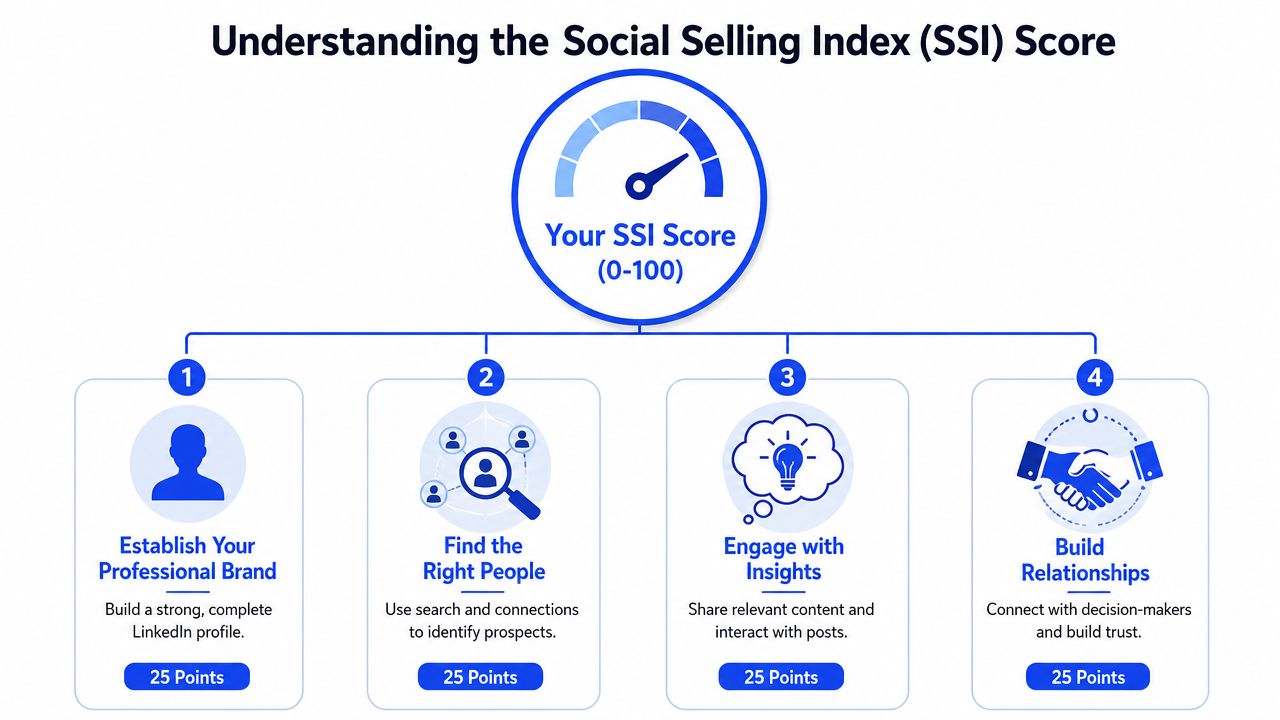
How LinkedIn structures the score
Here's what LinkedIn is grading:
Establishing a professional brand: profile completeness, posting activity, and visible credibility signals
Finding the right people: search behavior, account selection, and prospecting activity, often inside Sales Navigator
Engaging with insights: posting, commenting, sharing, and other content interactions
Building relationships: connection growth, message responsiveness, and ongoing interaction with your network
None of that is controversial. Revenue teams should care about profile quality, targeting, useful content, and real conversations. The problem is the packaging. Once those behaviors get rolled into one score, teams start optimizing for platform points instead of the lead generation KPIs that show whether LinkedIn is producing pipeline.
That distinction matters in practice. A rep can raise the "engaging with insights" pillar by commenting more often, but if those comments never lead to profile views from the right accounts, booked meetings, or replies from buying groups, the activity is cosmetic. I have seen SDR teams spend an hour a day on this and still miss quota because nobody checked whether the activity touched opportunities.
Where to find your score
If you want to check it, use LinkedIn's SSI dashboard while logged in. It shows your total and the four-pillar breakdown.
The operational takeaway is simple. Use the dashboard to spot behavior patterns, not to judge performance. If one pillar is low, ask which workflow is broken. Is the profile weak? Is Sales Navigator targeting sloppy? Are reps posting without a point of view? Are connection requests generic? Fix the workflow inside your CRM, Sales Navigator lists, content calendar, and outreach process. Do not turn SSI into the target.
Why your SSI score doesn't predict pipeline
High SSI and weak revenue can sit side by side for months. I've seen reps post every day, comment on every prospect thread, push their score up, and still produce nothing that a VP of Sales would count as pipeline.

The reason is simple. SSI measures platform-friendly behavior, not buying intent, deal progression, or account penetration. A seller can look active inside LinkedIn and still fail at the work that creates revenue: starting conversations with the right people, getting replies, booking meetings, and turning those meetings into qualified opportunities.
SSI tracks activity. Pipeline depends on conversion.
Revenue teams need to measure movement across a funnel. SSI compresses a handful of behaviors into one score and hides the trade-offs. That makes it a poor operating metric.
A rep can improve SSI by spending more time on actions like:
sending more connection requests
commenting more often on posts
posting more frequently
using Sales Navigator features more heavily
None of those actions are bad on their own. They become a problem when the team stops asking what happened after the activity. Did target accounts view the profile? Did accepted connections turn into DM conversations? Did DMs turn into meetings? Did meetings create pipeline in HubSpot or Salesforce? If you are not reviewing those steps, you are managing motion, not outcomes.
That is why I would rather track a short set of lead generation KPIs tied to response rates, meetings, and sourced pipeline than watch one composite score move up and down.
The score hides what actually deserves time
SSI also creates a black box problem. You can see the pillar labels, but you cannot manage a team well from labels alone.
A frontline manager needs to know which workflow is broken. Is the list bad in Sales Navigator? Are reps sending generic connection notes through Expandi or HeyReach? Is content getting reactions from peers instead of buyers? Are profile visits coming from students, recruiters, and vendors instead of target accounts? SSI does not answer any of that.
That gap matters in weekly reviews. Good operators inspect conversion points inside the system they already use. Sales Navigator for account lists. LinkedIn analytics for profile views and post clicks. Shield or Inlytics for content quality signals. HubSpot or Salesforce for source, meeting outcomes, and opportunity creation. SSI sits above all of that and tells you almost nothing about where to intervene.
LinkedIn's incentives are not your incentives
LinkedIn wants more usage. Your team needs more revenue.
Those goals overlap sometimes. They are not the same. A metric built inside the platform will naturally reward behavior that keeps people active inside the platform. That should make any revenue leader skeptical.
The same skepticism applies to broad creator advice about follower growth and monetization. If your goal is pipeline, you should filter that advice hard, even if it sounds attractive in guides on how to earn money from social media. B2B teams do not need more visibility for its own sake. They need visibility from buying committees inside target accounts.
That is the core issue with SSI. It flatters effort. It does not prove commercial impact.
A high score can mean a seller has built good habits. It can also mean they got very efficient at looking busy on LinkedIn while the CRM stays empty.
The 6 LinkedIn metrics that connect to revenue
SSI gives sales teams a clean number to admire. Revenue teams need a scoreboard they can act on.
If you are going to replace SSI, replace it with metrics that map to buyer movement. Keep the set small. Review it weekly for execution problems, monthly for trend lines, and quarterly against sourced pipeline and closed revenue.
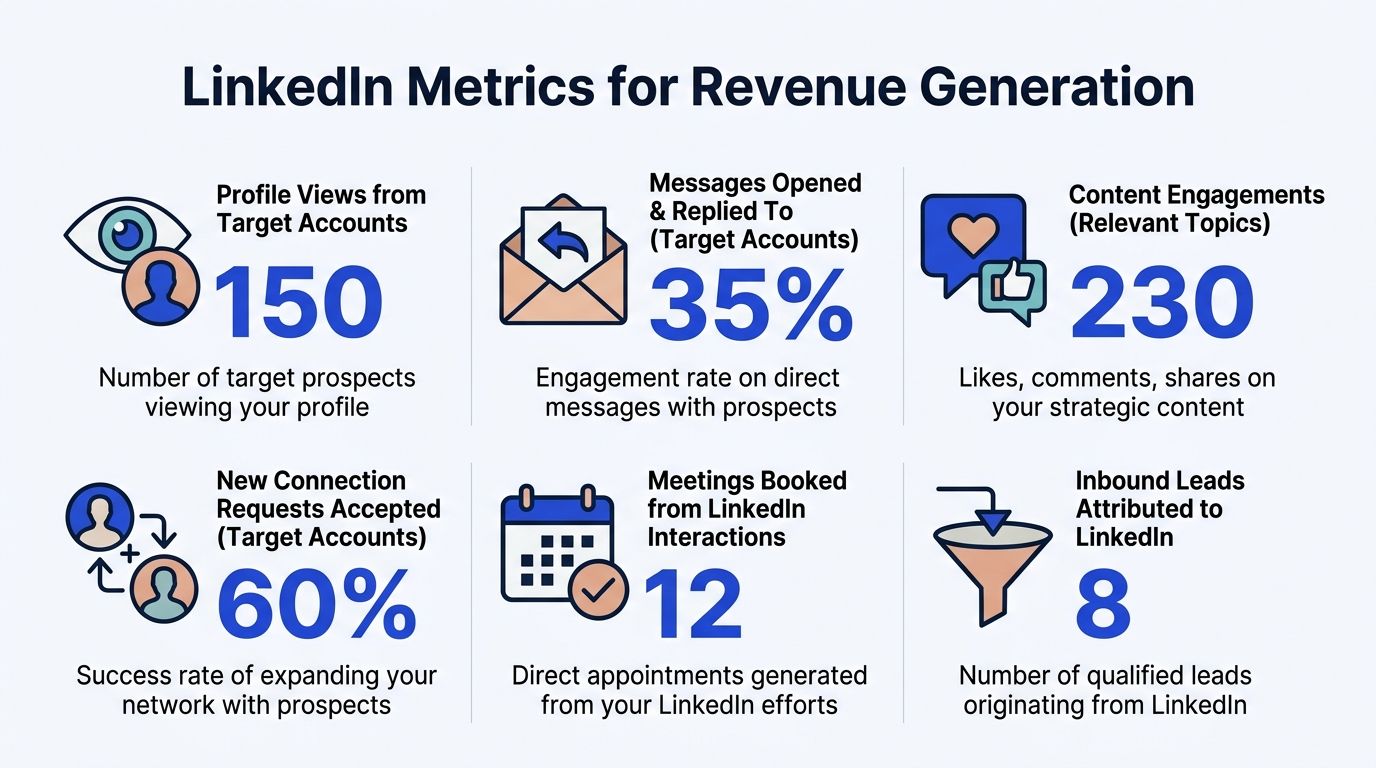
What belongs on the dashboard
Use one operating table. If a metric does not help a manager coach better outreach, better content, or better follow-up, cut it.
Metric | Why it matters | Where to track it |
|---|---|---|
Inbound DMs from ICP-fit prospects | Proves your profile and content are attracting buyers, not random attention | Native LinkedIn analytics, HubSpot notes |
Profile views from target companies | Shows whether the right accounts are checking you out after posts, comments, or outbound activity | LinkedIn profile analytics |
Connection request acceptance rate | Exposes list quality, profile credibility, and targeting discipline | Sales Navigator, HeyReach, manual tracking |
Reply rate on outbound LinkedIn DMs | Shows whether your opener is relevant enough to start a sales conversation | HubSpot, Google Sheets, outreach logs |
Quality content engagement | Saves, profile clicks, and thoughtful comments signal buying interest better than likes | LinkedIn analytics, Shield Analytics, Inlytics |
Pipeline value from LinkedIn-sourced conversations | Confirms whether the whole motion produces real commercial outcomes | HubSpot attribution, Salesforce campaign influence, CRM source tracking |
This is the filter I use. Ignore broad attention metrics unless they correlate with one of the six above. Impressions can rise while pipeline stays flat. Follower growth can look healthy while every new contact sits outside your ICP. Activity volume is the easiest metric to fake in a weekly meeting.
How to track them without building reporting theater
My preferred stack is plain because complicated reporting usually hides weak execution.
Sales Navigator for account lists, buyer tracking, and rep-level targeting
Native LinkedIn analytics for profile views, post clicks, and engagement detail
Shield or Inlytics for content signals that matter
Clay for enrichment and list cleanup before outreach starts
HeyReach for controlled LinkedIn outbound across multiple sender accounts
HubSpot or Salesforce for source capture, meeting outcomes, opportunity creation, and pipeline value
Google Sheets for one weekly scorecard the whole team can inspect in 10 minutes
The workflow matters more than the tool list. Every Monday, pull inbound DMs, target-account profile views, acceptance rates, reply rates, and LinkedIn-sourced pipeline into one sheet. Then inspect outliers. If profile views are up but inbound DMs are dead, fix the profile. If acceptance rate is weak, fix targeting. If replies are weak, rewrite the opener. If engagement looks healthy but no opportunities appear in CRM, your content is attracting spectators instead of buyers.
Teams building a creator-led motion can still learn from broader monetization playbooks. This guide on how to earn money from social media is useful because it ties attention to monetization paths instead of platform scores.
If organic demand is part of your go-to-market, document the playbook. A clear LinkedIn content strategy for pipeline generation should sit beside the dashboard so reps know what to post, who to engage, and what action each metric should trigger.
A pipeline-first framework for LinkedIn activity
Start with revenue mechanics, not SSI. Platform scores reward activity that looks productive. Revenue comes from a tighter chain: the right buyers see you, your profile converts curiosity into trust, your outreach gets replies, and those conversations turn into meetings and pipeline.
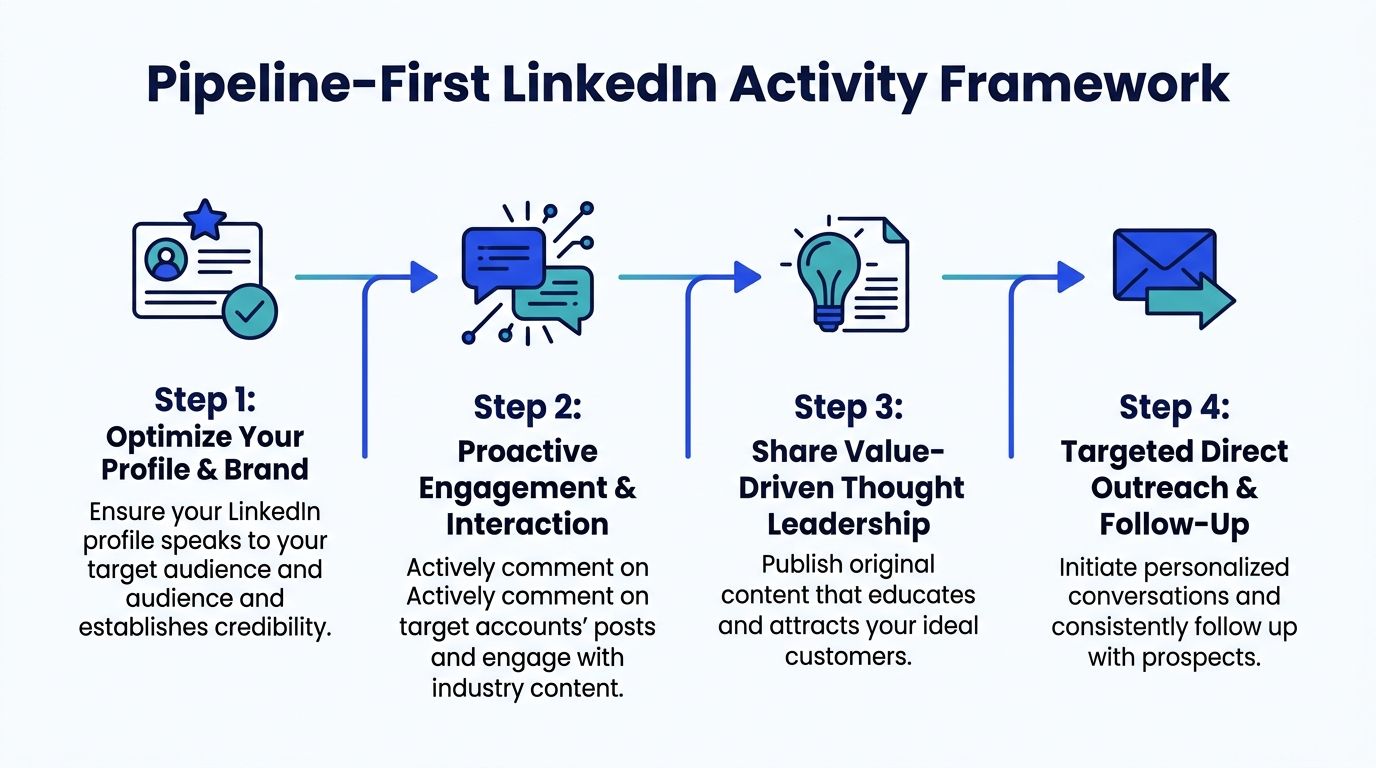
Priority 1, fix the profile before you publish
Your profile is a sales asset. Treat it like a landing page for warm B2B traffic.
A prospect clicks after seeing a post, a comment, or a connection request. They make a decision fast. Can this person help me? Do they understand my problem? Is there proof behind the pitch? If your profile misses those answers, every impression upstream loses value.
Use a simple rebuild sequence:
Rewrite the headline around the buyer problem and outcome.
Rewrite the About section so it explains who you help, what changes after working with you, and why your view is credible.
Edit experience entries to show commercial results, buying context, and scope.
Clean up the Featured section with proof assets. Case studies, a strong call recording clip, a sharp teardown, a category point of view.
Remove clutter that does not help a buyer say yes to a conversation.
Skip decorative optimization. A complete profile is not the goal. A profile that improves acceptance rates, inbound DMs, and reply rates is the goal.
If I were auditing a team, I would check the headline, banner, About section, and Featured section first. Then I would compare profile views against connection acceptance and DM reply rate inside Sales Navigator, Shield, and HubSpot. That workflow exposes profile problems fast.
Priority 2, publish on a cadence your team can sustain
Content earns attention only if it builds buyer confidence. Posting for reach alone is how teams drift into vanity metrics.
For a founder, AE, or sales-led marketer, two to three strong posts a week is enough. The standard is simple. Every post should do one of three jobs: sharpen your category position, show how you solve a real commercial problem, or create a reason for a qualified buyer to start a conversation.
Write posts that use real operating detail:
Trade-offs from recent GTM decisions
Screenshots or breakdowns from actual workflows
Commentary tied to buyer pain, budget pressure, stalled deals, or implementation risk
Specific tools and handoffs, such as Clay for account cleanup, Apollo for contact sourcing, Sales Navigator for targeting, and HubSpot for attribution
Weak content gets applause from peers. Strong content gets profile clicks from buyers and better conversion in outbound sequences.
It also improves what happens after the first call. Buyers who have seen your thinking need less persuasion when you send a proposal. These Encelade B2B proposal strategies are useful if your handoff from LinkedIn conversation to commercial document still feels loose.
Priority 3, build the right network
Network growth matters after the profile and content can do their job.
Do not chase broad audience growth. Build density inside accounts and segments that can buy, influence, refer, or expand distribution in your market. That means ICP prospects, buying committee members, consultants with deal access, channel partners, and a small number of respected operators your buyers already trust.
A working setup looks like this. Build target account lists in Clay or your CRM. Check fit in Sales Navigator. Send connection requests in controlled batches. Tag by segment, account tier, and role. Then review acceptance rate by audience slice, not as one blended number.
That is how you find out whether your targeting is sharp or sloppy.
Priority 4, engage with intent
Comments and reactions are useful only when they create commercial context. Random engagement routines waste rep time and teach nothing.
Pick a defined set of accounts each week. Track who is posting, who is active in comments, and who signals a live problem. Leave comments that show expertise, not agreement. Then follow through. If a stakeholder reacts, views your profile, or responds to a comment thread, route that signal into outreach and log the outcome in HubSpot or Salesforce.
A simple weekly motion works well:
Select target accounts and stakeholders
Monitor posts and comment threads from those accounts
Add a few high-quality comments where your team has real authority
Trigger outreach only when there is a credible reason to contact
Record meetings, disqualifications, and opportunity creation in CRM
This order matters because each layer supports the next. A sharp profile improves connection acceptance. Good content improves profile conversion. A focused network raises the odds that the right people see your posts. Intentional engagement creates context for outreach that does not feel cold.
If your team needs the full operating model, this guide on LinkedIn lead generation for B2B pipeline is the framework I would hand to a sales leader before changing rep behavior.
Your next step is an audit not an optimization
Stop asking how to improve your social selling index score by ten points. Ask what LinkedIn produced in the last 30 days.
Block time this Friday and run a simple audit. Open a sheet. Pull six fields for each rep or founder account, inbound DMs from ICP-fit prospects, profile views from target companies, connection acceptance rate, reply rate on first LinkedIn DM, quality engagement on recent posts, and LinkedIn-sourced pipeline created. If a number can't be found, that's not failure. That's the first reporting problem to fix.
Don't turn this into a dashboard project. One worksheet is enough for the first pass, and one review rhythm is enough. Weekly for operating movement, monthly for pattern review, quarterly for revenue attribution. If leadership still wants a single number for the board pack, use qualified meetings booked or pipeline created.
Run the audit before you touch posting cadence, connection volume, or comment routines. You need a baseline before you need tactics.
If you want a blunt diagnostic after the audit, run the team through this pipeline score quiz and compare LinkedIn activity quality against actual pipeline output.
Grou works with global B2B teams in iGaming, SaaS, manufacturing, legal tech, pharma, and adjacent categories where LinkedIn attention needs to become qualified conversations, not platform noise.
Our method is simple, structure turns attention into pipeline, by connecting profile positioning, content, outbound, CRM attribution, and review cadence into one operating system.
Your team was told to improve its Social Selling Index score, and that's usually where LinkedIn work starts going sideways. Reps start commenting for the sake of commenting, leaders stare at a platform number, and nobody can explain why qualified meetings still look flat.
SSI is a platform activity score, not a revenue dashboard
The metric is easy to game and hard to trust
The right LinkedIn system starts with profile conversion, then content, then selective network growth
Track six operating metrics that connect to conversations, meetings, and pipeline instead
Table of Contents
Your SSI score is probably a distraction
Most advice on the social selling index score treats it like a leading indicator of sales performance. I don't buy that. If a metric pushes your team toward busywork, weakens targeting, and gives leadership a neat number with no line to revenue, it belongs in the same bucket as other vanity metrics.
The problem isn't that LinkedIn activity doesn't matter. It does. The problem is that SSI wraps useful activities and useless ones into one score, then invites teams to chase the score instead of the outcome. That's how reps end up sending broad connection requests, dropping generic comments, and spending more time feeding the platform than building pipeline.
I've seen this pattern in iGaming, SaaS, manufacturing, legal tech, and pharma. The accounts that generate real conversations usually aren't the ones behaving like they're in a contest for platform points.
Practical rule: If your team can't explain how a metric connects to ICP-fit conversations, meeting-held rate, or pipeline creation, stop putting it on the scoreboard.
SSI can still be useful in one narrow sense. It shows what LinkedIn wants users to do more often. That makes it a decent diagnostic for platform behavior. It makes a poor operating target for a revenue team.
What the social selling index score measures
SSI is LinkedIn's behavior score. It is not a revenue score.
The system gives you a total from 0 to 100, broken into four buckets that cap at 25 points each. LinkedIn updates it based on recent platform activity, and the dashboard shows which bucket is rising or stalling. Useful for diagnosis. Weak as a management KPI.
How LinkedIn structures the score
Here's what LinkedIn is grading:
Establishing a professional brand: profile completeness, posting activity, and visible credibility signals
Finding the right people: search behavior, account selection, and prospecting activity, often inside Sales Navigator
Engaging with insights: posting, commenting, sharing, and other content interactions
Building relationships: connection growth, message responsiveness, and ongoing interaction with your network
None of that is controversial. Revenue teams should care about profile quality, targeting, useful content, and real conversations. The problem is the packaging. Once those behaviors get rolled into one score, teams start optimizing for platform points instead of the lead generation KPIs that show whether LinkedIn is producing pipeline.
That distinction matters in practice. A rep can raise the "engaging with insights" pillar by commenting more often, but if those comments never lead to profile views from the right accounts, booked meetings, or replies from buying groups, the activity is cosmetic. I have seen SDR teams spend an hour a day on this and still miss quota because nobody checked whether the activity touched opportunities.
Where to find your score
If you want to check it, use LinkedIn's SSI dashboard while logged in. It shows your total and the four-pillar breakdown.
The operational takeaway is simple. Use the dashboard to spot behavior patterns, not to judge performance. If one pillar is low, ask which workflow is broken. Is the profile weak? Is Sales Navigator targeting sloppy? Are reps posting without a point of view? Are connection requests generic? Fix the workflow inside your CRM, Sales Navigator lists, content calendar, and outreach process. Do not turn SSI into the target.
Why your SSI score doesn't predict pipeline
High SSI and weak revenue can sit side by side for months. I've seen reps post every day, comment on every prospect thread, push their score up, and still produce nothing that a VP of Sales would count as pipeline.
The reason is simple. SSI measures platform-friendly behavior, not buying intent, deal progression, or account penetration. A seller can look active inside LinkedIn and still fail at the work that creates revenue: starting conversations with the right people, getting replies, booking meetings, and turning those meetings into qualified opportunities.
SSI tracks activity. Pipeline depends on conversion.
Revenue teams need to measure movement across a funnel. SSI compresses a handful of behaviors into one score and hides the trade-offs. That makes it a poor operating metric.
A rep can improve SSI by spending more time on actions like:
sending more connection requests
commenting more often on posts
posting more frequently
using Sales Navigator features more heavily
None of those actions are bad on their own. They become a problem when the team stops asking what happened after the activity. Did target accounts view the profile? Did accepted connections turn into DM conversations? Did DMs turn into meetings? Did meetings create pipeline in HubSpot or Salesforce? If you are not reviewing those steps, you are managing motion, not outcomes.
That is why I would rather track a short set of lead generation KPIs tied to response rates, meetings, and sourced pipeline than watch one composite score move up and down.
The score hides what actually deserves time
SSI also creates a black box problem. You can see the pillar labels, but you cannot manage a team well from labels alone.
A frontline manager needs to know which workflow is broken. Is the list bad in Sales Navigator? Are reps sending generic connection notes through Expandi or HeyReach? Is content getting reactions from peers instead of buyers? Are profile visits coming from students, recruiters, and vendors instead of target accounts? SSI does not answer any of that.
That gap matters in weekly reviews. Good operators inspect conversion points inside the system they already use. Sales Navigator for account lists. LinkedIn analytics for profile views and post clicks. Shield or Inlytics for content quality signals. HubSpot or Salesforce for source, meeting outcomes, and opportunity creation. SSI sits above all of that and tells you almost nothing about where to intervene.
LinkedIn's incentives are not your incentives
LinkedIn wants more usage. Your team needs more revenue.
Those goals overlap sometimes. They are not the same. A metric built inside the platform will naturally reward behavior that keeps people active inside the platform. That should make any revenue leader skeptical.
The same skepticism applies to broad creator advice about follower growth and monetization. If your goal is pipeline, you should filter that advice hard, even if it sounds attractive in guides on how to earn money from social media. B2B teams do not need more visibility for its own sake. They need visibility from buying committees inside target accounts.
That is the core issue with SSI. It flatters effort. It does not prove commercial impact.
A high score can mean a seller has built good habits. It can also mean they got very efficient at looking busy on LinkedIn while the CRM stays empty.
The 6 LinkedIn metrics that connect to revenue
SSI gives sales teams a clean number to admire. Revenue teams need a scoreboard they can act on.
If you are going to replace SSI, replace it with metrics that map to buyer movement. Keep the set small. Review it weekly for execution problems, monthly for trend lines, and quarterly against sourced pipeline and closed revenue.
What belongs on the dashboard
Use one operating table. If a metric does not help a manager coach better outreach, better content, or better follow-up, cut it.
Metric | Why it matters | Where to track it |
|---|---|---|
Inbound DMs from ICP-fit prospects | Proves your profile and content are attracting buyers, not random attention | Native LinkedIn analytics, HubSpot notes |
Profile views from target companies | Shows whether the right accounts are checking you out after posts, comments, or outbound activity | LinkedIn profile analytics |
Connection request acceptance rate | Exposes list quality, profile credibility, and targeting discipline | Sales Navigator, HeyReach, manual tracking |
Reply rate on outbound LinkedIn DMs | Shows whether your opener is relevant enough to start a sales conversation | HubSpot, Google Sheets, outreach logs |
Quality content engagement | Saves, profile clicks, and thoughtful comments signal buying interest better than likes | LinkedIn analytics, Shield Analytics, Inlytics |
Pipeline value from LinkedIn-sourced conversations | Confirms whether the whole motion produces real commercial outcomes | HubSpot attribution, Salesforce campaign influence, CRM source tracking |
This is the filter I use. Ignore broad attention metrics unless they correlate with one of the six above. Impressions can rise while pipeline stays flat. Follower growth can look healthy while every new contact sits outside your ICP. Activity volume is the easiest metric to fake in a weekly meeting.
How to track them without building reporting theater
My preferred stack is plain because complicated reporting usually hides weak execution.
Sales Navigator for account lists, buyer tracking, and rep-level targeting
Native LinkedIn analytics for profile views, post clicks, and engagement detail
Shield or Inlytics for content signals that matter
Clay for enrichment and list cleanup before outreach starts
HeyReach for controlled LinkedIn outbound across multiple sender accounts
HubSpot or Salesforce for source capture, meeting outcomes, opportunity creation, and pipeline value
Google Sheets for one weekly scorecard the whole team can inspect in 10 minutes
The workflow matters more than the tool list. Every Monday, pull inbound DMs, target-account profile views, acceptance rates, reply rates, and LinkedIn-sourced pipeline into one sheet. Then inspect outliers. If profile views are up but inbound DMs are dead, fix the profile. If acceptance rate is weak, fix targeting. If replies are weak, rewrite the opener. If engagement looks healthy but no opportunities appear in CRM, your content is attracting spectators instead of buyers.
Teams building a creator-led motion can still learn from broader monetization playbooks. This guide on how to earn money from social media is useful because it ties attention to monetization paths instead of platform scores.
If organic demand is part of your go-to-market, document the playbook. A clear LinkedIn content strategy for pipeline generation should sit beside the dashboard so reps know what to post, who to engage, and what action each metric should trigger.
A pipeline-first framework for LinkedIn activity
Start with revenue mechanics, not SSI. Platform scores reward activity that looks productive. Revenue comes from a tighter chain: the right buyers see you, your profile converts curiosity into trust, your outreach gets replies, and those conversations turn into meetings and pipeline.
Priority 1, fix the profile before you publish
Your profile is a sales asset. Treat it like a landing page for warm B2B traffic.
A prospect clicks after seeing a post, a comment, or a connection request. They make a decision fast. Can this person help me? Do they understand my problem? Is there proof behind the pitch? If your profile misses those answers, every impression upstream loses value.
Use a simple rebuild sequence:
Rewrite the headline around the buyer problem and outcome.
Rewrite the About section so it explains who you help, what changes after working with you, and why your view is credible.
Edit experience entries to show commercial results, buying context, and scope.
Clean up the Featured section with proof assets. Case studies, a strong call recording clip, a sharp teardown, a category point of view.
Remove clutter that does not help a buyer say yes to a conversation.
Skip decorative optimization. A complete profile is not the goal. A profile that improves acceptance rates, inbound DMs, and reply rates is the goal.
If I were auditing a team, I would check the headline, banner, About section, and Featured section first. Then I would compare profile views against connection acceptance and DM reply rate inside Sales Navigator, Shield, and HubSpot. That workflow exposes profile problems fast.
Priority 2, publish on a cadence your team can sustain
Content earns attention only if it builds buyer confidence. Posting for reach alone is how teams drift into vanity metrics.
For a founder, AE, or sales-led marketer, two to three strong posts a week is enough. The standard is simple. Every post should do one of three jobs: sharpen your category position, show how you solve a real commercial problem, or create a reason for a qualified buyer to start a conversation.
Write posts that use real operating detail:
Trade-offs from recent GTM decisions
Screenshots or breakdowns from actual workflows
Commentary tied to buyer pain, budget pressure, stalled deals, or implementation risk
Specific tools and handoffs, such as Clay for account cleanup, Apollo for contact sourcing, Sales Navigator for targeting, and HubSpot for attribution
Weak content gets applause from peers. Strong content gets profile clicks from buyers and better conversion in outbound sequences.
It also improves what happens after the first call. Buyers who have seen your thinking need less persuasion when you send a proposal. These Encelade B2B proposal strategies are useful if your handoff from LinkedIn conversation to commercial document still feels loose.
Priority 3, build the right network
Network growth matters after the profile and content can do their job.
Do not chase broad audience growth. Build density inside accounts and segments that can buy, influence, refer, or expand distribution in your market. That means ICP prospects, buying committee members, consultants with deal access, channel partners, and a small number of respected operators your buyers already trust.
A working setup looks like this. Build target account lists in Clay or your CRM. Check fit in Sales Navigator. Send connection requests in controlled batches. Tag by segment, account tier, and role. Then review acceptance rate by audience slice, not as one blended number.
That is how you find out whether your targeting is sharp or sloppy.
Priority 4, engage with intent
Comments and reactions are useful only when they create commercial context. Random engagement routines waste rep time and teach nothing.
Pick a defined set of accounts each week. Track who is posting, who is active in comments, and who signals a live problem. Leave comments that show expertise, not agreement. Then follow through. If a stakeholder reacts, views your profile, or responds to a comment thread, route that signal into outreach and log the outcome in HubSpot or Salesforce.
A simple weekly motion works well:
Select target accounts and stakeholders
Monitor posts and comment threads from those accounts
Add a few high-quality comments where your team has real authority
Trigger outreach only when there is a credible reason to contact
Record meetings, disqualifications, and opportunity creation in CRM
This order matters because each layer supports the next. A sharp profile improves connection acceptance. Good content improves profile conversion. A focused network raises the odds that the right people see your posts. Intentional engagement creates context for outreach that does not feel cold.
If your team needs the full operating model, this guide on LinkedIn lead generation for B2B pipeline is the framework I would hand to a sales leader before changing rep behavior.
Your next step is an audit not an optimization
Stop asking how to improve your social selling index score by ten points. Ask what LinkedIn produced in the last 30 days.
Block time this Friday and run a simple audit. Open a sheet. Pull six fields for each rep or founder account, inbound DMs from ICP-fit prospects, profile views from target companies, connection acceptance rate, reply rate on first LinkedIn DM, quality engagement on recent posts, and LinkedIn-sourced pipeline created. If a number can't be found, that's not failure. That's the first reporting problem to fix.
Don't turn this into a dashboard project. One worksheet is enough for the first pass, and one review rhythm is enough. Weekly for operating movement, monthly for pattern review, quarterly for revenue attribution. If leadership still wants a single number for the board pack, use qualified meetings booked or pipeline created.
Run the audit before you touch posting cadence, connection volume, or comment routines. You need a baseline before you need tactics.
If you want a blunt diagnostic after the audit, run the team through this pipeline score quiz and compare LinkedIn activity quality against actual pipeline output.
Grou works with global B2B teams in iGaming, SaaS, manufacturing, legal tech, pharma, and adjacent categories where LinkedIn attention needs to become qualified conversations, not platform noise.
Our method is simple, structure turns attention into pipeline, by connecting profile positioning, content, outbound, CRM attribution, and review cadence into one operating system.
Your team was told to improve its Social Selling Index score, and that's usually where LinkedIn work starts going sideways. Reps start commenting for the sake of commenting, leaders stare at a platform number, and nobody can explain why qualified meetings still look flat.
SSI is a platform activity score, not a revenue dashboard
The metric is easy to game and hard to trust
The right LinkedIn system starts with profile conversion, then content, then selective network growth
Track six operating metrics that connect to conversations, meetings, and pipeline instead
Table of Contents
Your SSI score is probably a distraction
Most advice on the social selling index score treats it like a leading indicator of sales performance. I don't buy that. If a metric pushes your team toward busywork, weakens targeting, and gives leadership a neat number with no line to revenue, it belongs in the same bucket as other vanity metrics.
The problem isn't that LinkedIn activity doesn't matter. It does. The problem is that SSI wraps useful activities and useless ones into one score, then invites teams to chase the score instead of the outcome. That's how reps end up sending broad connection requests, dropping generic comments, and spending more time feeding the platform than building pipeline.
I've seen this pattern in iGaming, SaaS, manufacturing, legal tech, and pharma. The accounts that generate real conversations usually aren't the ones behaving like they're in a contest for platform points.
Practical rule: If your team can't explain how a metric connects to ICP-fit conversations, meeting-held rate, or pipeline creation, stop putting it on the scoreboard.
SSI can still be useful in one narrow sense. It shows what LinkedIn wants users to do more often. That makes it a decent diagnostic for platform behavior. It makes a poor operating target for a revenue team.
What the social selling index score measures
SSI is LinkedIn's behavior score. It is not a revenue score.
The system gives you a total from 0 to 100, broken into four buckets that cap at 25 points each. LinkedIn updates it based on recent platform activity, and the dashboard shows which bucket is rising or stalling. Useful for diagnosis. Weak as a management KPI.
How LinkedIn structures the score
Here's what LinkedIn is grading:
Establishing a professional brand: profile completeness, posting activity, and visible credibility signals
Finding the right people: search behavior, account selection, and prospecting activity, often inside Sales Navigator
Engaging with insights: posting, commenting, sharing, and other content interactions
Building relationships: connection growth, message responsiveness, and ongoing interaction with your network
None of that is controversial. Revenue teams should care about profile quality, targeting, useful content, and real conversations. The problem is the packaging. Once those behaviors get rolled into one score, teams start optimizing for platform points instead of the lead generation KPIs that show whether LinkedIn is producing pipeline.
That distinction matters in practice. A rep can raise the "engaging with insights" pillar by commenting more often, but if those comments never lead to profile views from the right accounts, booked meetings, or replies from buying groups, the activity is cosmetic. I have seen SDR teams spend an hour a day on this and still miss quota because nobody checked whether the activity touched opportunities.
Where to find your score
If you want to check it, use LinkedIn's SSI dashboard while logged in. It shows your total and the four-pillar breakdown.
The operational takeaway is simple. Use the dashboard to spot behavior patterns, not to judge performance. If one pillar is low, ask which workflow is broken. Is the profile weak? Is Sales Navigator targeting sloppy? Are reps posting without a point of view? Are connection requests generic? Fix the workflow inside your CRM, Sales Navigator lists, content calendar, and outreach process. Do not turn SSI into the target.
Why your SSI score doesn't predict pipeline
High SSI and weak revenue can sit side by side for months. I've seen reps post every day, comment on every prospect thread, push their score up, and still produce nothing that a VP of Sales would count as pipeline.
The reason is simple. SSI measures platform-friendly behavior, not buying intent, deal progression, or account penetration. A seller can look active inside LinkedIn and still fail at the work that creates revenue: starting conversations with the right people, getting replies, booking meetings, and turning those meetings into qualified opportunities.
SSI tracks activity. Pipeline depends on conversion.
Revenue teams need to measure movement across a funnel. SSI compresses a handful of behaviors into one score and hides the trade-offs. That makes it a poor operating metric.
A rep can improve SSI by spending more time on actions like:
sending more connection requests
commenting more often on posts
posting more frequently
using Sales Navigator features more heavily
None of those actions are bad on their own. They become a problem when the team stops asking what happened after the activity. Did target accounts view the profile? Did accepted connections turn into DM conversations? Did DMs turn into meetings? Did meetings create pipeline in HubSpot or Salesforce? If you are not reviewing those steps, you are managing motion, not outcomes.
That is why I would rather track a short set of lead generation KPIs tied to response rates, meetings, and sourced pipeline than watch one composite score move up and down.
The score hides what actually deserves time
SSI also creates a black box problem. You can see the pillar labels, but you cannot manage a team well from labels alone.
A frontline manager needs to know which workflow is broken. Is the list bad in Sales Navigator? Are reps sending generic connection notes through Expandi or HeyReach? Is content getting reactions from peers instead of buyers? Are profile visits coming from students, recruiters, and vendors instead of target accounts? SSI does not answer any of that.
That gap matters in weekly reviews. Good operators inspect conversion points inside the system they already use. Sales Navigator for account lists. LinkedIn analytics for profile views and post clicks. Shield or Inlytics for content quality signals. HubSpot or Salesforce for source, meeting outcomes, and opportunity creation. SSI sits above all of that and tells you almost nothing about where to intervene.
LinkedIn's incentives are not your incentives
LinkedIn wants more usage. Your team needs more revenue.
Those goals overlap sometimes. They are not the same. A metric built inside the platform will naturally reward behavior that keeps people active inside the platform. That should make any revenue leader skeptical.
The same skepticism applies to broad creator advice about follower growth and monetization. If your goal is pipeline, you should filter that advice hard, even if it sounds attractive in guides on how to earn money from social media. B2B teams do not need more visibility for its own sake. They need visibility from buying committees inside target accounts.
That is the core issue with SSI. It flatters effort. It does not prove commercial impact.
A high score can mean a seller has built good habits. It can also mean they got very efficient at looking busy on LinkedIn while the CRM stays empty.
The 6 LinkedIn metrics that connect to revenue
SSI gives sales teams a clean number to admire. Revenue teams need a scoreboard they can act on.
If you are going to replace SSI, replace it with metrics that map to buyer movement. Keep the set small. Review it weekly for execution problems, monthly for trend lines, and quarterly against sourced pipeline and closed revenue.
What belongs on the dashboard
Use one operating table. If a metric does not help a manager coach better outreach, better content, or better follow-up, cut it.
Metric | Why it matters | Where to track it |
|---|---|---|
Inbound DMs from ICP-fit prospects | Proves your profile and content are attracting buyers, not random attention | Native LinkedIn analytics, HubSpot notes |
Profile views from target companies | Shows whether the right accounts are checking you out after posts, comments, or outbound activity | LinkedIn profile analytics |
Connection request acceptance rate | Exposes list quality, profile credibility, and targeting discipline | Sales Navigator, HeyReach, manual tracking |
Reply rate on outbound LinkedIn DMs | Shows whether your opener is relevant enough to start a sales conversation | HubSpot, Google Sheets, outreach logs |
Quality content engagement | Saves, profile clicks, and thoughtful comments signal buying interest better than likes | LinkedIn analytics, Shield Analytics, Inlytics |
Pipeline value from LinkedIn-sourced conversations | Confirms whether the whole motion produces real commercial outcomes | HubSpot attribution, Salesforce campaign influence, CRM source tracking |
This is the filter I use. Ignore broad attention metrics unless they correlate with one of the six above. Impressions can rise while pipeline stays flat. Follower growth can look healthy while every new contact sits outside your ICP. Activity volume is the easiest metric to fake in a weekly meeting.
How to track them without building reporting theater
My preferred stack is plain because complicated reporting usually hides weak execution.
Sales Navigator for account lists, buyer tracking, and rep-level targeting
Native LinkedIn analytics for profile views, post clicks, and engagement detail
Shield or Inlytics for content signals that matter
Clay for enrichment and list cleanup before outreach starts
HeyReach for controlled LinkedIn outbound across multiple sender accounts
HubSpot or Salesforce for source capture, meeting outcomes, opportunity creation, and pipeline value
Google Sheets for one weekly scorecard the whole team can inspect in 10 minutes
The workflow matters more than the tool list. Every Monday, pull inbound DMs, target-account profile views, acceptance rates, reply rates, and LinkedIn-sourced pipeline into one sheet. Then inspect outliers. If profile views are up but inbound DMs are dead, fix the profile. If acceptance rate is weak, fix targeting. If replies are weak, rewrite the opener. If engagement looks healthy but no opportunities appear in CRM, your content is attracting spectators instead of buyers.
Teams building a creator-led motion can still learn from broader monetization playbooks. This guide on how to earn money from social media is useful because it ties attention to monetization paths instead of platform scores.
If organic demand is part of your go-to-market, document the playbook. A clear LinkedIn content strategy for pipeline generation should sit beside the dashboard so reps know what to post, who to engage, and what action each metric should trigger.
A pipeline-first framework for LinkedIn activity
Start with revenue mechanics, not SSI. Platform scores reward activity that looks productive. Revenue comes from a tighter chain: the right buyers see you, your profile converts curiosity into trust, your outreach gets replies, and those conversations turn into meetings and pipeline.
Priority 1, fix the profile before you publish
Your profile is a sales asset. Treat it like a landing page for warm B2B traffic.
A prospect clicks after seeing a post, a comment, or a connection request. They make a decision fast. Can this person help me? Do they understand my problem? Is there proof behind the pitch? If your profile misses those answers, every impression upstream loses value.
Use a simple rebuild sequence:
Rewrite the headline around the buyer problem and outcome.
Rewrite the About section so it explains who you help, what changes after working with you, and why your view is credible.
Edit experience entries to show commercial results, buying context, and scope.
Clean up the Featured section with proof assets. Case studies, a strong call recording clip, a sharp teardown, a category point of view.
Remove clutter that does not help a buyer say yes to a conversation.
Skip decorative optimization. A complete profile is not the goal. A profile that improves acceptance rates, inbound DMs, and reply rates is the goal.
If I were auditing a team, I would check the headline, banner, About section, and Featured section first. Then I would compare profile views against connection acceptance and DM reply rate inside Sales Navigator, Shield, and HubSpot. That workflow exposes profile problems fast.
Priority 2, publish on a cadence your team can sustain
Content earns attention only if it builds buyer confidence. Posting for reach alone is how teams drift into vanity metrics.
For a founder, AE, or sales-led marketer, two to three strong posts a week is enough. The standard is simple. Every post should do one of three jobs: sharpen your category position, show how you solve a real commercial problem, or create a reason for a qualified buyer to start a conversation.
Write posts that use real operating detail:
Trade-offs from recent GTM decisions
Screenshots or breakdowns from actual workflows
Commentary tied to buyer pain, budget pressure, stalled deals, or implementation risk
Specific tools and handoffs, such as Clay for account cleanup, Apollo for contact sourcing, Sales Navigator for targeting, and HubSpot for attribution
Weak content gets applause from peers. Strong content gets profile clicks from buyers and better conversion in outbound sequences.
It also improves what happens after the first call. Buyers who have seen your thinking need less persuasion when you send a proposal. These Encelade B2B proposal strategies are useful if your handoff from LinkedIn conversation to commercial document still feels loose.
Priority 3, build the right network
Network growth matters after the profile and content can do their job.
Do not chase broad audience growth. Build density inside accounts and segments that can buy, influence, refer, or expand distribution in your market. That means ICP prospects, buying committee members, consultants with deal access, channel partners, and a small number of respected operators your buyers already trust.
A working setup looks like this. Build target account lists in Clay or your CRM. Check fit in Sales Navigator. Send connection requests in controlled batches. Tag by segment, account tier, and role. Then review acceptance rate by audience slice, not as one blended number.
That is how you find out whether your targeting is sharp or sloppy.
Priority 4, engage with intent
Comments and reactions are useful only when they create commercial context. Random engagement routines waste rep time and teach nothing.
Pick a defined set of accounts each week. Track who is posting, who is active in comments, and who signals a live problem. Leave comments that show expertise, not agreement. Then follow through. If a stakeholder reacts, views your profile, or responds to a comment thread, route that signal into outreach and log the outcome in HubSpot or Salesforce.
A simple weekly motion works well:
Select target accounts and stakeholders
Monitor posts and comment threads from those accounts
Add a few high-quality comments where your team has real authority
Trigger outreach only when there is a credible reason to contact
Record meetings, disqualifications, and opportunity creation in CRM
This order matters because each layer supports the next. A sharp profile improves connection acceptance. Good content improves profile conversion. A focused network raises the odds that the right people see your posts. Intentional engagement creates context for outreach that does not feel cold.
If your team needs the full operating model, this guide on LinkedIn lead generation for B2B pipeline is the framework I would hand to a sales leader before changing rep behavior.
Your next step is an audit not an optimization
Stop asking how to improve your social selling index score by ten points. Ask what LinkedIn produced in the last 30 days.
Block time this Friday and run a simple audit. Open a sheet. Pull six fields for each rep or founder account, inbound DMs from ICP-fit prospects, profile views from target companies, connection acceptance rate, reply rate on first LinkedIn DM, quality engagement on recent posts, and LinkedIn-sourced pipeline created. If a number can't be found, that's not failure. That's the first reporting problem to fix.
Don't turn this into a dashboard project. One worksheet is enough for the first pass, and one review rhythm is enough. Weekly for operating movement, monthly for pattern review, quarterly for revenue attribution. If leadership still wants a single number for the board pack, use qualified meetings booked or pipeline created.
Run the audit before you touch posting cadence, connection volume, or comment routines. You need a baseline before you need tactics.
If you want a blunt diagnostic after the audit, run the team through this pipeline score quiz and compare LinkedIn activity quality against actual pipeline output.
Grou works with global B2B teams in iGaming, SaaS, manufacturing, legal tech, pharma, and adjacent categories where LinkedIn attention needs to become qualified conversations, not platform noise.
Our method is simple, structure turns attention into pipeline, by connecting profile positioning, content, outbound, CRM attribution, and review cadence into one operating system.

Pipeline OS Newsletter
Build qualified pipeline
Get weekly tactics to generate demand, improve lead quality, and book more meetings.





Trusted by industry leaders
Trusted by industry leaders
Trusted by industry leaders
Ready to build qualified pipeline?
Ready to build qualified pipeline?
Ready to build qualified pipeline?
Book a call to see if we're the right fit, or take the 2-minute quiz to get a clear starting point.
Book a call to see if we're the right fit, or take the 2-minute quiz to get a clear starting point.
Book a call to see if we're the right fit, or take the 2-minute quiz to get a clear starting point.
" height="30.21639343089746px" id="hfGbXmQR2" width="30.216393430897455px"/></svg>)
Copyright © 2026 – All Right Reserved
Copyright © 2026 – All Right Reserved
Copyright © 2026 – All Right Reserved