%22%3E%3C/path%3E%3Cpath d=%22M 63.072 7.554 C 62.258 8.022 61.577 8.689 61.092 9.493 L 61.092 7.076 L 57.158 7.076 L 57.158 22.64 L 61.089 22.64 L 61.089 14.888 C 61.089 13.446 61.403 12.434 62.03 11.853 C 62.818 11.218 63.818 10.907 64.826 10.982 L 65.868 10.982 L 65.868 6.851 C 64.891 6.834 63.926 7.076 63.073 7.554 Z%22 fill=%22rgb(17,17,17)%22%3E%3C/path%3E%3Cpath d=%22M 78.916 7.82 C 76.363 6.49 73.321 6.49 70.768 7.82 C 69.562 8.473 68.564 9.451 67.888 10.644 C 67.167 11.931 66.803 13.387 66.834 14.862 C 66.804 16.332 67.157 17.785 67.86 19.077 C 68.515 20.267 69.494 21.246 70.684 21.901 C 71.924 22.576 73.318 22.92 74.73 22.898 C 76.164 22.918 77.58 22.575 78.846 21.901 C 80.062 21.247 81.073 20.27 81.768 19.077 C 82.506 17.797 82.88 16.339 82.85 14.862 C 82.88 13.389 82.517 11.934 81.797 10.647 C 81.12 9.455 80.122 8.477 78.917 7.824 M 78.803 14.862 C 78.829 15.739 78.636 16.608 78.241 17.391 C 77.903 18.046 77.38 18.588 76.738 18.95 C 76.124 19.293 75.432 19.472 74.729 19.47 C 73.668 19.497 72.648 19.061 71.934 18.276 C 71.139 17.323 70.741 16.1 70.823 14.862 C 70.741 13.62 71.149 12.395 71.959 11.45 C 72.687 10.667 73.715 10.233 74.783 10.256 C 75.859 10.236 76.894 10.67 77.635 11.45 C 78.464 12.387 78.884 13.616 78.801 14.864%22 fill=%22rgb(17,17,17)%22%3E%3C/path%3E%3Cpath d=%22M 95.906 7.076 L 95.906 15.646 C 95.975 16.68 95.643 17.701 94.979 18.498 C 94.311 19.184 93.379 19.547 92.422 19.495 C 91.475 19.544 90.553 19.18 89.894 18.498 C 89.23 17.701 88.898 16.68 88.967 15.646 L 88.967 7.076 L 85.033 7.076 L 85.033 16.207 C 85 17.449 85.275 18.68 85.834 19.79 C 86.327 20.75 87.095 21.542 88.039 22.065 C 89.033 22.594 90.145 22.861 91.271 22.838 C 92.188 22.847 93.095 22.65 93.926 22.263 C 94.708 21.905 95.388 21.36 95.906 20.675 L 95.906 22.645 L 99.865 22.645 L 99.865 7.076 Z%22 fill=%22rgb(17,17,17)%22%3E%3C/path%3E%3Cpath d=%22M 4.513 15.626 C 4.511 10.815 7.606 6.549 12.181 5.059 C 16.756 3.57 21.77 5.195 24.601 9.086 L 27.816 5.87 C 24.074 1.186 17.981 -0.943 12.137 0.393 C 6.292 1.728 1.728 6.292 0.393 12.137 C -0.943 17.981 1.186 24.074 5.87 27.816 L 9.085 24.601 C 6.214 22.512 4.515 19.177 4.513 15.626%22 fill=%22rgb(32,62,235)%22%3E%3C/path%3E%3Cpath d=%22M 17.114 14.343 L 13.354 18.01 L 13.354 18.026 L 21.071 18.026 L 11.412 27.609 L 17.389 27.609 L 23.999 21.081 L 23.999 28.316 L 24.005 28.316 L 27.967 24.393 L 27.967 14.343 Z%22 fill=%22rgb(32,62,235)%22%3E%3C/path%3E%3C/g%3E%3C/svg%3E) ×
× ××
××›
›
›
›
Marketing automation agency: how to choose one that builds B2B pipeline
Marketing automation agency: how to choose one that builds B2B pipeline
Marketing automation agency: how to choose one that builds B2B pipeline
Marketing automation agency: how to choose one that builds B2B pipeline
Marketing automation agency: how to choose one that builds B2B pipeline
Marketing automation agency: how to choose one that builds B2B pipeline

Author
Aljaz Peklaj

Your stack is live, but the pipeline still feels shaky. HubSpot is full, Clay is enriching, Lemlist or Smartlead is sending, and sales is still asking why booked meetings don't match the ICP. That's the moment it becomes evident that tools don't create revenue structure does.
A real automation marketing agency fixes routing, qualification, CRM hygiene, and reporting, not just campaign setup
Good engagements show clear 30, 60, and 90 day signals, with baseline work done in the first month
The right system can lift qualified pipeline, but only when workflows, targeting, and sales handoff are tightly connected
CRM integration depth is the first platform filter, not AI features or integration count
Automation and personalization belong in the same system, with different effort levels for different account tiers
Table of Contents
What a real automation marketing agency does
Teams often don't need more campaigns. They need a system that turns attention into sales-ready movement. That's what an automation marketing agency is supposed to build.
The gap is real. Recent data shows 68% of automated leads fail strict ICP criteria, and 55% of marketing leaders cite data silos as their top attribution blocker according to Moving Minds on marketing automation agency structure. If your LinkedIn content, outbound, forms, and CRM all run on separate logic, sales gets activity, not pipeline.
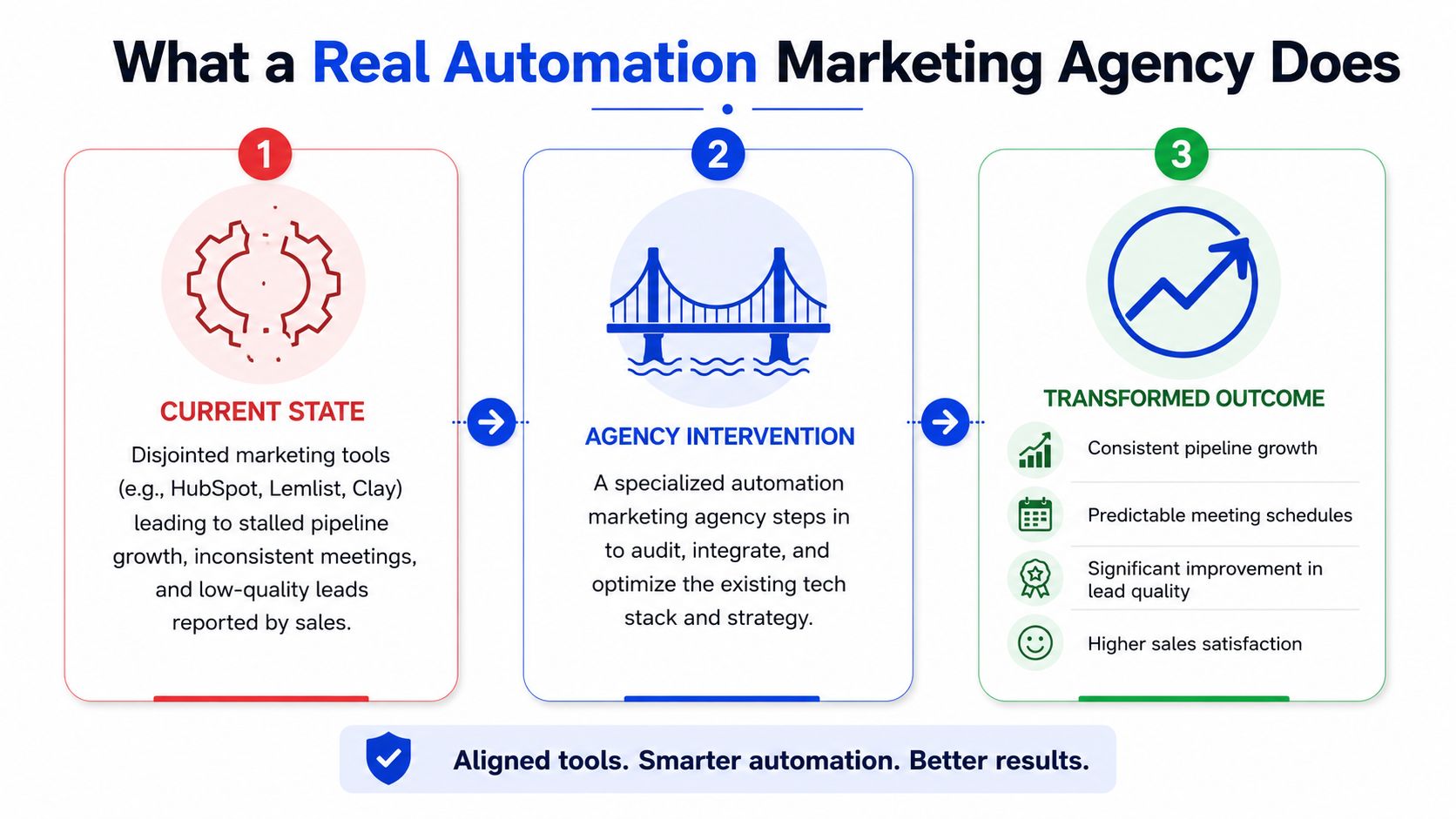
The real job is qualification infrastructure
A serious partner starts with flow design. Who enters the system, why they entered, what signal triggered entry, what data gets written into the CRM, who owns the reply, and what happens if they don't convert yet.
In practice, that usually means one coordinated engine, not five disconnected motions:
Signal-triggered intake: Clay watches for timing signals instead of feeding static lists into Apollo or Instantly.
CRM context writeback: HubSpot or Salesforce gets signal type, source context, and owner assignment before the first reply comes in.
Reply routing: Positive replies go to the AE fast, neutral replies go to SDR review, negatives get suppressed from future sequences.
Nurture exits: A contact shouldn't keep receiving top-of-funnel email after a booked meeting or stage change.
Practical rule: if sales has to ask where a lead came from, the automation layer is unfinished.
This is why content systems matter too. If your team runs a heavy content motion, Contesimal for content organizations is a useful reference for thinking about how publishing workflows should connect to operational automation rather than sit beside it.
What weak agencies still get wrong
The weak version of this service looks busy. You get dashboards, campaign calendars, and a lot of channel activity. But the logic behind the system is fragmented, and the reporting line never reaches held meetings, qualified pipeline, or sales cycle movement.
That's also why most “digital marketing agency” positioning misses the point. A pipeline system needs one target list, one message map, and one reporting structure. If you want the broader strategic backdrop on that shift, data-driven digital marketing agency thinking gets closer to the revenue view than most channel-first agency advice.
For iGaming, SaaS, manufacturing, legal tech, and pharma, the common pattern is the same. More tools don't fix poor handoff logic. Better structure does.
The 30-60-90 day signals of a successful engagement
A good engagement doesn't produce instant revenue, but it should produce visible proof that the system is being built correctly. If you can't see operational progress by month one, you should question the engagement.
The foundation window matters. Agencies need to establish baseline metrics in the first 30 days by importing and cleaning contact databases and setting up welcome workflows, and that work correlates with a 20% faster sales cycle reduction in later phases, according to Digital Applied's AI marketing agency guide.
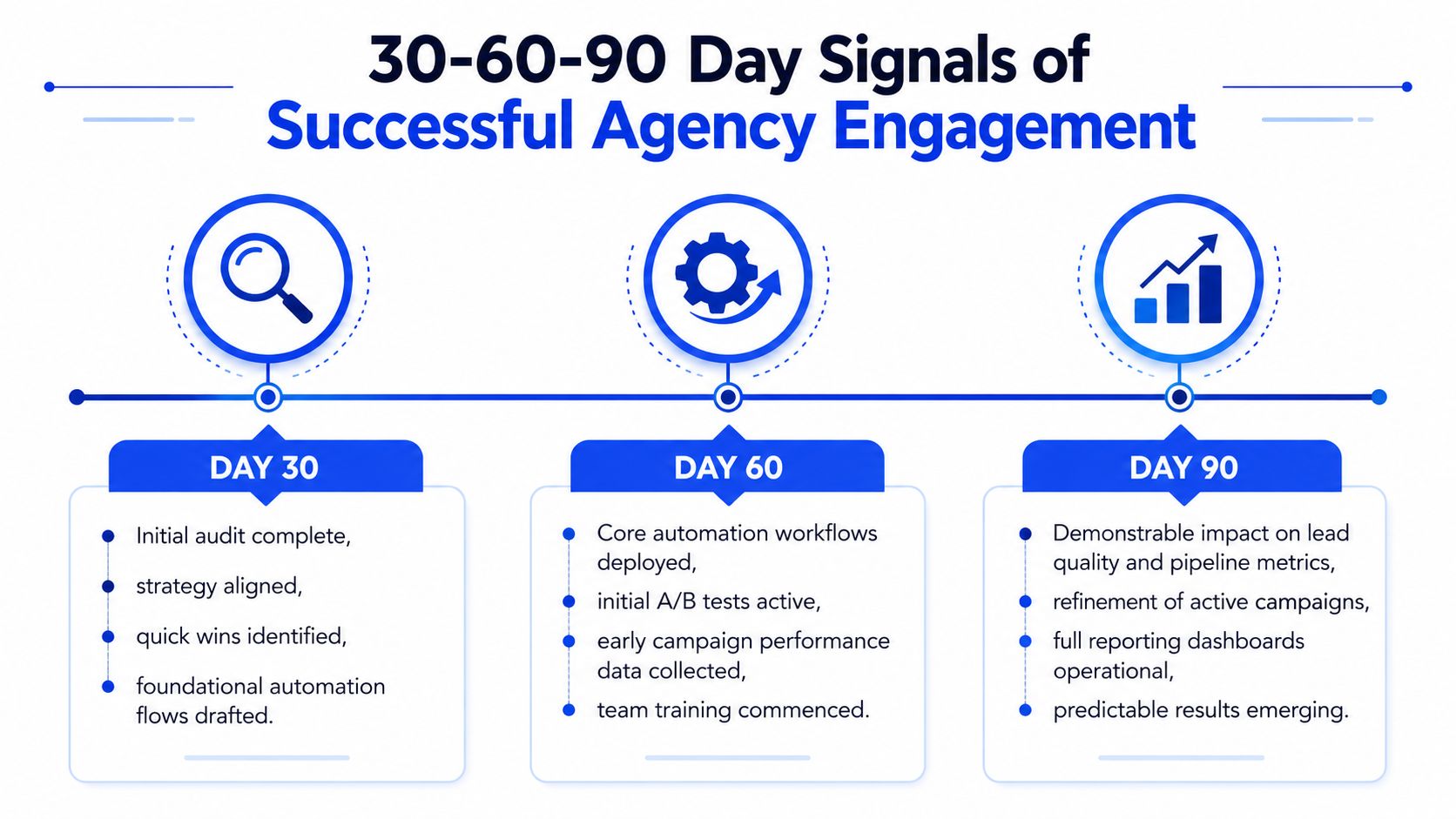
Days 1 to 30
This stage is mostly invisible to outsiders, which is why founders often misread it. You should see data cleanup, field mapping, workflow documentation, routing logic, exclusions, and baseline reporting.
The signs of competence here are operational, not cosmetic:
Clean CRM structure: duplicate rules, owner fields, lifecycle rules, and source tagging are settled
Core workflows live: meeting-booked suppression, positive reply routing, nurture entry, and stage-based task triggers are active
Baseline dashboard defined: lead-to-meeting, meeting-held, meeting-to-opportunity, and source-to-pipeline logic are agreed
A team that skips this stage usually ends up arguing about attribution later. If you need the KPI layer alongside this work, lead generation KPIs for pipeline teams is the right companion read.
Days 31 to 60
Early evidence begins to emerge. Not full maturity, but enough data to judge whether the machine is finding the right people and handing them off correctly.
You should expect to see message performance by segment, reply classification accuracy, and the first stable pattern in qualified meetings. You should also know which parts are not working. Good operators don't hide weak segments or bad messaging. They cut them.
By day 60, you don't need perfect efficiency. You do need proof that the system can create repeatable qualified conversations.
Days 61 to 90
By the end of this window, the engagement should feel governed, not experimental. Sales should know what to do with inbound replies, marketing should know which signals produce traction, and RevOps should be able to inspect the path from outreach to pipeline.
A healthy 90 day view usually includes:
Signal | What you should see |
|---|---|
Pipeline reporting | Clear view of created opportunities and source logic |
Meeting quality | Fewer complaints about poor fit or bad timing |
Sales handoff | Faster ownership after replies and fewer dropped conversations |
Workflow stability | Fewer manual fixes, fewer duplicate sends, cleaner suppression |
If you still have channel activity but no confidence in held meetings or pipeline value by this point, the issue usually isn't effort. It's architecture.
Anatomy of a pipeline build: a B2B SaaS case study
Theory sounds good in workshops. Pipeline only shows up when the workflow is wired end to end.
Here's a real example. A B2B SaaS company in RevOps, around 50 employees, with average ACV of €38k, had a sales team of 5 people, including 2 AEs and 3 SDRs. They were using HubSpot, but automation was limited to basic blasts. Outbound was inconsistent, follow-up was loose, and sales didn't trust marketing-sourced leads.
The starting point
The company needed more than volume. Early-stage B2B SaaS businesses often target 10% to 20% monthly MRR growth as a healthy range for traction, according to Monday.com on B2B sales metrics. But that kind of growth doesn't come from random outreach and slow follow-up.
Their baseline looked familiar. Qualified meetings were stuck around 7 to 10 per month. Outbound reply rates were in the 4% to 6% range. Show rate sat at 68%, median sales cycle on outbound-sourced deals was 67 days, and cost per qualified meeting was roughly €420.
What changed in the system
The rebuild lasted 90 days and centered on six workflow decisions.
First, static lists were replaced with signal-triggered intake in Clay. The team monitored 6 specific signal types including recent funding, leadership changes, hiring patterns related to RevOps, public pain posts, tool stack changes, and conference attendance signals.
Second, every triggered prospect created or updated a HubSpot record with signal type, signal date, and signal description. That fixed duplicate outreach and gave AEs context before contact.
Third, reply handling moved to rules. Positive replies routed to the AE Slack channel within 2 minutes. Negative replies were tagged out of future outbound. Neutral replies went to SDR review.
Fourth, non-converting responders entered a 90-day nurture sequence with substantive content and exit triggers on re-engagement. Fifth, Calendly synced meetings into HubSpot with context and no-show follow-up. Sixth, deal stage changes in HubSpot triggered progression tasks so opportunities couldn't just sit there.
What actually moved the numbers
Over 6 months, outbound reply rate moved to 11% to 14% on signal-triggered campaigns. Qualified meetings rose to 19 to 24 per month. Cost per qualified meeting dropped to roughly €195, and show rate improved to 84%.
Median outbound sales cycle fell from 67 days to 52 days. Time recovered across the sales team was roughly 18 to 25 hours per week. Pipeline value created over the period reached roughly €840k against agency spend of roughly €54k, a 15.5x pipeline-to-spend ratio. Closed-won revenue over 6 months reached roughly €380k, with another €120k closing in the following 90 days.
The biggest lift didn't come from copy. It came from timing, routing speed, and cleaner qualification.
One small step mattered more than is typically expected. A personalized Loom video became the default at proposal stage for opportunities above €25k, and that compressed the proposal-to-close phase by 9 days median.
This case also fits the broader economics. Businesses that apply automation correctly see an 80% increase in lead volume, a 451% increase in qualified leads, and an average return of $5.44 in revenue for every $1.00 spent, based on Thunderbit's marketing automation statistics.
The caution is simple. These results came from connected workflows and disciplined use. The software did not save the motion by itself.
The vendor evaluation checklist for B2B operators
Verdict first, CRM integration wins. If a platform doesn't sync cleanly with your CRM at the data-model level, skip it. Everything else is secondary.
That sounds obvious, but teams still buy on UI polish, AI demos, or a giant integration marketplace. Then they spend months fixing field mismatches, broken lifecycle logic, and reporting gaps. According to Forrester's minimum requirements for marketing automation platforms, native bi-directional SFA integration and real-time data updates are essential, and platforms that lack them fail to reduce sales cycle times by the required 20% to 30% in enterprise environments.

The verdict first
For most B2B operators with 50 to 500 employees, HubSpot is the safest default because the CRM and automation layer already share the same foundation. If you're a large enterprise with a real marketing ops team, Marketo earns the complexity. If you're deep in Salesforce and unlikely to leave, Pardot can still fit. If budget is tight and workflow flexibility matters more than reporting depth, ActiveCampaign is often enough.
Klaviyo is the easy one to rule out. It's strong in ecommerce and awkward in most B2B motions.
The eight criteria that matter
Here's the actual checklist we use when evaluating platforms for SaaS, iGaming, manufacturing, legal tech, and pharma teams.
CRM integration depth
Bidirectional sync, custom field mapping, error handling, object alignment. This is the strongest predictor of success.Segmentation flexibility
You need firmographic, behavioral, engagement, and custom property logic without ugly workarounds.Deliverability infrastructure
Authentication handling, reputation monitoring, and warm-up support matter more than template libraries.Reporting and attribution depth
If pipeline attribution lives outside the platform from day one, expect friction.Workflow flexibility
Multi-trigger logic, branching, delays, exits, and asynchronous behavior need to be usable by operators, not just developers.Content handling
Quick templates and custom HTML both matter. B2B teams need both.API and developer friendliness
You may not need custom work in week one. You probably will by month six.Pricing structure over time
Evaluate total cost over 24 months, not just the first contract.
Buy for the operating model you actually have, not the one your vendor demo implies you'll have.
The same logic applies outside email platforms. When teams compare form handlers or low-code lead capture infrastructure, surface features can hide ugly backend trade-offs. This detailed form backend comparison is a good example of how to evaluate implementation depth rather than marketing copy.
If you're selecting an agency at the same time as the platform, lead generation agency evaluation for B2B teams helps frame the operational side, not just the vendor side.
Platform fit by context
A short reference table keeps these decisions honest.
Platform | Best fit | Main caution |
|---|---|---|
HubSpot | Mid-market B2B SaaS, services, general B2B | Enterprise reporting gets thin |
Marketo | Enterprise B2B with dedicated ops staff | User experience is heavy, cost is high |
Pardot | Salesforce-first organizations | Product momentum feels weaker |
ActiveCampaign | Smaller B2B teams with tighter budgets | Reporting is moderate |
Customer.io | Product-led B2B SaaS | Less natural for classic outbound and content-led B2B |
Klaviyo | Ecommerce-heavy motions | Usually wrong for B2B |
Ignore the vanity filters. Number of integrations available, AI feature tabs, brand fame, and pretty UI screens don't predict whether the system will work.
How to combine automation and personalization at scale
The usual question is wrong. You don't balance automation against personalization. You layer them.
Automation should own the infrastructure layer. Personalization should own the relevance layer. When teams treat those as opposites, they either send generic high-volume sequences or drown their reps in manual research.

The three tier system
The cleanest operating model is a three-tier outreach system.
Tier 1, signal-triggered templates
This covers the bulk of volume. Clay or Apollo enriches the account, a trigger puts the prospect into queue, and templated structure carries a real reference. It's fast and good enough for most accounts.Tier 2, AI draft with human review
This is for stronger signals and higher-value accounts. AI writes the first draft, then a human checks context, tone, and factual references before send.Tier 3, manual research and writing
Reserved for the accounts that can justify founder or senior seller attention. Real LinkedIn posts, podcasts, company announcements, and role-specific context shape the message.
Tools like Sales Navigator, Clay, HeyReach, Lemlist, Instantly, and Smartlead are well-suited. They support workflow and execution. They don't replace judgment.
A useful benchmark for outbound with strong lead quality and product-market fit is a 3% to 7% lead-to-meeting conversion ratio, according to Pipeline Factory on B2B SaaS KPIs. If your volume looks healthy but your meetings don't materialize, the issue is usually qualification depth or weak tiering.
What automation should never own
Some steps should stay human, even in an advanced system.
ICP and message map decisions: humans decide what matters to each segment
Review of AI-generated drafts: no serious team should skip this
Reply substance: once a buyer responds with context, a rep needs to think
Discovery and proposal work: these are judgment tasks, not mechanical tasks
Strong automation makes deep personalization cheaper. It doesn't make judgment optional.
If you're trying to connect this with sales execution, AI sales automation in a real pipeline context is the right frame. The point isn't to hand everything to AI. The point is to remove repetitive work so reps can spend time on decisions that affect revenue.
Six automation pitfalls every team hits and how to fix them
Every team hits failure points. The competent ones catch them early.
That matters more now because the category is getting bigger and faster. The global marketing automation market is projected to reach $15.58 billion by 2030, and 45% of marketing teams reported using at least one agentic AI system for automation tasks in 2026, driving 27% faster campaign build times and 19% lower cost per qualified lead, according to Emarsys marketing automation statistics. More systems in motion means more ways to break routing, data quality, and trust.
The failures that show up early
The first three usually happen in the first launch window.
Prospects keep getting outreach after booking
This happens when the sending tool and CRM don't suppress on meeting booked, positive reply, or stage change. Fix it with bidirectional sync and immediate exit logic.Warm-up gets rushed and deliverability collapses
Teams launch new domains too hard, too early. The fix is ugly but simple. Pause, rebuild sending reputation slowly, and don't relaunch until placement stabilizes.AI personalization writes something false
Wrong employer, wrong post, wrong event. Add a human review checkpoint between generation and send. Keep a checklist of recurring error patterns.
The failures that hurt later
These take longer to notice and often create more damage.
Workflow loops
A contact replies, the workflow misfires, and the next email goes out again. Then again. In HubSpot, this is usually bad enrollment and exit logic.CRM data degradation
Clay-to-HubSpot syncs can fill records with bad company names, duplicate contacts, and mismatched titles if validation rules are weak.Over-automation of judgment tasks
Proposal language, sensitive reply handling, and nuanced routing should not be left to auto-logic without review.
A lot of teams only notice these when sales complains. That's too late.
The operating discipline that keeps systems stable
The fix isn't perfection. It's process.
Practice | Why it matters |
|---|---|
Pilot before scale | Small launches expose routing and copy problems before brand damage spreads |
Weekly anomaly review | Reply rates, exit rates, and error logs reveal issues early |
Written workflow docs | Hidden logic breaks when people leave or forget |
Manual overrides | Every system needs a stop button |
Quarterly audits | Platform changes and field drift create silent failures |
If you want the sales-side extension of this, sales process automation for RevOps teams is where the handoff piece becomes visible. Marketing automation without sales process control usually creates more noise than revenue.
The trade-off is simple. Fast systems create value. Unobserved systems create embarrassing mistakes.
Audit your meeting-held rate this Friday. Pull the last 30 booked meetings, tag each one by source, signal, and ICP fit, then check how many were worth AE time. That single review will tell you whether your automation is building pipeline or just creating calendar activity.
Grou is a global B2B pipeline agency that connects LinkedIn content, outbound, and lead generation into one revenue system. The methodology is simple, structure the target list, routing logic, and reporting line so attention turns into qualified pipeline instead of disconnected activity.
Your stack is live, but the pipeline still feels shaky. HubSpot is full, Clay is enriching, Lemlist or Smartlead is sending, and sales is still asking why booked meetings don't match the ICP. That's the moment it becomes evident that tools don't create revenue structure does.
A real automation marketing agency fixes routing, qualification, CRM hygiene, and reporting, not just campaign setup
Good engagements show clear 30, 60, and 90 day signals, with baseline work done in the first month
The right system can lift qualified pipeline, but only when workflows, targeting, and sales handoff are tightly connected
CRM integration depth is the first platform filter, not AI features or integration count
Automation and personalization belong in the same system, with different effort levels for different account tiers
Table of Contents
What a real automation marketing agency does
Teams often don't need more campaigns. They need a system that turns attention into sales-ready movement. That's what an automation marketing agency is supposed to build.
The gap is real. Recent data shows 68% of automated leads fail strict ICP criteria, and 55% of marketing leaders cite data silos as their top attribution blocker according to Moving Minds on marketing automation agency structure. If your LinkedIn content, outbound, forms, and CRM all run on separate logic, sales gets activity, not pipeline.
The real job is qualification infrastructure
A serious partner starts with flow design. Who enters the system, why they entered, what signal triggered entry, what data gets written into the CRM, who owns the reply, and what happens if they don't convert yet.
In practice, that usually means one coordinated engine, not five disconnected motions:
Signal-triggered intake: Clay watches for timing signals instead of feeding static lists into Apollo or Instantly.
CRM context writeback: HubSpot or Salesforce gets signal type, source context, and owner assignment before the first reply comes in.
Reply routing: Positive replies go to the AE fast, neutral replies go to SDR review, negatives get suppressed from future sequences.
Nurture exits: A contact shouldn't keep receiving top-of-funnel email after a booked meeting or stage change.
Practical rule: if sales has to ask where a lead came from, the automation layer is unfinished.
This is why content systems matter too. If your team runs a heavy content motion, Contesimal for content organizations is a useful reference for thinking about how publishing workflows should connect to operational automation rather than sit beside it.
What weak agencies still get wrong
The weak version of this service looks busy. You get dashboards, campaign calendars, and a lot of channel activity. But the logic behind the system is fragmented, and the reporting line never reaches held meetings, qualified pipeline, or sales cycle movement.
That's also why most “digital marketing agency” positioning misses the point. A pipeline system needs one target list, one message map, and one reporting structure. If you want the broader strategic backdrop on that shift, data-driven digital marketing agency thinking gets closer to the revenue view than most channel-first agency advice.
For iGaming, SaaS, manufacturing, legal tech, and pharma, the common pattern is the same. More tools don't fix poor handoff logic. Better structure does.
The 30-60-90 day signals of a successful engagement
A good engagement doesn't produce instant revenue, but it should produce visible proof that the system is being built correctly. If you can't see operational progress by month one, you should question the engagement.
The foundation window matters. Agencies need to establish baseline metrics in the first 30 days by importing and cleaning contact databases and setting up welcome workflows, and that work correlates with a 20% faster sales cycle reduction in later phases, according to Digital Applied's AI marketing agency guide.
Days 1 to 30
This stage is mostly invisible to outsiders, which is why founders often misread it. You should see data cleanup, field mapping, workflow documentation, routing logic, exclusions, and baseline reporting.
The signs of competence here are operational, not cosmetic:
Clean CRM structure: duplicate rules, owner fields, lifecycle rules, and source tagging are settled
Core workflows live: meeting-booked suppression, positive reply routing, nurture entry, and stage-based task triggers are active
Baseline dashboard defined: lead-to-meeting, meeting-held, meeting-to-opportunity, and source-to-pipeline logic are agreed
A team that skips this stage usually ends up arguing about attribution later. If you need the KPI layer alongside this work, lead generation KPIs for pipeline teams is the right companion read.
Days 31 to 60
Early evidence begins to emerge. Not full maturity, but enough data to judge whether the machine is finding the right people and handing them off correctly.
You should expect to see message performance by segment, reply classification accuracy, and the first stable pattern in qualified meetings. You should also know which parts are not working. Good operators don't hide weak segments or bad messaging. They cut them.
By day 60, you don't need perfect efficiency. You do need proof that the system can create repeatable qualified conversations.
Days 61 to 90
By the end of this window, the engagement should feel governed, not experimental. Sales should know what to do with inbound replies, marketing should know which signals produce traction, and RevOps should be able to inspect the path from outreach to pipeline.
A healthy 90 day view usually includes:
Signal | What you should see |
|---|---|
Pipeline reporting | Clear view of created opportunities and source logic |
Meeting quality | Fewer complaints about poor fit or bad timing |
Sales handoff | Faster ownership after replies and fewer dropped conversations |
Workflow stability | Fewer manual fixes, fewer duplicate sends, cleaner suppression |
If you still have channel activity but no confidence in held meetings or pipeline value by this point, the issue usually isn't effort. It's architecture.
Anatomy of a pipeline build: a B2B SaaS case study
Theory sounds good in workshops. Pipeline only shows up when the workflow is wired end to end.
Here's a real example. A B2B SaaS company in RevOps, around 50 employees, with average ACV of €38k, had a sales team of 5 people, including 2 AEs and 3 SDRs. They were using HubSpot, but automation was limited to basic blasts. Outbound was inconsistent, follow-up was loose, and sales didn't trust marketing-sourced leads.
The starting point
The company needed more than volume. Early-stage B2B SaaS businesses often target 10% to 20% monthly MRR growth as a healthy range for traction, according to Monday.com on B2B sales metrics. But that kind of growth doesn't come from random outreach and slow follow-up.
Their baseline looked familiar. Qualified meetings were stuck around 7 to 10 per month. Outbound reply rates were in the 4% to 6% range. Show rate sat at 68%, median sales cycle on outbound-sourced deals was 67 days, and cost per qualified meeting was roughly €420.
What changed in the system
The rebuild lasted 90 days and centered on six workflow decisions.
First, static lists were replaced with signal-triggered intake in Clay. The team monitored 6 specific signal types including recent funding, leadership changes, hiring patterns related to RevOps, public pain posts, tool stack changes, and conference attendance signals.
Second, every triggered prospect created or updated a HubSpot record with signal type, signal date, and signal description. That fixed duplicate outreach and gave AEs context before contact.
Third, reply handling moved to rules. Positive replies routed to the AE Slack channel within 2 minutes. Negative replies were tagged out of future outbound. Neutral replies went to SDR review.
Fourth, non-converting responders entered a 90-day nurture sequence with substantive content and exit triggers on re-engagement. Fifth, Calendly synced meetings into HubSpot with context and no-show follow-up. Sixth, deal stage changes in HubSpot triggered progression tasks so opportunities couldn't just sit there.
What actually moved the numbers
Over 6 months, outbound reply rate moved to 11% to 14% on signal-triggered campaigns. Qualified meetings rose to 19 to 24 per month. Cost per qualified meeting dropped to roughly €195, and show rate improved to 84%.
Median outbound sales cycle fell from 67 days to 52 days. Time recovered across the sales team was roughly 18 to 25 hours per week. Pipeline value created over the period reached roughly €840k against agency spend of roughly €54k, a 15.5x pipeline-to-spend ratio. Closed-won revenue over 6 months reached roughly €380k, with another €120k closing in the following 90 days.
The biggest lift didn't come from copy. It came from timing, routing speed, and cleaner qualification.
One small step mattered more than is typically expected. A personalized Loom video became the default at proposal stage for opportunities above €25k, and that compressed the proposal-to-close phase by 9 days median.
This case also fits the broader economics. Businesses that apply automation correctly see an 80% increase in lead volume, a 451% increase in qualified leads, and an average return of $5.44 in revenue for every $1.00 spent, based on Thunderbit's marketing automation statistics.
The caution is simple. These results came from connected workflows and disciplined use. The software did not save the motion by itself.
The vendor evaluation checklist for B2B operators
Verdict first, CRM integration wins. If a platform doesn't sync cleanly with your CRM at the data-model level, skip it. Everything else is secondary.
That sounds obvious, but teams still buy on UI polish, AI demos, or a giant integration marketplace. Then they spend months fixing field mismatches, broken lifecycle logic, and reporting gaps. According to Forrester's minimum requirements for marketing automation platforms, native bi-directional SFA integration and real-time data updates are essential, and platforms that lack them fail to reduce sales cycle times by the required 20% to 30% in enterprise environments.
The verdict first
For most B2B operators with 50 to 500 employees, HubSpot is the safest default because the CRM and automation layer already share the same foundation. If you're a large enterprise with a real marketing ops team, Marketo earns the complexity. If you're deep in Salesforce and unlikely to leave, Pardot can still fit. If budget is tight and workflow flexibility matters more than reporting depth, ActiveCampaign is often enough.
Klaviyo is the easy one to rule out. It's strong in ecommerce and awkward in most B2B motions.
The eight criteria that matter
Here's the actual checklist we use when evaluating platforms for SaaS, iGaming, manufacturing, legal tech, and pharma teams.
CRM integration depth
Bidirectional sync, custom field mapping, error handling, object alignment. This is the strongest predictor of success.Segmentation flexibility
You need firmographic, behavioral, engagement, and custom property logic without ugly workarounds.Deliverability infrastructure
Authentication handling, reputation monitoring, and warm-up support matter more than template libraries.Reporting and attribution depth
If pipeline attribution lives outside the platform from day one, expect friction.Workflow flexibility
Multi-trigger logic, branching, delays, exits, and asynchronous behavior need to be usable by operators, not just developers.Content handling
Quick templates and custom HTML both matter. B2B teams need both.API and developer friendliness
You may not need custom work in week one. You probably will by month six.Pricing structure over time
Evaluate total cost over 24 months, not just the first contract.
Buy for the operating model you actually have, not the one your vendor demo implies you'll have.
The same logic applies outside email platforms. When teams compare form handlers or low-code lead capture infrastructure, surface features can hide ugly backend trade-offs. This detailed form backend comparison is a good example of how to evaluate implementation depth rather than marketing copy.
If you're selecting an agency at the same time as the platform, lead generation agency evaluation for B2B teams helps frame the operational side, not just the vendor side.
Platform fit by context
A short reference table keeps these decisions honest.
Platform | Best fit | Main caution |
|---|---|---|
HubSpot | Mid-market B2B SaaS, services, general B2B | Enterprise reporting gets thin |
Marketo | Enterprise B2B with dedicated ops staff | User experience is heavy, cost is high |
Pardot | Salesforce-first organizations | Product momentum feels weaker |
ActiveCampaign | Smaller B2B teams with tighter budgets | Reporting is moderate |
Customer.io | Product-led B2B SaaS | Less natural for classic outbound and content-led B2B |
Klaviyo | Ecommerce-heavy motions | Usually wrong for B2B |
Ignore the vanity filters. Number of integrations available, AI feature tabs, brand fame, and pretty UI screens don't predict whether the system will work.
How to combine automation and personalization at scale
The usual question is wrong. You don't balance automation against personalization. You layer them.
Automation should own the infrastructure layer. Personalization should own the relevance layer. When teams treat those as opposites, they either send generic high-volume sequences or drown their reps in manual research.
The three tier system
The cleanest operating model is a three-tier outreach system.
Tier 1, signal-triggered templates
This covers the bulk of volume. Clay or Apollo enriches the account, a trigger puts the prospect into queue, and templated structure carries a real reference. It's fast and good enough for most accounts.Tier 2, AI draft with human review
This is for stronger signals and higher-value accounts. AI writes the first draft, then a human checks context, tone, and factual references before send.Tier 3, manual research and writing
Reserved for the accounts that can justify founder or senior seller attention. Real LinkedIn posts, podcasts, company announcements, and role-specific context shape the message.
Tools like Sales Navigator, Clay, HeyReach, Lemlist, Instantly, and Smartlead are well-suited. They support workflow and execution. They don't replace judgment.
A useful benchmark for outbound with strong lead quality and product-market fit is a 3% to 7% lead-to-meeting conversion ratio, according to Pipeline Factory on B2B SaaS KPIs. If your volume looks healthy but your meetings don't materialize, the issue is usually qualification depth or weak tiering.
What automation should never own
Some steps should stay human, even in an advanced system.
ICP and message map decisions: humans decide what matters to each segment
Review of AI-generated drafts: no serious team should skip this
Reply substance: once a buyer responds with context, a rep needs to think
Discovery and proposal work: these are judgment tasks, not mechanical tasks
Strong automation makes deep personalization cheaper. It doesn't make judgment optional.
If you're trying to connect this with sales execution, AI sales automation in a real pipeline context is the right frame. The point isn't to hand everything to AI. The point is to remove repetitive work so reps can spend time on decisions that affect revenue.
Six automation pitfalls every team hits and how to fix them
Every team hits failure points. The competent ones catch them early.
That matters more now because the category is getting bigger and faster. The global marketing automation market is projected to reach $15.58 billion by 2030, and 45% of marketing teams reported using at least one agentic AI system for automation tasks in 2026, driving 27% faster campaign build times and 19% lower cost per qualified lead, according to Emarsys marketing automation statistics. More systems in motion means more ways to break routing, data quality, and trust.
The failures that show up early
The first three usually happen in the first launch window.
Prospects keep getting outreach after booking
This happens when the sending tool and CRM don't suppress on meeting booked, positive reply, or stage change. Fix it with bidirectional sync and immediate exit logic.Warm-up gets rushed and deliverability collapses
Teams launch new domains too hard, too early. The fix is ugly but simple. Pause, rebuild sending reputation slowly, and don't relaunch until placement stabilizes.AI personalization writes something false
Wrong employer, wrong post, wrong event. Add a human review checkpoint between generation and send. Keep a checklist of recurring error patterns.
The failures that hurt later
These take longer to notice and often create more damage.
Workflow loops
A contact replies, the workflow misfires, and the next email goes out again. Then again. In HubSpot, this is usually bad enrollment and exit logic.CRM data degradation
Clay-to-HubSpot syncs can fill records with bad company names, duplicate contacts, and mismatched titles if validation rules are weak.Over-automation of judgment tasks
Proposal language, sensitive reply handling, and nuanced routing should not be left to auto-logic without review.
A lot of teams only notice these when sales complains. That's too late.
The operating discipline that keeps systems stable
The fix isn't perfection. It's process.
Practice | Why it matters |
|---|---|
Pilot before scale | Small launches expose routing and copy problems before brand damage spreads |
Weekly anomaly review | Reply rates, exit rates, and error logs reveal issues early |
Written workflow docs | Hidden logic breaks when people leave or forget |
Manual overrides | Every system needs a stop button |
Quarterly audits | Platform changes and field drift create silent failures |
If you want the sales-side extension of this, sales process automation for RevOps teams is where the handoff piece becomes visible. Marketing automation without sales process control usually creates more noise than revenue.
The trade-off is simple. Fast systems create value. Unobserved systems create embarrassing mistakes.
Audit your meeting-held rate this Friday. Pull the last 30 booked meetings, tag each one by source, signal, and ICP fit, then check how many were worth AE time. That single review will tell you whether your automation is building pipeline or just creating calendar activity.
Grou is a global B2B pipeline agency that connects LinkedIn content, outbound, and lead generation into one revenue system. The methodology is simple, structure the target list, routing logic, and reporting line so attention turns into qualified pipeline instead of disconnected activity.
Your stack is live, but the pipeline still feels shaky. HubSpot is full, Clay is enriching, Lemlist or Smartlead is sending, and sales is still asking why booked meetings don't match the ICP. That's the moment it becomes evident that tools don't create revenue structure does.
A real automation marketing agency fixes routing, qualification, CRM hygiene, and reporting, not just campaign setup
Good engagements show clear 30, 60, and 90 day signals, with baseline work done in the first month
The right system can lift qualified pipeline, but only when workflows, targeting, and sales handoff are tightly connected
CRM integration depth is the first platform filter, not AI features or integration count
Automation and personalization belong in the same system, with different effort levels for different account tiers
Table of Contents
What a real automation marketing agency does
Teams often don't need more campaigns. They need a system that turns attention into sales-ready movement. That's what an automation marketing agency is supposed to build.
The gap is real. Recent data shows 68% of automated leads fail strict ICP criteria, and 55% of marketing leaders cite data silos as their top attribution blocker according to Moving Minds on marketing automation agency structure. If your LinkedIn content, outbound, forms, and CRM all run on separate logic, sales gets activity, not pipeline.
The real job is qualification infrastructure
A serious partner starts with flow design. Who enters the system, why they entered, what signal triggered entry, what data gets written into the CRM, who owns the reply, and what happens if they don't convert yet.
In practice, that usually means one coordinated engine, not five disconnected motions:
Signal-triggered intake: Clay watches for timing signals instead of feeding static lists into Apollo or Instantly.
CRM context writeback: HubSpot or Salesforce gets signal type, source context, and owner assignment before the first reply comes in.
Reply routing: Positive replies go to the AE fast, neutral replies go to SDR review, negatives get suppressed from future sequences.
Nurture exits: A contact shouldn't keep receiving top-of-funnel email after a booked meeting or stage change.
Practical rule: if sales has to ask where a lead came from, the automation layer is unfinished.
This is why content systems matter too. If your team runs a heavy content motion, Contesimal for content organizations is a useful reference for thinking about how publishing workflows should connect to operational automation rather than sit beside it.
What weak agencies still get wrong
The weak version of this service looks busy. You get dashboards, campaign calendars, and a lot of channel activity. But the logic behind the system is fragmented, and the reporting line never reaches held meetings, qualified pipeline, or sales cycle movement.
That's also why most “digital marketing agency” positioning misses the point. A pipeline system needs one target list, one message map, and one reporting structure. If you want the broader strategic backdrop on that shift, data-driven digital marketing agency thinking gets closer to the revenue view than most channel-first agency advice.
For iGaming, SaaS, manufacturing, legal tech, and pharma, the common pattern is the same. More tools don't fix poor handoff logic. Better structure does.
The 30-60-90 day signals of a successful engagement
A good engagement doesn't produce instant revenue, but it should produce visible proof that the system is being built correctly. If you can't see operational progress by month one, you should question the engagement.
The foundation window matters. Agencies need to establish baseline metrics in the first 30 days by importing and cleaning contact databases and setting up welcome workflows, and that work correlates with a 20% faster sales cycle reduction in later phases, according to Digital Applied's AI marketing agency guide.
Days 1 to 30
This stage is mostly invisible to outsiders, which is why founders often misread it. You should see data cleanup, field mapping, workflow documentation, routing logic, exclusions, and baseline reporting.
The signs of competence here are operational, not cosmetic:
Clean CRM structure: duplicate rules, owner fields, lifecycle rules, and source tagging are settled
Core workflows live: meeting-booked suppression, positive reply routing, nurture entry, and stage-based task triggers are active
Baseline dashboard defined: lead-to-meeting, meeting-held, meeting-to-opportunity, and source-to-pipeline logic are agreed
A team that skips this stage usually ends up arguing about attribution later. If you need the KPI layer alongside this work, lead generation KPIs for pipeline teams is the right companion read.
Days 31 to 60
Early evidence begins to emerge. Not full maturity, but enough data to judge whether the machine is finding the right people and handing them off correctly.
You should expect to see message performance by segment, reply classification accuracy, and the first stable pattern in qualified meetings. You should also know which parts are not working. Good operators don't hide weak segments or bad messaging. They cut them.
By day 60, you don't need perfect efficiency. You do need proof that the system can create repeatable qualified conversations.
Days 61 to 90
By the end of this window, the engagement should feel governed, not experimental. Sales should know what to do with inbound replies, marketing should know which signals produce traction, and RevOps should be able to inspect the path from outreach to pipeline.
A healthy 90 day view usually includes:
Signal | What you should see |
|---|---|
Pipeline reporting | Clear view of created opportunities and source logic |
Meeting quality | Fewer complaints about poor fit or bad timing |
Sales handoff | Faster ownership after replies and fewer dropped conversations |
Workflow stability | Fewer manual fixes, fewer duplicate sends, cleaner suppression |
If you still have channel activity but no confidence in held meetings or pipeline value by this point, the issue usually isn't effort. It's architecture.
Anatomy of a pipeline build: a B2B SaaS case study
Theory sounds good in workshops. Pipeline only shows up when the workflow is wired end to end.
Here's a real example. A B2B SaaS company in RevOps, around 50 employees, with average ACV of €38k, had a sales team of 5 people, including 2 AEs and 3 SDRs. They were using HubSpot, but automation was limited to basic blasts. Outbound was inconsistent, follow-up was loose, and sales didn't trust marketing-sourced leads.
The starting point
The company needed more than volume. Early-stage B2B SaaS businesses often target 10% to 20% monthly MRR growth as a healthy range for traction, according to Monday.com on B2B sales metrics. But that kind of growth doesn't come from random outreach and slow follow-up.
Their baseline looked familiar. Qualified meetings were stuck around 7 to 10 per month. Outbound reply rates were in the 4% to 6% range. Show rate sat at 68%, median sales cycle on outbound-sourced deals was 67 days, and cost per qualified meeting was roughly €420.
What changed in the system
The rebuild lasted 90 days and centered on six workflow decisions.
First, static lists were replaced with signal-triggered intake in Clay. The team monitored 6 specific signal types including recent funding, leadership changes, hiring patterns related to RevOps, public pain posts, tool stack changes, and conference attendance signals.
Second, every triggered prospect created or updated a HubSpot record with signal type, signal date, and signal description. That fixed duplicate outreach and gave AEs context before contact.
Third, reply handling moved to rules. Positive replies routed to the AE Slack channel within 2 minutes. Negative replies were tagged out of future outbound. Neutral replies went to SDR review.
Fourth, non-converting responders entered a 90-day nurture sequence with substantive content and exit triggers on re-engagement. Fifth, Calendly synced meetings into HubSpot with context and no-show follow-up. Sixth, deal stage changes in HubSpot triggered progression tasks so opportunities couldn't just sit there.
What actually moved the numbers
Over 6 months, outbound reply rate moved to 11% to 14% on signal-triggered campaigns. Qualified meetings rose to 19 to 24 per month. Cost per qualified meeting dropped to roughly €195, and show rate improved to 84%.
Median outbound sales cycle fell from 67 days to 52 days. Time recovered across the sales team was roughly 18 to 25 hours per week. Pipeline value created over the period reached roughly €840k against agency spend of roughly €54k, a 15.5x pipeline-to-spend ratio. Closed-won revenue over 6 months reached roughly €380k, with another €120k closing in the following 90 days.
The biggest lift didn't come from copy. It came from timing, routing speed, and cleaner qualification.
One small step mattered more than is typically expected. A personalized Loom video became the default at proposal stage for opportunities above €25k, and that compressed the proposal-to-close phase by 9 days median.
This case also fits the broader economics. Businesses that apply automation correctly see an 80% increase in lead volume, a 451% increase in qualified leads, and an average return of $5.44 in revenue for every $1.00 spent, based on Thunderbit's marketing automation statistics.
The caution is simple. These results came from connected workflows and disciplined use. The software did not save the motion by itself.
The vendor evaluation checklist for B2B operators
Verdict first, CRM integration wins. If a platform doesn't sync cleanly with your CRM at the data-model level, skip it. Everything else is secondary.
That sounds obvious, but teams still buy on UI polish, AI demos, or a giant integration marketplace. Then they spend months fixing field mismatches, broken lifecycle logic, and reporting gaps. According to Forrester's minimum requirements for marketing automation platforms, native bi-directional SFA integration and real-time data updates are essential, and platforms that lack them fail to reduce sales cycle times by the required 20% to 30% in enterprise environments.
The verdict first
For most B2B operators with 50 to 500 employees, HubSpot is the safest default because the CRM and automation layer already share the same foundation. If you're a large enterprise with a real marketing ops team, Marketo earns the complexity. If you're deep in Salesforce and unlikely to leave, Pardot can still fit. If budget is tight and workflow flexibility matters more than reporting depth, ActiveCampaign is often enough.
Klaviyo is the easy one to rule out. It's strong in ecommerce and awkward in most B2B motions.
The eight criteria that matter
Here's the actual checklist we use when evaluating platforms for SaaS, iGaming, manufacturing, legal tech, and pharma teams.
CRM integration depth
Bidirectional sync, custom field mapping, error handling, object alignment. This is the strongest predictor of success.Segmentation flexibility
You need firmographic, behavioral, engagement, and custom property logic without ugly workarounds.Deliverability infrastructure
Authentication handling, reputation monitoring, and warm-up support matter more than template libraries.Reporting and attribution depth
If pipeline attribution lives outside the platform from day one, expect friction.Workflow flexibility
Multi-trigger logic, branching, delays, exits, and asynchronous behavior need to be usable by operators, not just developers.Content handling
Quick templates and custom HTML both matter. B2B teams need both.API and developer friendliness
You may not need custom work in week one. You probably will by month six.Pricing structure over time
Evaluate total cost over 24 months, not just the first contract.
Buy for the operating model you actually have, not the one your vendor demo implies you'll have.
The same logic applies outside email platforms. When teams compare form handlers or low-code lead capture infrastructure, surface features can hide ugly backend trade-offs. This detailed form backend comparison is a good example of how to evaluate implementation depth rather than marketing copy.
If you're selecting an agency at the same time as the platform, lead generation agency evaluation for B2B teams helps frame the operational side, not just the vendor side.
Platform fit by context
A short reference table keeps these decisions honest.
Platform | Best fit | Main caution |
|---|---|---|
HubSpot | Mid-market B2B SaaS, services, general B2B | Enterprise reporting gets thin |
Marketo | Enterprise B2B with dedicated ops staff | User experience is heavy, cost is high |
Pardot | Salesforce-first organizations | Product momentum feels weaker |
ActiveCampaign | Smaller B2B teams with tighter budgets | Reporting is moderate |
Customer.io | Product-led B2B SaaS | Less natural for classic outbound and content-led B2B |
Klaviyo | Ecommerce-heavy motions | Usually wrong for B2B |
Ignore the vanity filters. Number of integrations available, AI feature tabs, brand fame, and pretty UI screens don't predict whether the system will work.
How to combine automation and personalization at scale
The usual question is wrong. You don't balance automation against personalization. You layer them.
Automation should own the infrastructure layer. Personalization should own the relevance layer. When teams treat those as opposites, they either send generic high-volume sequences or drown their reps in manual research.
The three tier system
The cleanest operating model is a three-tier outreach system.
Tier 1, signal-triggered templates
This covers the bulk of volume. Clay or Apollo enriches the account, a trigger puts the prospect into queue, and templated structure carries a real reference. It's fast and good enough for most accounts.Tier 2, AI draft with human review
This is for stronger signals and higher-value accounts. AI writes the first draft, then a human checks context, tone, and factual references before send.Tier 3, manual research and writing
Reserved for the accounts that can justify founder or senior seller attention. Real LinkedIn posts, podcasts, company announcements, and role-specific context shape the message.
Tools like Sales Navigator, Clay, HeyReach, Lemlist, Instantly, and Smartlead are well-suited. They support workflow and execution. They don't replace judgment.
A useful benchmark for outbound with strong lead quality and product-market fit is a 3% to 7% lead-to-meeting conversion ratio, according to Pipeline Factory on B2B SaaS KPIs. If your volume looks healthy but your meetings don't materialize, the issue is usually qualification depth or weak tiering.
What automation should never own
Some steps should stay human, even in an advanced system.
ICP and message map decisions: humans decide what matters to each segment
Review of AI-generated drafts: no serious team should skip this
Reply substance: once a buyer responds with context, a rep needs to think
Discovery and proposal work: these are judgment tasks, not mechanical tasks
Strong automation makes deep personalization cheaper. It doesn't make judgment optional.
If you're trying to connect this with sales execution, AI sales automation in a real pipeline context is the right frame. The point isn't to hand everything to AI. The point is to remove repetitive work so reps can spend time on decisions that affect revenue.
Six automation pitfalls every team hits and how to fix them
Every team hits failure points. The competent ones catch them early.
That matters more now because the category is getting bigger and faster. The global marketing automation market is projected to reach $15.58 billion by 2030, and 45% of marketing teams reported using at least one agentic AI system for automation tasks in 2026, driving 27% faster campaign build times and 19% lower cost per qualified lead, according to Emarsys marketing automation statistics. More systems in motion means more ways to break routing, data quality, and trust.
The failures that show up early
The first three usually happen in the first launch window.
Prospects keep getting outreach after booking
This happens when the sending tool and CRM don't suppress on meeting booked, positive reply, or stage change. Fix it with bidirectional sync and immediate exit logic.Warm-up gets rushed and deliverability collapses
Teams launch new domains too hard, too early. The fix is ugly but simple. Pause, rebuild sending reputation slowly, and don't relaunch until placement stabilizes.AI personalization writes something false
Wrong employer, wrong post, wrong event. Add a human review checkpoint between generation and send. Keep a checklist of recurring error patterns.
The failures that hurt later
These take longer to notice and often create more damage.
Workflow loops
A contact replies, the workflow misfires, and the next email goes out again. Then again. In HubSpot, this is usually bad enrollment and exit logic.CRM data degradation
Clay-to-HubSpot syncs can fill records with bad company names, duplicate contacts, and mismatched titles if validation rules are weak.Over-automation of judgment tasks
Proposal language, sensitive reply handling, and nuanced routing should not be left to auto-logic without review.
A lot of teams only notice these when sales complains. That's too late.
The operating discipline that keeps systems stable
The fix isn't perfection. It's process.
Practice | Why it matters |
|---|---|
Pilot before scale | Small launches expose routing and copy problems before brand damage spreads |
Weekly anomaly review | Reply rates, exit rates, and error logs reveal issues early |
Written workflow docs | Hidden logic breaks when people leave or forget |
Manual overrides | Every system needs a stop button |
Quarterly audits | Platform changes and field drift create silent failures |
If you want the sales-side extension of this, sales process automation for RevOps teams is where the handoff piece becomes visible. Marketing automation without sales process control usually creates more noise than revenue.
The trade-off is simple. Fast systems create value. Unobserved systems create embarrassing mistakes.
Audit your meeting-held rate this Friday. Pull the last 30 booked meetings, tag each one by source, signal, and ICP fit, then check how many were worth AE time. That single review will tell you whether your automation is building pipeline or just creating calendar activity.
Grou is a global B2B pipeline agency that connects LinkedIn content, outbound, and lead generation into one revenue system. The methodology is simple, structure the target list, routing logic, and reporting line so attention turns into qualified pipeline instead of disconnected activity.
Pipeline OS Newsletter
Build qualified pipeline
Get weekly tactics to generate demand, improve lead quality, and book more meetings.






Trusted by industry leaders
Trusted by industry leaders
Trusted by industry leaders
Ready to build qualified pipeline?
Ready to build qualified pipeline?
Ready to build qualified pipeline?
Book a call to see if we're the right fit, or take the 2-minute quiz to get a clear starting point.
Book a call to see if we're the right fit, or take the 2-minute quiz to get a clear starting point.
Book a call to see if we're the right fit, or take the 2-minute quiz to get a clear starting point.
" height="30.21639343089746px" id="hfGbXmQR2" width="30.216393430897455px"/></svg>)
Copyright © 2026 – All Right Reserved
Copyright © 2026 – All Right Reserved
Copyright © 2026 – All Right Reserved